The Tamesis
June 3, 2026
jakarta – Indonesia’s top official launched the government’s most detailed defense yet of President Prabowo Subianto’s frequent overseas travel, rebuffing growing criticism from politicians, diplomats and international media about the cost, scale and priorities of his global diplomacy.
In a nearly seven-minute video posted on the official YouTube channel of the Cabinet Secretariat on June 1, Cabinet Secretary Teddy Indra Wijaya responded point by point to concerns raised by former Deputy Foreign Minister Dino Patti Djalal and other critics.
The detailed rebuttal marked the first time a senior government official responded directly to criticism surrounding Prabowo’s overseas travel, which has intensified as Indonesia grapples with a declining rupiah and broader economic uncertainty.
Since taking office in October 2024, Prabowo has visited at least 29 countries on more than 50 overseas engagements, drawing scrutiny from critics who question whether the president is spending too much time abroad amid growing challenges at home.
Teddy believes the visits have brought tangible benefits to Indonesia, ranging from investment inflows and trade deals to stronger defense ties and support for Palestine.
Hard to justify?
Dino posted a video on Instagram on May 30 urging Prabowo to significantly reduce overseas travel, arguing that the frequency of his trips was becoming increasingly difficult to justify.
He argued that Prabowo’s unusually frequent overseas travels raised concerns about costs, saying presidential travel could cost hundreds of billions of rupees once transportation, accommodation, logistics and security costs are taken into account.
“Since taking office, the president has spent roughly one day out of every six days abroad. So it’s understandable that some people think that’s unusual,” Dino said.
He also suggested that the president make greater use of video calls and delegate more diplomatic tasks to Prime Minister Sugino.
In his June 1 response, Teddy thanked Dino for his “very thorough and well-organized” input, then noted that the veteran diplomat had “only been deputy foreign minister for about three months.”
Teddy is a former military officer who served as an aide to former Presidents Joko Widodo and Prabowo when they were defense ministers. Teddy is widely regarded as one of the president’s closest aides and often travels with the president and participates in major diplomatic events.
Addressing concerns about costs, Teddy said: “Any excess costs in the national budget are entirely borne by President Prabowo himself.”
Teddy also rejected suggestions that the president was traveling with an overly large delegation, saying the number of officials accompanying Prabowo had dropped by more than half compared with previous administrations.
“In the past, the number of people who went abroad at one time may have exceeded 120. This was the case during the Parkdino era. During the era of President Prabowo, the maximum number of people who went abroad was between 50 and 60.”
Reactions to the legend have been mixed. Following Teddy’s response on June 2, Indonesian Democratic Party of Struggle (PDI-P) politician Andreas Hugo Pareira described Dino’s comments as constructive criticism aimed at strengthening the government and said they deserved consideration.
However, Gerindra Vice Chairman Habiburokhman dismissed the comments as unproductive and unfair, arguing that Prabowo needs to continue to be proactive in engaging with world leaders amid growing global uncertainty.
Dynamic development
Teddy said global developments were becoming more dynamic and stressed that it was impossible to plan all overseas visits a year in advance.
He denied that the visits were just “show and ceremony”, saying: “We need to look at what has been achieved in the past year and a half.”
These include Indonesia’s membership of the BRICS, the end of long-running trade talks with the European Union and investment inflows worth about 2430 trillion rupiah (S$174 billion) in the past 18 months, he said.
Teddy said recent overseas visits had yielded concrete results, noting that investments worth about 575 trillion rupees had been committed following Prabowo’s visit to Japan and South Korea at the end of March.
He also cited expanded defense partnerships with countries including France, the United States, Russia, China and the United Kingdom, as well as progress in arrangements for Indonesian pilgrims in Saudi Arabia.
Regarding Palestine, Teddy mentioned Indonesia’s humanitarian efforts, including providing aid, a hospital ship and scholarships for Palestinian students.
The Indonesian activist returned in May after being detained by Israel while trying to break the Gaza blockade, which he said was achieved through public and behind-the-scenes diplomacy.
“All of this is diplomacy that President Prabowo pursues through various public and private means, because what matters most to us are concrete results,” he said.
The debate over Prabowo’s trip has intensified in recent weeks as a weak rupiah, an energy cost crisis, slowing economic momentum and regulatory uncertainty raise questions about the government’s priorities.
Criticism has also come from politicians and foreign policy observers, who have questioned whether the goals and outcomes of some overseas visits have been clearly communicated to the public.
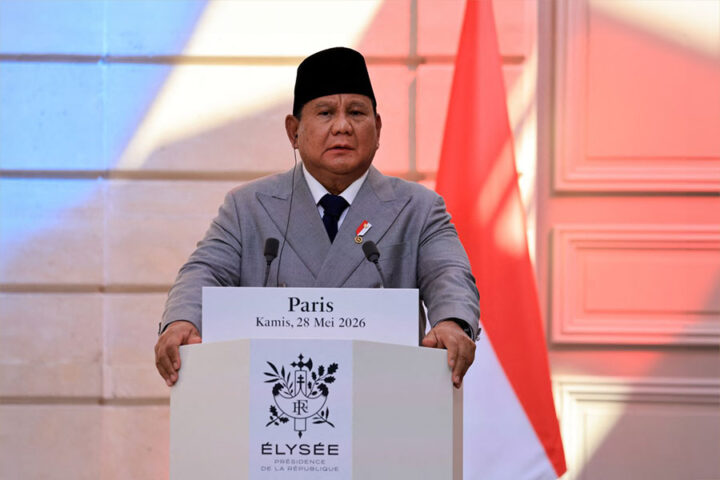
Among them was opposition DMK politician Mohamad Guntur Romli, who argued that Prabowo’s recent trip to France had received limited attention from French media and pointed to critical coverage of the trip.
“While Indonesian media and official government accounts highly praised President Prabowo’s state visit to Paris, it was all but ignored by French media,” Guntur said in a May 31 Instagram post.
“One of France’s most influential media outlets: Le Monde, has just published a scathing criticism of Prabowo’s economic policies.”
He was referring to an article published by a French newspaper on May 22 titled “Indonesia: President Prabowo’s interventionism causes market turmoil,” which explored investor concerns over a series of economic policy interventions by the Indonesian government.
While welcoming the criticism, Teddy said the public debate should not lose sight of what he believed was the government’s achievements.
“We certainly welcome space for any opinion,” he said, “but we must not gloss over the reality of all the results we have achieved.”