The Tamesis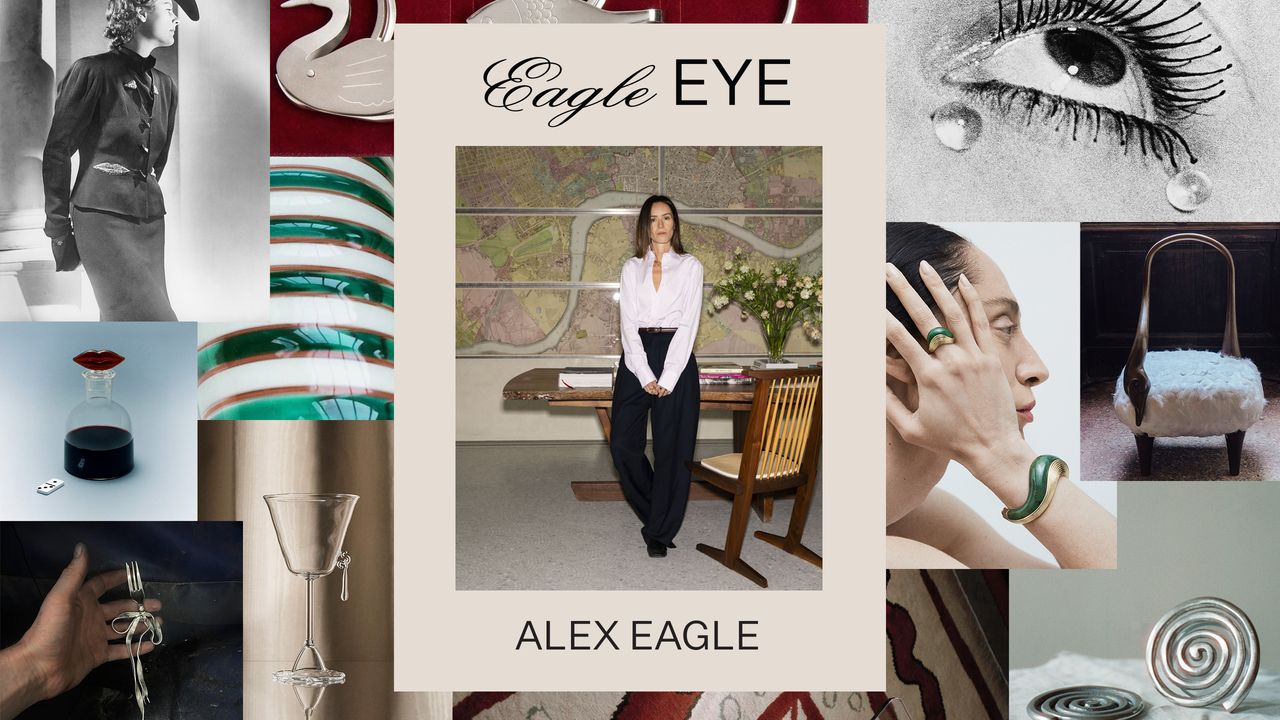
eagle eye exists to explain the gap between how we dress and how we live; between the spaces you gravitate to and the coats you keep reaching for. Each month, London-based designer and creative director Alex Eagle taps into her list of friends and experts to explore the “why” behind a subject—why we’re attracted to certain things, and how those instincts develop without us really noticing. It’s a column rooted in interior design, with many offshoots (and, of course, a thoughtful edit of shoppable products).
The first time surrealism made sense to me was when I was very young. Dali’s clocks, encountered in books or on classroom walls, do something that purely abstract art never quite does: they let me in. They’re rendered so accurately, so realistically, and then completely, quietly wrong. A slight turn of the dial was reality, and to be honest, I never really recovered from it. The Venice Art Biennale opens this month with the theme minor keycurated by the late Koyo Kouoh. It’s an intimate, poetic, quietly unstable subject – and for me, that’s enough to turn my mind back to surrealism.
The term was first coined in Paris in the 1920s, when the poet André Breton published his manifesto calling for art rooted in the unconscious (dreams, desires, irrationality) as a rebellion against an order that, in his view, was leading Europe to disaster. The movement that followed produced some of the most striking images in art history: Dalí’s melting clocks, Magritte’s bowler-hatted men, Meret Oppenheim’s fur-lined teacups. In the age of constantly optimized and algorithmically approved wardrobes, its relevance has never been more immediate. As Egyptian designer Laila Gohar says: “Minimalism and quiet luxury were so boring. People wanted something that had a pulse again.” Her objects and tablescapes are among the most Surrealist-influenced works today.
If modernism, which I wrote about last month, allowed for editing, Surrealism allowed for dreaming. Jewelry designer Delfina Delettrez’s work lies somewhere between the physical and the subconscious, which she describes as “desire without logic—letting instinct, obsession, memory, contradiction, humor, sensuality and fantasy enter the room.” Marie-Louise Scio, CEO and creative director of Il Pellicano, is one of the people I know with the most instinctive collector’s eye, and her frame is simpler. “Surrealism opens the door to emotion, fantasy and the unexpected.”
It reminded me of Venice and Peggy Guggenheim, her house on the Grand Canal becoming less of a museum and more of a layered, slightly eccentric collage. What I find so compelling about her world is how unprecious it feels: the art doesn’t keep a reverent distance but lives in it, passing by it on the way to lunch, ever so slightly askew, if that’s the right feeling. This quality is exactly what I look for in the things I buy and the spaces I build now, and I’m not alone. Gohar owns a huge silver teapot that, she freely admits, is completely unusable: too eye-catching to pour from, too beautiful to put away. “I like objects that start out looking practical and then slowly take on an emotional dimension,” she says. “Home shouldn’t feel so tense.” Ultimately, what Surrealism offers is the freedom to hold contradictions without having to resolve them. Not everything needs to add up. Venice feels like the place to be this month.