The Tamesis
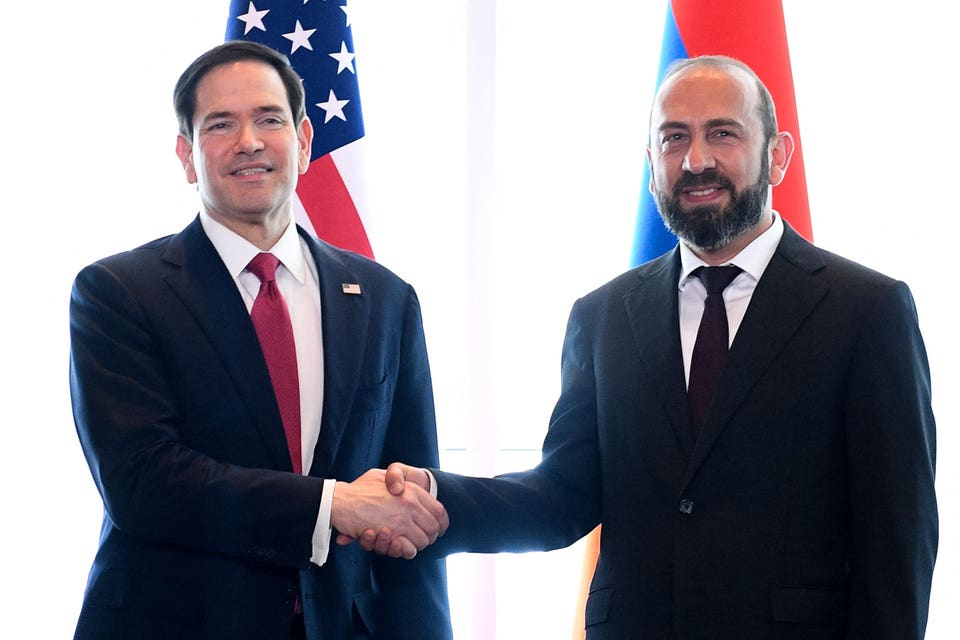
U.S. Secretary of State Marco Rubio and Armenian Foreign Minister Ararat Mirzoyan shake hands during their meeting at Zvartnots International Airport in Yerevan on May 26, 2026. (Photo by KAREN MINASYAN/AFP via Getty Images)
AFP via Getty Images
On May 26, when U.S. Secretary of State Rubio visited YerevanthIn 2026, the United States and Armenia signed a strategic cooperation agreement covering energy and other fields, attracting world attention. Rubio’s visit follows the historic visit of US Vice President Vance in February this year, during which he signed a civilian nuclear energy cooperative development agreement with Armenian Prime Minister Pashinyan.
Unless a war breaks out, a pipeline is threatened, or a great power expands its footprint, the South Caucasus attracts little attention.
The region has quietly become one of the most strategically competitive crossroads in Eurasia. The South Caucasus region, located between Russia, Iran, Türkiye and the Caspian Sea, is the center of energy transport, east-west and north-south trade, and Western access to Central Asia. Much of the world’s energy security, and particularly Europe’s efforts to diversify supply sources, relies on energy transport from the region. For the United States, due to its proximity to Russia and Iran, this is directly related to long-term geopolitical competition and the future architecture of Eurasian connectivity.
This reality helps explain why Armenia’s June 7 elections are important far beyond Yerevan. The vote will determine whether the South Caucasus continues toward diplomatic normalization, regional integration and diversified economic partnerships, or returns to the cycle of instability and dependence that has long allowed Moscow to dominate the region. This is not only related to the political future of Armenian Prime Minister Nikol Pashinyan, but also to the geopolitical direction of the entire South Caucasus region.
white race
The South Caucasus has become an arena for overlapping geoeconomic competition among the United States, Russia, China and Iran. Each viewed the Caucasus through a different strategic lens. Russia sees the region as its southern Achilles’ heel, which is crucial to maintaining its influence over the former Soviet region. Since the 18th century, the Russian Empire and the Soviet Union had viewed the region as a bridgehead against Iran and the Ottoman Empire/Turkey.
Iran resents Azerbaijan’s secular Shiite government, its close ties with Sunni regional power Turkey and its cooperation with Israel, and fears the emergence of transport corridors that could bypass it and weaken its regional influence.
The United States sees opportunities to strengthen European energy security, deepen ties with Central Asia, increase pressure on Iran from the north, and reduce the coercive power Moscow gains from freezing conflict and energy dependence.
At the same time, China views the Caucasus from an infrastructure and trade perspective. Beijing’s long-term interests center on establishing an overland trade route from China to Europe that does not rely on partners such as Russia or Iran who have their own agendas. Unlike the east-west routes, land transport corridors are less susceptible to a hypothetical U.S. naval blockade.
This convergence of U.S. and Chinese interests is testament to the adage that “politics makes strange bedfellows.” Washington’s support for projects such as the Middle Corridor and broader regional connectivity initiatives, including the Trump Peace and Prosperity Route through Armenia, reflects a desire to ensure lasting connectivity between Europe, the Caucasus and Central Asia. China seeks many of the same outcomes for different reasons. Both countries benefit from stability, normal functioning of transit networks and normalization of relations between Armenia and Azerbaijan.
Russia and Iran benefit in the opposite direction.
For decades, Moscow’s influence in the South Caucasus has depended on unresolved disputes, military dependence and the ability to position itself as an indispensable arbiter between hostile neighbors. The Kremlin-induced frozen conflict created leverage and the need for Russian “peacekeepers.” Normalization of relations between Armenia and Azerbaijan, especially as it accompanies economic integration and expanded engagement with the West, threatens the basis of Russia’s regional influence.
Energy, elections and Russian machinations
Russia, mired in the conflict in Ukraine, currently lacks the military resources to immediately consolidate its position in the South Caucasus. That’s why Armenia’s elections have become the focus of Russia’s increasingly aggressive political interference and covert operations. Achieving a favorable election outcome at relatively low cost could simultaneously reassert Moscow’s influence, support Iran, threaten U.S. and European energy plans, and ensure that China does not have too much leverage over Russia.
Russia has been pulling out all the stops to achieve its goals. President Putin compared Armenia’s westward quest to Ukraine’s attempts to gain associate membership of the European Union, which led to Russia’s intervention in 2014. Recent investigative reporting by groups including the Organized Crime and Reporting Project (OCCRP) and The Insider has revealed a vast ecosystem of Russian political influence operations targeting Armenia in the lead-up to the vote. The leaked materials outline efforts to shape public opinion in Armenia through a diaspora mobilization campaign and a coordinated disinformation initiative aimed at discrediting Pashinyan’s government and its civil contract parties.
The details speak volumes. According to OCCRP, one initiative specifically targets Armenian voters with Russian citizenship, saying they have the ability to have a “decisive influence” on the election results. Other leaked documents reportedly outline plans to cultivate hostility toward Pashinyan while promoting figures who advocate the closest alliance with Russia. The campaign reportedly went beyond traditional propaganda to include intelligence operations, influence operations through Kremlin-linked cultural organizations, covert financing networks, and efforts to weaponize religious and nationalist sentiment against the Armenian government.
One shocking piece of evidence comes from a recorded video of former ICC prosecutor Luis Ocampo and his son Tomas allegedly using their European networks and the residual prestige of the ICC to undermine European initiatives that would bring Armenia closer to EU institutions and ultimately contribute to Pashinyan’s downfall. According to videos circulating online, the Ocampos family allegedly used funds from Armenian-Russian businessmen and collaborated with the Armenian lobby in the United States.
The broader goals are clear. Moscow seeks to derail Armenia’s westward trajectory, undermine normalization with Azerbaijan and Turkey, and prevent the emergence of a South Caucasus energy regime that integrates into Western and Asian commercial networks outside of Russian control.
Inflection points and opportunities
What is unique about this moment is that the United States and China have far more overlapping interests, both inside and outside energy, than either side publicly admits. Washington and Beijing remain strategic rivals, but both benefit from predictability in the Caucasus and beyond, and both suffer when Russia injects instability. This dynamic is increasingly evident in other parts of Eurasia and Africa, where Russia’s actions harm the long-term commercial and strategic interests of France and the United States and threaten local geopolitical stability in Africa. Russia exploits short-term instability to essentially prey on developing countries to prop up its economies, which are struggling due to sanctions.
Geopolitics often creates uneasy alliances. During the Cold War, the United States worked with authoritarian regimes such as Nicaragua’s Anastasio Somoza and then-Zaire’s Mobutu Sese Seko to curb Soviet expansion, often to intense opposition. Today, Washington faces a different reality in the South Caucasus. China is a competitor, but Russia’s pattern of disruption, coercion, and controlled instability creates direct obstacles to U.S. energy security, European diversification, and regional connectivity.
China, the United States and Europe face a rare opportunity in which shared self-interest can drive cooperation, solidify a fragile peace, foster trust among world powers and hopefully avoid a return to the abyss of Cold War-era competition.
Therefore, the United States, China, Europe and numerous energy companies such as BP, SOCAR, TotalEnergies, Eni, ExxonMobil and Chevron have a direct strategic interest in the outcome of Armenia’s upcoming elections. If Russia’s destabilizing and disinformation efforts succeed, global energy markets, already battered by the crisis in the Strait of Hormuz, will be hit again. If the Russian initiative fails, the energy interests of Europe, China and the United States will be better protected.