The Tamesis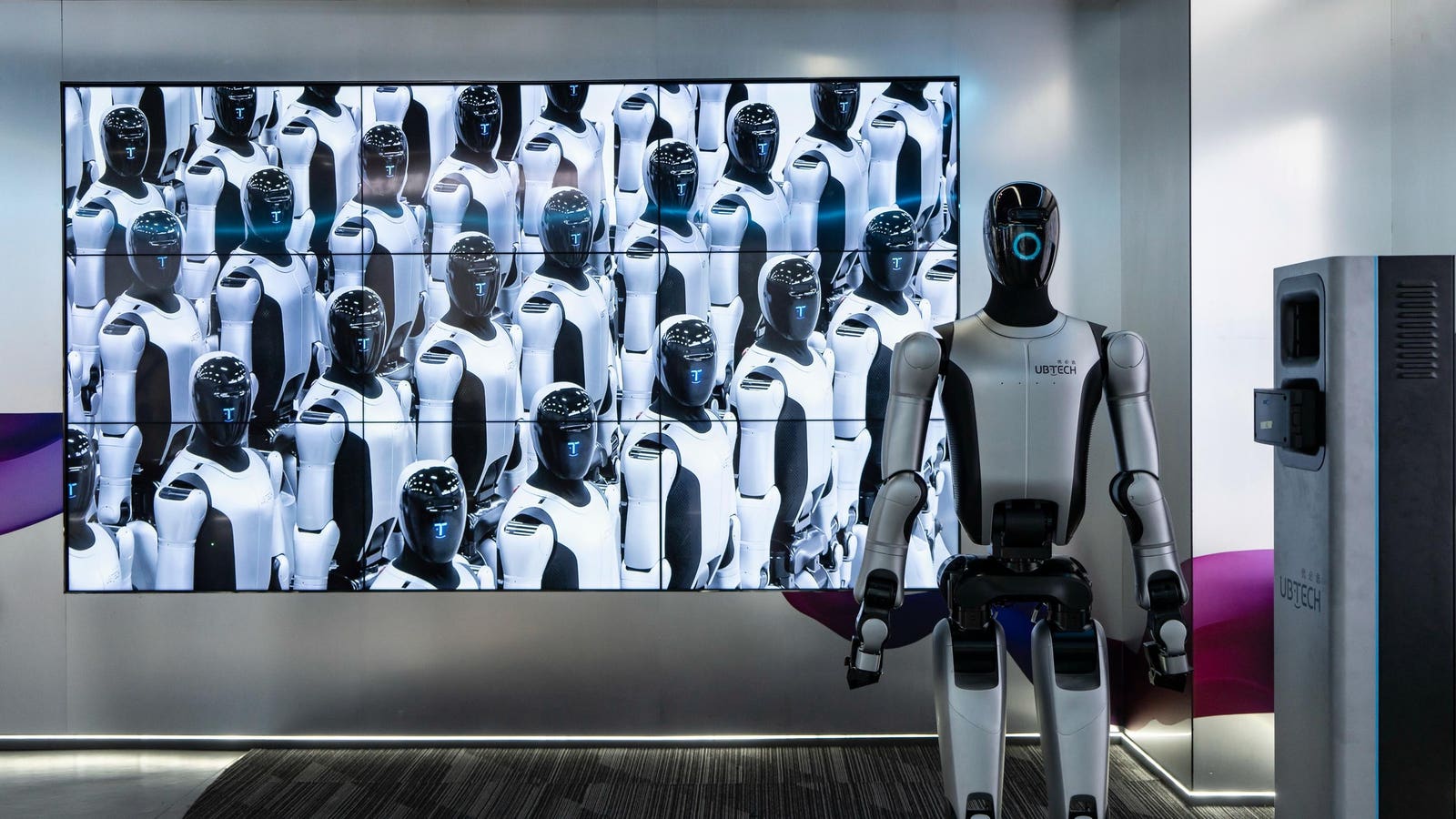
According to JPMorgan, Leaderdrive provides actuators and modules for UBTech’s Walker S2 humanoid robot.
Shen Qilai/Bloomberg
asThe market for humanoid robots has reached fever pitch, with soaring demand for its components sparking a gold rush for the industry’s suppliers. Leader Harmonious Drive Systems, a Shanghai-listed company that makes robot joints (harmonic reducers in industry parlance), has seen its share price rise 40% in the past year on strong sales. The surge in stock prices has created a pair of new billionaires: company founder and chairman Zuo Yuyu, 56, and brother and vice chairman Zuo Jing, 61. Based on Thursday’s closing price of 203.8 yuan, the brothers and sisters each own 17% of the shares and are worth US$1 billion.
Also known as Leaderdrive, the Suzhou-based company was founded by Yuyu in 2011 with a mission to make affordable components for robots. Today, it is China’s largest manufacturer of harmonic reducers, which are the joints of robots, by market share. According to JPMorgan Chase, Leaderdrive’s domestic customers include humanoid robot giants UBTech Robotics and Agibot. The investment bank said it has also fulfilled small-volume development orders for Figure AI, which is backed by Tesla and Nvidia. Leaderdrive did not name its client and did not respond to a request for comment on the brothers’ net worth.
JP Morgan estimated in a March report that Leaderdrive’s share of China’s harmonic reducer market was between 30% and 40%. The company also makes other components, such as rotary actuators, which are “muscles” that convert electrical signals into motion. These components are deployed in a range of applications from semiconductor manufacturing equipment to medical devices.
In 2025, Leaderdrive’s net profit more than doubled year-on-year to 124.4 million yuan ($18.2 million), and revenue increased 47% to 570.7 million yuan. The company attributes this growth to the booming market for industrial robots and humanoid robots. The company produced components for this segment, which accounted for 74% of its sales during the same period. Machinery equipment parts account for nearly a fifth of total revenue, with the remainder coming from components for computer numerically controlled (CNC) machines and medical equipment.
90% of Leaderdrive’s revenue comes from the local market, and it has begun to expand overseas markets. In February, the company formed a joint venture with Taiwanese billionaire Chen Zhenghua’s auto parts supplier Minshi Group to develop joint modules for humanoid robots in the United States. JPMorgan noted in a February report that the joint venture is “well-positioned to serve major customers such as Tesla, Figure AI and Boston Dynamics, and will benefit from the accelerated adoption of humanoid robots in the U.S.”
Yuyu graduated from the Department of Physics of Nanjing University. In 1999, he joined Hengjia Metal, a metal processing company in Suzhou, and was responsible for the mechanical engineering business. According to Leaderdrive’s 2020 prospectus, he expanded his product portfolio to include electrical components and secured major customers such as Switzerland’s ABB, U.S. General Electric and Japan’s Nachi-Fujikoshi.
In 2003, Yuyu turned to robot components and began developing harmonic reducers part-time. It wasn’t until 2011 that the first product was ready to launch, when he founded Leaderdrive, according to the company’s prospectus. Interviewed by a state-owned newspaper Shanghai Securities News In 2020, Yuyu revealed that his success was hard-won. “The core technology is firmly in the hands of Japanese companies. We have no blueprint, only a process of trial and error,” he recalled. “If there’s a secret to our success, it’s the ability to persist and the willingness to put in the time.”
His brother Jing, who works in the government tax bureau, joined the company as general manager in 2014. In 2020, the two led the company to be listed on the Shanghai Science and Technology Innovation Board, and the IPO raised approximately 1.1 billion yuan.
The Zuo brothers are the latest Chinese billionaires to amass wealth from the robotics supply chain. Other billionaires include Wang Xinyang, founder of Changchun Changchun Microelectronics Co., a maker of robotic image sensors, and Howard Huang, founder of Shenzhen-based Orbbec, which makes 3D vision cameras that enable robots to sense depth like the human eye.