The Tamesis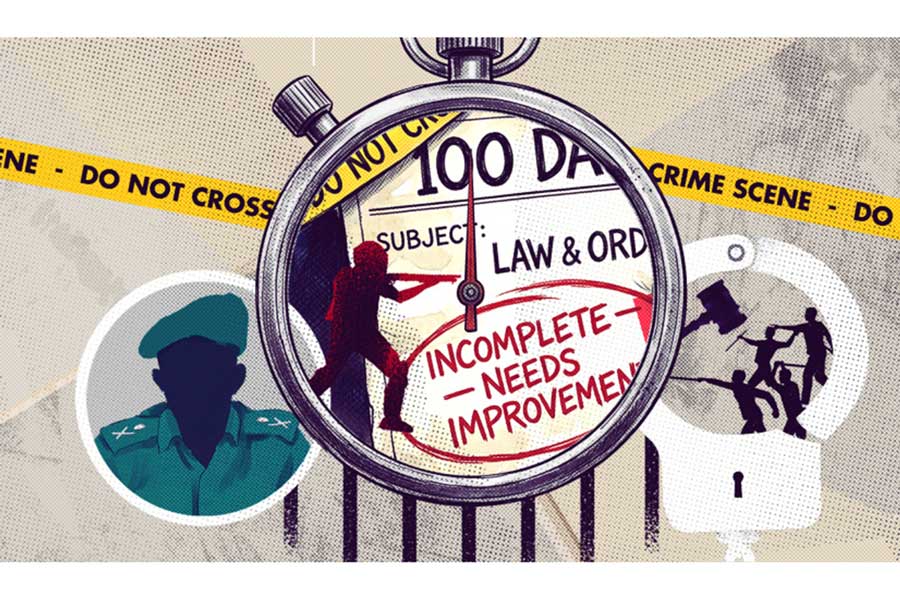
June 5, 2026
Dhaka – Ahead of February elections, the BNP vowed to restore law and order and ensure public safety if elected. At the first cabinet meeting chaired by Prime Minister Tariq Rahman on February 18, the new government reiterated that stabilizing law and order would be one of its top priorities.
However, more than three months after taking office, the country has yet to see the level of improvement many expected, experts say.
Violent crimes such as murder, rape, extortion, mob attacks, and kidnapping continue to attract public attention across the country. Meanwhile, law enforcement agencies are still working to rebuild public trust following the political transition, they added.
The BNP came to power in February after 17 months of an interim government led by Professor Muhammad Yunus. The Human Rights Support Society (HRSS) described the human rights situation during the transition as worrying.
Experts and analysts say that while the BNP government has launched a number of anti-crime operations since taking office, it has yet to make significant improvements or send a strong message to restore public confidence.
A series of brutal killings, rapes and attacks on law enforcement officers in recent weeks has reignited concerns about public safety.
The rape and murder of eight-year-old Ramisa Akter on May 19 in Dhaka’s Pallabi was one of the most brutal incidents that sparked outrage across the country. The main suspect, Sohel Rana, has now been arrested and charged with rape and murder.
Other gang-style and politically-linked killings were also reported across the country in Dhaka and Chittagong, as well as murders allegedly committed by family members and acquaintances.
Overall crime data for March and April 2026 also paint a disturbing picture when compared to the corresponding months in 2024 and 2025.
Murders increased in 2026 compared with both months of the previous two years, according to Police Headquarters (PHQ) figures. Robbery increased in 2025 and decreased slightly in 2026, but was still higher than in 2024.
Repression against women and children peaked in 2025 and declined in 2026, but remains above 2024 levels. A similar pattern was observed in attacks on police officers, with an increase in 2025 and a slight decrease in 2026, but still higher than the 2024 figures.
During the interim government’s tenure, mob violence reached such levels that state troops failed to take appropriate action. Interior Minister Salahuddin Ahmed has repeatedly strongly opposed “mob culture” since taking office in February.
However, mob violence still occurs frequently. According to HRSS, in the first four months of 2026, there have been 132 mob-related incidents resulting in at least 71 deaths. Of these, 69 incidents occurred in March and April alone, resulting in 35 deaths.
After the BNP government came to power, extortion gangs, criminal networks and politicians linked to the ruling party began vying for control of markets, transport hubs, land and commercial centers, with accusations against party members regularly making headlines.
The government has since compiled nationwide lists of criminals and extortionists and launched operations to restore law and order, but these efforts have yet to have significant results.
Rights activist Noor Khan Liton said that the new government has been in office for nearly 100 days, but the overall security situation has not improved significantly.
“It was initially expected that the situation, especially law and order, would improve after the government takeover. But mob violence, torture and killings by organized groups continue to occur,” he said.
Weaknesses in the police system that emerged after August 5 have not yet been addressed, he said, noting that 100 days is still too short for the government to fully stabilize the situation.
Additional Inspector General of Police (Crime and Operations) Khondkar Rafiqul Islam admitted that despite various policing initiatives, major crimes were still taking place.
“It is extremely regrettable that the recent incidents could not have been avoided. We are working hard and the main suspects in several incidents have been arrested,” he said.
He added that law enforcement agencies were cracking down on drug traffickers and extortionists across the country. “I hope the situation will improve in a short time.”
Professor Omar Farooq from the Department of Criminology and Police Science at Maulana Bashani University of Science and Technology said police forces are still struggling with institutional instability caused by reorganization, low morale and the hangovers of political transition, limiting their effectiveness.
“The level of attention and measures that people can expect when a new government is formed is unclear,” he told the Daily Star.
He also pointed to gaps in training, surveillance and intelligence gathering that create an environment conducive to crime.
He believes that political will is the key to solving this problem. “Without strong commitment, it’s difficult to bring about meaningful change,” he said.
[Note: This report did not consider crime data for February as the BNP government took office in the middle of that month. PHQ crime data for May was not available at the time of publication.]