The Tamesis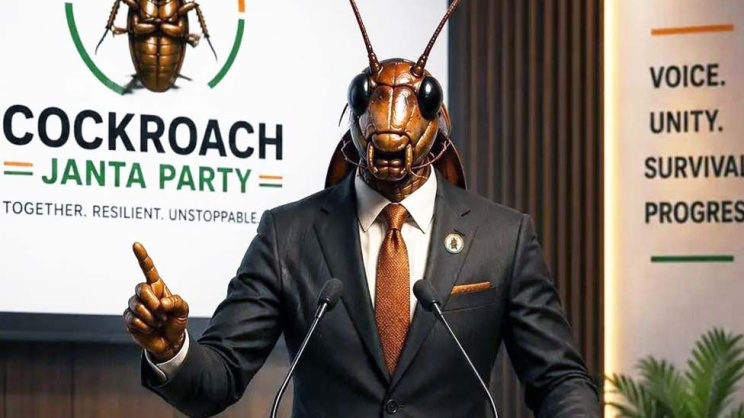
May 26, 2026
Dhaka – What would happen if, one fine morning, a call was given – “Cockroaches of the world unite!” Suddenly millions of meaningless, lazy little creatures swarm out of their ugly lairs – from behind boxes, from under beds, from the dark corners of old cupboards?
Cockroaches are lazy but resilient, refusing to evolve over the past 150 million years. All they do is survive and reproduce. You drive them away with a broom, smash them with your sandals, spray them with “hit” and they still come back. When dirt builds up, cockroaches are bound to appear.
“What if all the cockroaches gathered together?” — that was the question asked by 30-year-old Abhijit Dipke after Chief Justice Surya Kant compared India’s unemployed youth to “cockroaches” during a hearing on May 15.
Within 24 hours, Dipke launched a website and social media accounts called Cockroach Janata Party (CJP) on X and Instagram.
The name itself is a mockery of the central ruling party. Then there’s the logo: a cockroach sitting on a smartphone with full internet connection – reflecting the Chief Justice’s further accusation that professionally worthless young people turn into media or social media activists and attack everyone.
But do cockroaches really attack people? Its awkward wing flapping could cause trouble, while its flat presence could carry information for future dissemination. Sure, it causes trouble, but rarely harm.
Cockroaches are the result of systemic betrayal
The Cockroach People’s Party expects its members to meet certain standards. Gender, caste or religion does not matter. Interested individuals are encouraged to perform a self-check on qualifications to ensure that they are in fact unemployed, physically lazy, chronically online, and capable of roaring professionally.
These standards perfectly reflect the growing perception of Generation Z in Indian society. Justice Surya Kant’s remarks, despite his later clarification, were not just a personal slip of the tongue. It reflects the broader mentality of India’s comfortable middle class, which cannot withstand the chronic financial and career pressures faced by the country’s young people.
Generation Z, those born between 1997 and 2012, currently accounts for more than a quarter of India’s population. However, nearly 40% of young graduates remain unemployed and only about 7% find permanent paid employment within a year of graduation, according to Azim Premji University’s State of Work in India 2026 report.
In rural India, reliance on agriculture has increased post-pandemic. In urban India, the rapid expansion of the gig economy continues to drive down wages and undermine job security. The Modi government endlessly extols India’s “demographic dividend” while offering few guarantees for young people’s educational, career or economic aspirations.
At the same time, inflation, rising fuel prices due to the Middle East crisis, and growing concerns that artificial intelligence will consume skilled jobs have deepened existing anxieties. Affordable education, health care and housing remain increasingly inaccessible. At the same time, the gradual transfer of national wealth to crony capitalists like Adani and Ambani has become harder to ignore. Public trust in the judiciary is rapidly eroding.
apolitical political orientation
The CJP’s manifesto contains five demands: the chief justice should not be given a federal house seat after retirement; the chief election commissioner should face UAPA charges if legal votes are deleted; 50% of cabinet positions should be reserved for women; media companies owned by Adani and Ambani should have their licenses revoked; and any MLA or MP who defected from one party to another should be banned from contesting elections or holding public office for twenty years.
Rallies, slogans and street speeches no longer attract the educated youth as they once did. Instead, young people express their political consciousness through satire, memes, parody, and comedy.
The party has also demanded the resignation of the Union Education Minister following the recent cancellation of the NEET 2026 examination due to question paper leaks.
The demands, which mainly target corruption and institutional decay, are very reminiscent of the 2011 anti-corruption movement – popularly known as the Anna Andolan movement – which sought to address political corruption through the Jan Lokpal Bill.
This nonpartisan citizens’ movement eventually gave birth to Arvind Kejriwal’s Aam Aadmi Party, while reinforcing the anti-Congress rhetoric of the BJP ahead of the 2014 elections.
Will the CJP similarly evolve into a larger anti-establishment movement?
This speculation becomes even stronger considering that Deepke himself was associated with AAP between 2020 and 2023.
But for now, the CJP serves primarily as a platform to raise questions and demand accountability. “The rest is a travesty,” they said.
Their website has a smart aesthetic. There are rankings based on the number of questions asked by top citizens, top states, and top revolutionaries. Their headquarters? “As long as there’s WiFi.”
Within days of its launch, the CJP’s Instagram following far exceeded that of the BJP. Speaking to Al Jazeera, Deepke said, “Those in power think citizens are cockroaches and parasites… They should know that cockroaches breed in rotten places. This is India today.”
The CJP’s emergence as the voice of Generation Z will inevitably draw comparisons to recent youth-led mobilizations in Sri Lanka, Bangladesh and Nepal, all of which successfully toppled their respective governments.
Yet Dipke himself told Dawn, “Whatever we do, we will do it within our constitutional rights. We will do it in a democratic, peaceful way. It will not be like Nepal or Bangladesh.”
Even so, the CJP has announced its first mobilization event – BharatX: Phase 1 – asking supporters to walk silently at 6am, carry Indian flags, use black avatars and spread the movement into youth spaces.
Their website declares, “This phase is not about politics. It is about awakening people, creating discipline and creating a national youth movement focused on change, action and India’s future.”
In contemporary India, spontaneous issue-based citizen movements tend to inspire deeper trust among educated urban and semi-urban youth than organized political parties.
The Rat Dakhal movement in Kolkata sparked unprecedented public outrage in 2024 after an on-duty trainee doctor was raped and murdered. Similarly, in April last year, spontaneous worker protests across NCR forced the Uttar Pradesh government to revise the minimum wage amid a police crackdown.
The CJP was also born out of accumulated resentment – not resentment over a single incident but over years of unfulfilled promises, suddenly crystallized by a careless remark from the country’s highest judicial office. This resentment is directed at the right-wing political order, but it is also rooted in the unfulfilled promises of the right itself.
When “jargon” replaces language
A large section of India’s youth has become completely disillusioned with traditional political parties. But what language can the alternative movement speak?
In an age of collapsing attention spans and a relentless flow of digital content, all political parties compete in a cutthroat market for attention. Yet traditional political vocabulary is increasingly unable to keep up with Gen Z’s anxieties, humor and communication styles.
Cockroaches no longer want to be silently crushed. They want to return insult with insult. They prefer the open, horizontal space of digital media to the rigid hierarchies of traditional political parties.
Rallies, slogans and street speeches no longer attract the educated youth as they once did. Instead, young people express their political consciousness through satire, memes, parody, and comedy. The popularity of comedians like Kunal Kamra, Varun Grover, Samdish Bhatia or Veer Das reflects exactly this shift.
This phenomenon is not unique to India. Around the world, Gen Z movements are exploring new forms of political communication and organizing.
Unlike traditional party politics, political identities formed through collective shaming become more effective in mobilizing support.
In India, direct criticism of the government has become increasingly dangerous due to the growing threats of reactionary Hindutva, ultra-nationalism and restrictive laws such as UAPA. India’s ranking in the World Press Freedom Index continues to decline significantly.
In this case, ridicule becomes a political language. An example recently emerged in West Bengal, where a section of the Muslim community, in response to the Bharatiya Janata Party’s restrictions on cow slaughter ahead of Eid, staged protests demanding that cows be declared India’s national animal.
However, it would be wrong to view the Cockroach PPP as a movement specifically targeting the BJP. The party made it clear that no political force in India truly represents the younger generation. The scope of ridicule is therefore wider than the electoral opposition. It targets the political system itself.
The fate of the cockroach
Political commentators remain understandably skeptical about the CJP’s future. Is this just another viral digital moment, or a sign of something bigger?
After all, there’s nothing inherently revolutionary about letting frustrated internet users gain token party membership via a Google form.
However, the speed with which the movement has caught on indicates something important: Cockroaches no longer want to be crushed in silence. They want to return insult with insult. They prefer the open, horizontal space of digital media to the rigid hierarchies of traditional political parties.
Still, the larger question remains whether the basis for a mass movement actually exists in a country as vast, fragmented, and institutionally powerful as India.
A movement of this magnitude would require a complete collapse of public confidence in the existing system. India has not yet fully realized this reality. The BJP continues to rule much of the country through a so-called “twin-engine” government. Belief in Narendra Modi’s ‘Vishwaguru’ persona, slogans such as Sabka Saath, Sabka Vikas and the wider Hindu faith project remains widespread – including among many young people visible on social media.
The Cockroach People’s Party (CJP) uses biting satire and striking imagery to express Gen Z’s frustration with unemployment and systemic political decline. Photo: CJP website
So why was the BJP government so quick to block the BJP’s Instagram account?
Because the BJP feels challenged.
The BJP’s sudden popularity signals the risk of losing some of its psychological base as it seeks to capture the political imagination of Generation Z itself.
This insecurity also explains the increasingly coercive character of the Indian state. Many people reportedly lost their right to vote through procedures such as Special Intensification Revision (SIR). Meanwhile, journalists, activists and dissidents face growing legal and administrative pressure.
As the political space shrinks and the PPP’s dominance becomes more assertive, conditions are ripe for public outrage.
For now, it is reasonable to view the rise of the Cockroach People’s Party as a stage in a larger preparatory process.
Arka Bhaduri is an independent journalist, executive editor of The International and Hammer magazines, and a columnist for The Morning Star. He has written extensively on political dynamics in South Asia and Europe