The Tamesis
Samsung Electronics this week is expected to report a 160% rise in fourth-quarter operating profit as a severe shortage of semiconductors sends memory chip prices soaring.
Chip prices have soared recently as customers scramble to meet a boom in demand for artificial intelligence.
The chip industry’s focus on AI-related chips has affected the production of traditional memory chips, while demand for traditional and advanced chips used to train and run AI models has surged.
See also: Trump’s attack on Venezuela ‘could bolster China’s territorial claims’
Samsung is likely to expect operating profit of 16.9 trillion won ($11.7 billion) in the October-December period, according to 31 analysts at LSEG SmartEstimate, which favors those analysts who are more accurate.
This compares with 6.49 trillion won in the same period last year, which would mark the highest quarterly profit since the third quarter of 2018 and hit a record high of 17.6 trillion won.
Some analysts have raised Samsung’s fourth-quarter operating profit forecast to more than 20 trillion won in recent weeks due to stronger-than-expected prices for traditional chips.
The world’s largest memory chip maker will release its revenue and operating profit forecasts on Thursday.
Memory chip prices soar
According to data from market research firm TrendForce, the price of DDR5 DRAM chips increased by 314% year-on-year in the fourth quarter.
It expects traditional DRAM contract prices to rise 55% to 60% this quarter from October to December.
TrendForce analyst Avril Wu said: “As traditional DRAM prices continue to surge, Samsung – whose production capacity is mainly concentrated in this area – will gain relatively more from the current price increase cycle.”
DRAM chips are used in servers, computers, and smartphones to temporarily store data and help run programs and applications smoothly and quickly. DDR5 DRAM is a traditional chip that is faster and more efficient than its predecessor.
In December, Micron Technology forecast second-quarter adjusted profit to be nearly double Wall Street expectations. Micron CEO Sanjay Mehrotra said he expects the memory market to remain tight after 2026, and in the medium term, only half to two-thirds of the needs of several major customers are expected to be met.
Stock price surges
Samsung’s booming profits mark a dramatic turnaround, just over a year after Samsung Chief Executive Jun Young-hyun apologized for the company’s disappointing earnings and performance as it fell behind crosstown rival SK Hynix in supplying high-end chips to Nvidia, the main maker of artificial intelligence processors.
Samsung’s stock price rose 125% last year, its largest annual percentage gain in 26 years. On Tuesday morning, the broader market fell 2.1%, with the broader market down 0.2%, taking a breather after recent gains.
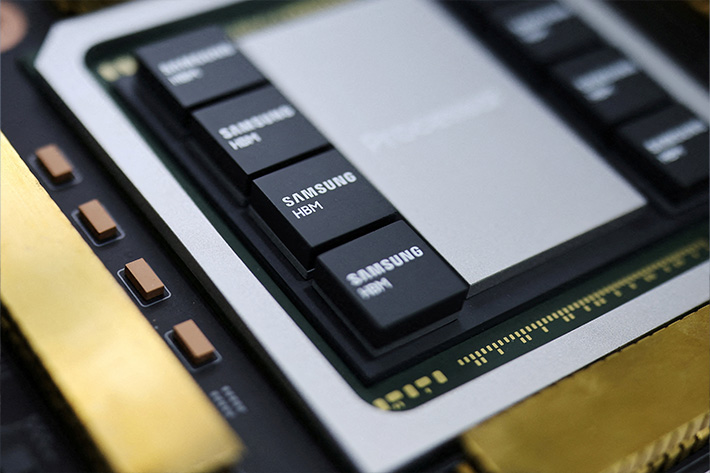
Jun said on Friday that Samsung customers praised the competitive advantages of its next-generation high-bandwidth memory (HBM) chips (HBM4), quoting them as saying, “Samsung is back,” helping Samsung’s stock price continue to rise to record highs in recent sessions.
He did not elaborate on those customers, but analysts said Samsung is making progress in supplying chips to Nvidia, potentially taking market share from SK Hynix and Micron.
Nvidia CEO Jensen Huang said on Monday that the company Next-generation chips are in full mass production. Nvidia said the Vera Rubin platform will use the HBM4 chip and is expected to be launched later this year.
Analysts said Samsung’s operating profit is expected to more than double this year to more than 100 trillion won as rising chip prices will more than offset slowing profits in its mobile business.
‘Risk of demand slowdown’
BNK Investment & Securities analyst Lee Min-hee said he was cautious about Samsung’s valuation as soaring chip prices could weaken demand for PCs and smartphones, citing the “risk of a slowdown in demand” for artificial intelligence data centers that increasingly rely on debt to finance.
While the global memory chip shortage is a boon for Samsung’s mainstay semiconductor business, soaring chip prices are squeezing profits at its smartphone unit, its second-largest source of revenue.
“As this situation is unprecedented, no company will be immune to its impact,” Samsung co-CEO Roh Moo-hyun (TM Roh), who oversees Samsung’s mobile, TV and home appliance businesses, told Reuters, adding that the company was working to minimize the impact, which looked “inevitable.”
Device output “doubled”
at the same time, Samsung plans to double the number of its “Galaxy AI”-enabled mobile devices this year, mainly powered by Google’s Gemini, its co-chief executive said. That would give the U.S. company an edge over its rivals as the global race for artificial intelligence heats up.
The South Korean tech giant launched Gemini-powered AI features on about 400 million smartphones and tablets last year and plans to increase that number to 800 million by 2026.
“We will apply artificial intelligence to all products, all functions and all services as soon as possible,” TM Roh told Reuters.
The plan from the world’s largest backer of Google’s Android mobile platform will provide a major boost for Google, which is competing with companies such as OpenAI to attract more consumer users to its artificial intelligence models.
Samsung seeks to regain its lost crown from Apple in the smartphone market and fend off competition from Chinese rivals not just in phones but also in televisions and home appliances, all of which are headed by Roh Moo-hyun.
It will offer integrated artificial intelligence services across consumer products, market researchers say, extending its lead over Apple in those features even as the latter emerged as the top smartphone maker last year Counterpoint.
Gemini 3 leads the AI race
Alphabet’s Google launched the latest version of Gemini in November, highlighting Gemini 3’s leadership in a number of popular industry AI model performance metrics.
in response Gemini 3OpenAI CEO Sam Altman reportedly issued an internal “code red” to suspend non-core projects and realign the team to accelerate development. A few weeks later, the makers of ChatGPT launched the GPT-5.2 artificial intelligence model.
Roh expects AI adoption to accelerate, as Samsung’s awareness survey of its Galaxy AI brand jumped from about 30% to 80% in just one year.
“While AI technologies may seem a little questionable now, in six months to a year these technologies will become more widespread,” he said.
While search is the most commonly used AI feature on mobile phones, consumers also regularly use a range of generative AI editing and productivity tools for images and other content, as well as translation and summarization features, he said.
Galaxy AI is Samsung’s term for its suite of artificial intelligence features, including features for different tasks powered by Google’s Gemini model and Samsung’s own Bixby.
- Additional links provided by Reuters Edited by Jim Pollard
See also:
Sustained AI demand pushes Asian stocks to five-year high
South Korean and Chinese stocks post highest gains in years amid AI boom
TSMC, South Korean companies “can send chip manufacturing tools to Chinese factories”
Seoul accuses former Samsung employee of leaking DRAM technology to China
China now requires chipmakers to use at least 50% domestic equipment
China’s big technological secret: Dutch chip-making machine replicated in laboratory
Chinese companies lobby for Nvidia H200 but retain local chips