The Tamesis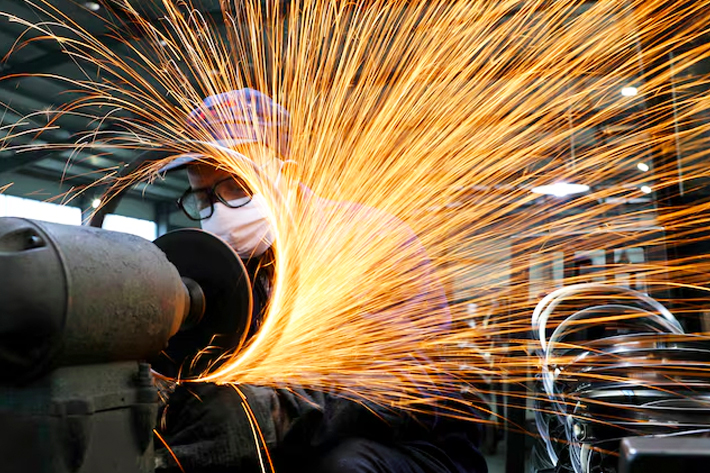
The global steel industry remains in crisis as Chinese production subsidies flood the market with cheap steel and war in the Middle East weakens demand, the OECD said on Thursday.
“Global steel production capacity has continued to expand steadily despite shrinking demand, resulting in capacity utilization well below sustainable levels,” the Organization for Economic Co-operation and Development (OECD) said in its annual report on the industry.
The OECD states that steel is necessary for almost all industrial activities and is also critical in many strategic sectors.
AF also mentioned: Asian markets slide on artificial intelligence, interest rate hike fears; oil prices fall due to Lebanon deal
The report pointed out that excess production capacity reached 640 million tons last year and is expected to increase to 745 million tons by 2028.
That left excess capacity accounting for more than a third of last year’s roughly 1.8 billion tons of steel demand.
Meanwhile, the OECD predicts that steel demand will grow by just 0.9% annually until 2030.
The OECD, which consists of 38 mostly industrialized countries, said most of the excess steel capacity comes from China, accounting for 54% of the total.
Beijing doubles subsidies for steel companies
The report noted that since 2019, Beijing has nearly doubled the subsidy rate for Chinese steelmakers to 15 times the subsidy rate for steelmakers in OECD countries.
Chinese steelmakers have stepped up exports as China’s domestic market slows.
“The resulting surge in overcapacity has led to dumped and subsidized exports flooding international markets,” the report said.
At the same time, conflicts in the Middle East are driving up energy costs in energy-intensive industries and disrupting supply chains.
“Concerted international action is needed to address the structural problems and impacts,” the OECD said, noting that a global alliance of steel producers that excludes China is developing a comprehensive framework to address the issue.
The OECD report notes that despite increasing trade restrictions, large amounts of cheap and dumped steel are threatening the financial viability of quality producers.
“If current trends continue, the long-term viability of the industry and the national economic security of many countries will be compromised,” the report warned.
- Vishakha Saxena Additional Editor AFP
Also read:
Asia ‘worst hit by energy crisis’ due to Iran war
Energy crisis triggered by Iran war fuels renewable energy boom, IEA says
War with Iran could hit some of Asia’s biggest economies hard
China’s trade surplus tops US$1 trillion as exports surpass US
The International Monetary Fund tells China: Cut exports, increase consumption, and “let go of the zombies”
Trump’s ‘no exemption’ tariffs unnerve Chinese steelmakers
Foreign companies struggle amid China’s recession and trade war
Investigation finds Asian steelmakers failing to switch to renewable energy