The Tamesis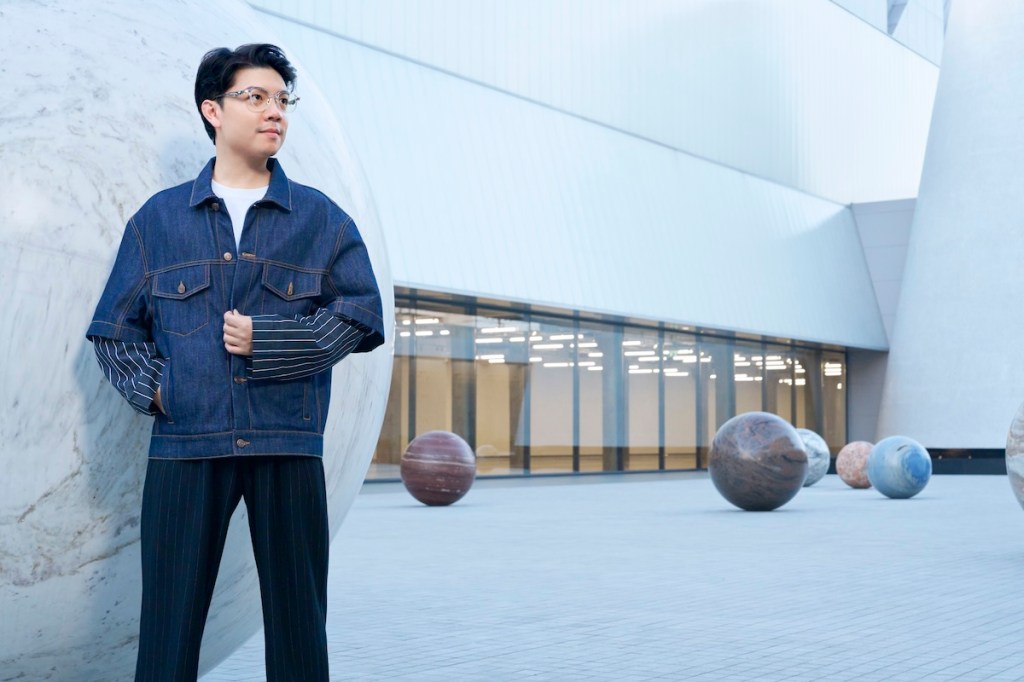
Despite the proximity of the holidays, some 100 guests – including many of the most influential figures in the contemporary art world – gathered in Bangkok on December 20 for the highly anticipated opening of Dib Bangkok.
Positioned as one of the most important cultural openings in the region in 2025, Dib Bangkok is hailed as Thailand’s first international standard contemporary art museum. Dib was founded by Petch Osathanugrah, once one of the country’s most famous industrialists and major art collectors with more than 1,000 works of art, and was completed by his son Purat “Chang” Osathanugrah after his father’s death in 2023.
Related articles
For Osatanugla, now president of the museum, the institution is about national pride and accessibility. “We are very proud to be the first institution of this level,” he said at the opening. “In the past, for ordinary people in Thailand to see this caliber of international contemporary art, they had to hop on a plane, book a hotel and pay extra to visit museums abroad.”
Reflecting the city’s tropical heat, a festive atmosphere permeated the museum’s courtyard, which featured a monumental natural stone installation by Polish artist Alicja Kwade, while the reception featured a site-specific dance performance choreographed by renowned Thai artist Dujdao Vadhanapakorn.
However, the official opening of the first exhibition was marked by a visceral, high-decibel performance. In a moment that shocked the audience, Zhang hit a rectangular white wall with a baseball bat, leaving deep dents in its surface. The behavior is constellation (2015-2025), a work by Marco Fusinato that is only possible through physical contact. When the bat hits the wall, the hidden speakers emit a loud, booming sound that’s impossible to ignore—a literal and metaphorical “bang” for Thailand’s newest cultural landmark.
Titled “(In)visible Presence,” the exhibition, curated by Thai artist and curator Ariana Chaivaranon and the museum’s first director Dr. Miwako Tezuka, features 81 works by 40 artists drawn from the museum’s extensive collection.
Zhang revealed that nearly half of the museum’s collection was developed with his father starting in 2015, through frequent informal conversations. “We would discuss which pieces stood out the most over a dinner table, coffee or a drink at the bar,” he says.
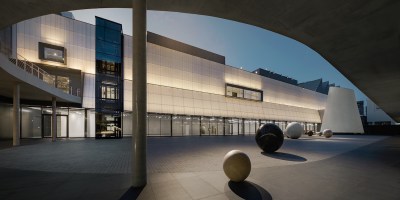
Dib Bangkok appearance at night.
Photo W Workspace/Courtesy of Bangkok Dib/
With a strong musical pedigree—both Zhang and his father were aspiring musicians—the museum places a special emphasis on sensory interaction. Many featured works, such as Fusinato’s, eschew static observation in favor of audience participation or integrated soundscapes.
A case in point is Korean artist Jinjoon Lee’s multi-channel video installation Daejeon, summer 2023is a recently acquired project that combines painting, artificial intelligence, and music. During the summer of 2023, Lee painted on vinyl records every day; in the installation, the turntable uses a camera sensor instead of a traditional stylus to “read” visual data. Custom artificial intelligence programs then transform the artist’s summer memories into real-time sonic experiences. camera sensor imitation Wu Xianqinthe Korean academic concept of “stringless guzheng,” which symbolizes a state of mind so highly sublime that physical sound is no longer needed.
“I am fortunate that my father and I share similar tastes that align the collection with the institution we seek to build,” Zhang added. “But in turning a private dream into a public museum, I tried to balance personal preference with the broader mission.”
Zhang said his main focus since founding the institution has been to fill “gaps” in the collection and acquire works of historical significance, even if they contradict his own aesthetic.
While one of the exhibition’s overarching themes is a tribute to Zhang’s late father, Chaiwaranon and Tezuka deliberately juxtaposed internationally renowned figures with Thai artists to give them equal importance. For example, fabric sculptures by Louise Bourgeois are paired with similar silhouette installations by Thai artist Navin Rawanchaikul. The latter’s works, no soundis a milestone in Chiang Mai’s social installation movement, which is known for its advocacy of displaying art in non-traditional spaces to directly intervene in social discourse.
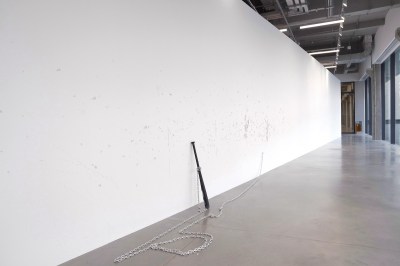
Installation view constellation (2015-2025), work by Marco Fusinato, at Dib Bangkok.
Photo Wikran Poungput/Courtesy of Bangkok Dib
Meanwhile, the entire third floor is dedicated to a dialogue between two great figures: Anselm Kiefer and Monty Bouma. Zhang said that this may be Kiefer’s first large-scale installation in Thailand, and that he and his father had specially driven to Kiefer’s studio in the Paris countryside to ensure its safety. title lost letterthe installation uses a Heidelberg printing press as its “centre of gravity,” with several resin-cast sunflowers towering more than 23 feet tall.
“This artwork becomes a way for us to think about the possibilities for growth and reconciliation in the wake of great loss—both personal and the loss of our collective humanity,” Chaivaranon said during the opening tour.
The remaining galleries on this floor form a concise retrospective of Montien Boonma, whom Zhang describes as the “unsung hero” of Thai contemporary art. His seminal 1992 installation Lotus Voice— originally exhibited at the first Asia-Pacific Triennial in 1993 — is presented here for the first time exactly as the artist intended. Due to resource and space constraints, the early Australian version contained only 350 bells, while this final version contains 500 bells, creating the immersive meditation environment Boonma envisioned decades ago.
Dib Bangkok’s arrival is the latest sign of growing private sector patronage of Thailand’s arts scene. Founded in 2018 by Apinan Poshyananda with the backing of drinks giant ThaiBev, the Bangkok Art Biennale has since expanded into a city-wide celebration, most recently in 2023. In 2022, Marisa Chearavanont, wife of Soopakij Chearavanont, chairman of CP Group, one of Asia’s most powerful conglomerates, purchased a Brutalist building on the edge of Chinatown that had been abandoned for more than two decades after a fire and transformed it into the Bangkok Art Gallery, a space dedicated to experimental art and film screenings.
Looking ahead, real estate group Central Group is preparing to launch deCentral, a social enterprise focused on curating exhibitions, commissioning new works and promoting interdisciplinary collaboration between Bangkok and Chiang Mai.
Amid the surge in activity, local players are expanding their reach, while international players are eyeing the market with renewed interest.
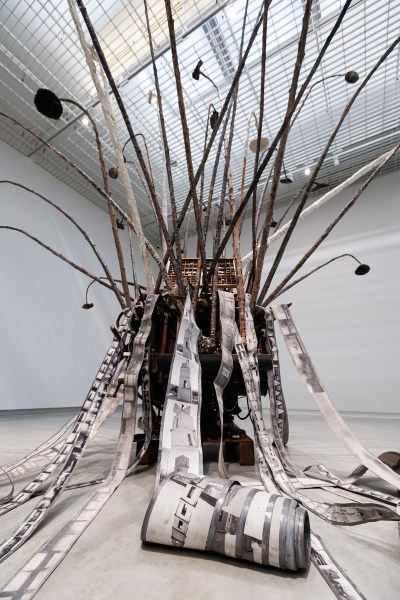
Anselm Kiefer’s exhibition view Verolen Buchstabe (2019) in Dib Bangkok.
Photo Auntika Ounjittichai/Courtesy of Bangkok Dib
Influential local gallery Nova Contemporary expanded its reach last April, and British-Thai artist Tuck Muntarbhorn opened a commercial gallery on the occasion of Dib Bangkok’s opening. Muang Dam Phong’s space is dedicated to a unique curatorial vision that blends Thai contemporary art and traditional craftsmanship with a diverse international perspective.
The international community is also paying attention. New York-based Harper’s Gallery plans to open its first international branch in Bangkok this April. Meanwhile, AccessBangkok, the boutique art fair Cearavanont helped launch in 2024, will be rebranded and expanded later this year as ArtBangkok International.
“The transformation of Thailand’s art scene will be one of the biggest art stories of 2026,” Harper Levine, founder of the eponymous gallery, told us art news. Levine said that after a successful pop-up exhibition in Bangkok last year, he realized that the scene was undergoing a sea change, but there was a lack of Western galleries of the same caliber to anchor the market.
However, behind the enthusiasm, several prominent local galleries, including Bangkok’s CityCity Gallery and Ver Gallery, pointed to a clear cooling of the business environment in 2025, raising questions about the long-term sustainability of the market.
“What we lack in Thailand is a strong market,” said Gridthiya Gaweewong, artistic director of the Jim Thompson Center for the Arts. art news. Despite the government’s rhetoric around promoting the arts, she noted that inconsistent policies hinder the market’s appeal compared to regional hubs such as Singapore. Many high-profile initiatives, including tax breaks for collectors and artists announced last August, have yet to be fully implemented.
“Thailand’s problem is a lack of sustainability in policy,” she said. “Successive governments often don’t want to continue the work of their predecessors; they either introduce entirely new initiatives or cancel existing ones entirely.”
She points to some notable exceptions, including the fully government-funded Thailand Biennale, which has won international acclaim for hosting high-level exhibitions while challenging Bangkok-centric thinking. By rotating its venues, the Biennale attracts widespread attention and cultural investment from across the country. Last year’s edition was held in Phuket.
Gaweewong believes that in the absence of sustained long-term state support, the private sector must take greater responsibility for supporting Thai artists at home and abroad. “Many internationally successful Thai artists still lack formal gallery representation,” she points out.
Jongsuwat Angsuvarnsiri, director of Bangkok’s SAC Gallery (which will transform into a foundation in February this year), echoed this sentiment and shared plans to launch an English-language platform that aims to give international audiences a better understanding of scholarship and narratives about Thai artists.
For Purat “Chang” Osathanugrah, the opening of the Dib Bangkok store represents an opportunity to build on the foundation laid by his father.
“Our mission is not just to collect; it’s to support living artists and preserve them,” Zhang said. “Ultimately, we are here to tell the stories of the creativity that shapes our world today.”