The Tamesis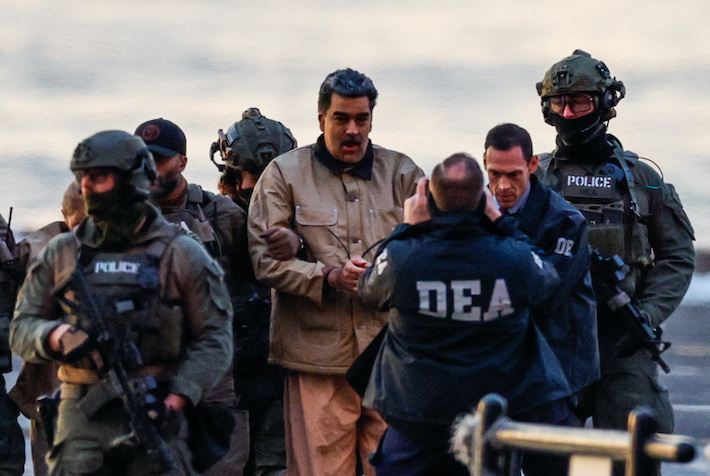
Analysts believe the U.S. attack on Venezuela will encourage China to strengthen its territorial claims over Taiwan and parts of the South China Sea.
But they do not believe it would accelerate a potential invasion of Taiwan. They say President Xi Jinping’s considerations for Taiwan and his timetable differ from the situation in Latin America and may be influenced more by domestic developments in China than by U.S. actions.
However, analysts say the president Donald Trump’s bold attack The capture of Venezuelan leader Nicolás Maduro on Saturday presents China with an unexpected opportunity that Beijing may use in the short term to amplify its criticism of Washington and solidify its own position on the international stage.
Also read: India ‘could face higher tariffs’ if Russia continues oil purchases
Further, Beijing could use Trump’s actions to defend its stance against the United States on territorial issues such as Taiwan, Tibet and islands in the East and South China Seas.
“Naked act of hegemony”
“The consistent, long-standing argument in Washington has always been that China’s actions violate international law, but they are now undermining international law,” said William Young, an analyst at the Brussels-based NGO International Crisis Group.
“This does create a lot of opportunities and cheap ammunition for China to counterattack the United States in the future.”
China claims democratic governance over Taiwan – a claim Taiwan’s government denies – and claims sovereignty over nearly all of the South China Sea, a position that puts it at odds with several Southeast Asian countries that also claim parts of the vital trade route.
China’s Foreign Ministry, Taiwan Affairs Office and Taiwan’s presidential office did not immediately respond to requests for comment.
Beijing condemned Trump’s attack on Venezuela, saying it violated international law and threatened peace and security in Latin America. It called on the United States to release Maduro and his wife, who are being held in New York awaiting trial.
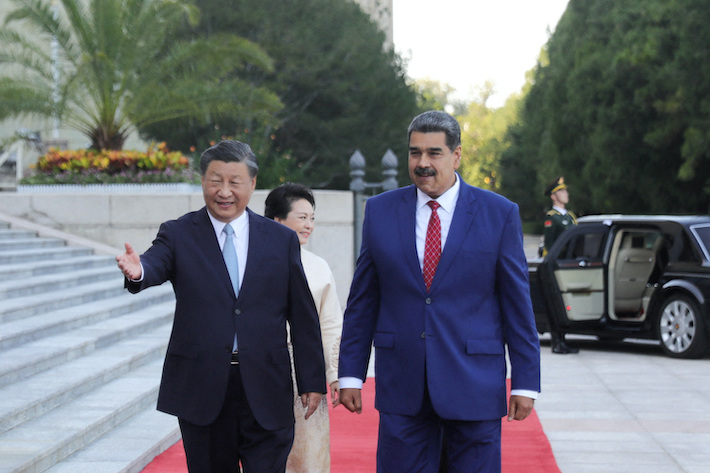
Hours before his arrest, Maduro met with a high-level Chinese delegation in Caracas, according to photos he posted on his Instagram page.
China’s Foreign Ministry did not immediately respond to a request for comment on the whereabouts of the delegation, which includes Qiu Xiaoqi, China’s special representative for Latin America and the Caribbean.
On Sunday, China’s official Xinhua News Agency called the U.S. attack a “naked act of hegemony.”
“The U.S. invasion has made it increasingly clear to everyone that the so-called ‘rules-based international order’ the U.S. talks about is actually just a ‘predatory order based on U.S. interests,'” state-run Xinhua News Agency said.
US move ‘may help justify Taiwan takeover’
Taiwan, in particular, faces increasing pressure from Beijing. China surrounded the island last week in its most extensive military drills yet, demonstrating Beijing’s ability to cut off the island from outside support in a conflict.
But analysts say they don’t expect China to take advantage of the situation in Venezuela and escalate it into an attack anytime soon.
“Taking over Taiwan depends on China’s developing but still insufficient capabilities, rather than what Trump is doing on the distant continent,” said Shi Yinhong, a professor of international relations at Renmin University in Beijing.
Neil Thomas, a China politics researcher at Asia Society, said China views Taiwan as an internal matter and is therefore unlikely to use U.S. actions against Venezuela as a precedent for any cross-strait military strikes.
“Beijing wants to contrast itself with Washington to promote its claims for peace, development and moral leadership,” Thomas said. “Xi Jinping doesn’t care about Venezuela any more than he cares about China. He would want Venezuela to turn into a quagmire for the United States.”
Wang Dingyu, a senior member of Taiwan’s ruling party and a member of the Legislative Yuan’s Foreign Affairs and Defense Committee, rejected the idea that China might follow the United States in attacking Taiwan.
China has never lacked hostility towards Taiwan, but it does lack feasible means. “Wang Yi posted on Facebook, “China is not the United States, and Taiwan is not Venezuela. “If China could really do it, it would have done it long ago!”
Some observers say the situation still magnifies Taiwan’s risks and could force Taipei to seek more support from the Trump administration.
On China’s Weibo social media platform, discussion of the U.S. attacks was trending on Sunday, with some users saying Beijing should learn from Trump’s approach.
Lev Nachman, a political science professor at National Taiwan University, said he expected the Taiwanese government to show relaxed support for U.S. action against Venezuela. Taiwan has not yet issued any statement.
“I do think Trump’s actions can help Xi Jinping’s narrative in the future create more justification for actions against Taiwan,” he said.
China to count billions of dollars in loans to Venezuela
In related news, China’s top financial regulator asked its policy banks and other major lenders to report their lending exposure to Venezuela in the wake of the U.S. capture of Maduro, Reuters reported Monday, citing a Bloomberg report.
The State Financial Supervisory Authority also recommended that banks strengthen risk monitoring of all Venezuela-related credits to assess potential risks to Chinese banks, the report added. The NFRA did not immediately respond to Reuters’ request for comment.
China has reportedly provided lines of credit to Venezuela under loan-for-oil agreements for years. The NFRA’s move thus highlights the regulator’s growing concerns about the possible hit to the banking sector as geopolitical risks intensify.
China has extended billions of dollars in loans to the South American country over the past decade, largely led by policy banks such as China Development Bank, the report added.
China’s Foreign Ministry on Monday reiterated Beijing’s stance on the situation following the U.S. attacks and called for Maduro’s immediate release.
Meanwhile, Reuters reported that Maduro’s ouster would quickly redirect Venezuela’s oil exports to the United States rather than China Columnist Ron BussoHe said the move would provide an immediate boost to U.S. refineries, but President Trump’s plans to restore production in Latin American countries may be slower to materialize.
Maduro to face New York court
Maduro is due to face drug charges in a New York court on Monday as the United Nations debates the legality of a special U.S. operation to capture him. While Trump has denounced Maduro as a dictator and drug lord who allegedly flooded the United States with cocaine, he has also made no secret of his desire to share in Venezuela’s oil wealth.
It has the world’s largest reserves – about 303 billion barrels, most of which are heavy oil from the Orinoco region. But the industry has long been in decline due to mismanagement, underinvestment and U.S. sanctions, with output averaging 1.1 million barrels per day last year, just a third of its heyday in the 1970s.
Venezuela’s acting president, Delcy Rodriguez, first denounced Maduro’s arrest as a colonial oil grab and “kidnapping” but changed his tune on Sunday, saying a respectful relationship with Washington was a priority.
“We invite the U.S. government to jointly develop an agenda for cooperation,” Rodriguez said. “President Donald Trump, our people and our region deserve peace and dialogue, not war.”
- Reuters Additional editing by Jim Pollard
See also:
Sustained AI demand pushes Asian stocks to five-year high
Meta acquires an artificial intelligence startup founded in China, regarded as the “next DeepSeek”
COSCO’s demands ‘could block BlackRock’s $23 billion takeover of Hutchison Ports’
China’s big technological secret: Dutch chip-making machine replicated in laboratory
Solar power surge, data centers fuel China’s battery boom
Japan will test mining “rare earth mud” from the deep seabed
Japan reaffirms nuclear weapons-free commitment after raising weapons idea
Mexico approves steep tariff hikes on Chinese and other Asian imports