The Tamesis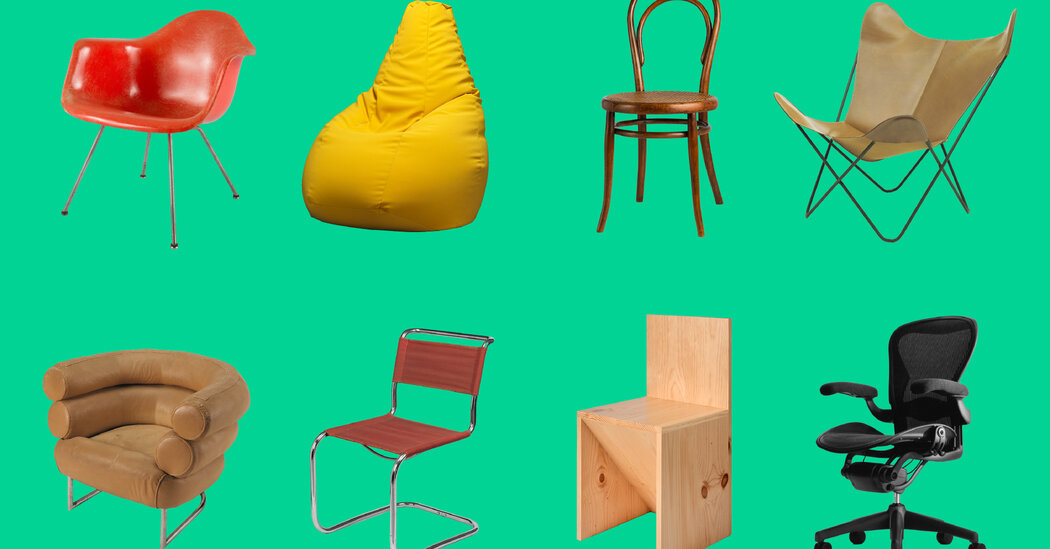
Architecture and Design
[–>
1. No. 14 (1859) by Michael Thonet
“Thonet’s company was the first to mass-produce chairs on a tremendous scale,” says Tanja Hwang, 39, a design curator at the Museum of Modern Art in New York. “About 50 million were sold between 1859 and 1930.” A master joiner from Germany, Thonet made the lightweight No. 14 by bending wood with steam and used catalogs and model numbers for easy ordering. His business’s approach, in which the chairs were shipped disassembled, was in some ways, Hwang says, “a predecessor to Ikea.”
2. No. 35 Folding Chair (early 1900s) from Gold Medal Camp Furniture Co.
While most people associate it with Hollywood directors, the foldable chair with X-shaped legs originated in ancient Egypt, where it was used to elevate figures of authority during public gatherings and military campaigns. “This form is something that’s repeated over and over throughout different cultures,” says Alexandra Cunningham Cameron, 45, the New York-based curator of contemporary design at Cooper Hewitt, Smithsonian Design Museum. “A chair, like a throne, can be a symbol of distinction and privilege.”
3. Bibendum (1926) by Eileen Gray
The Irish architect Eileen Gray “was one of the few women with an established design career” in her era, says Cunningham Cameron. “This chair was created at the same time as some of the more prominent Bauhaus tubular steel furniture, but it incorporated sensual, padded and curvaceous forms that were a rebuke to the austerity of the Bauhaus.”
4. B33 (1927-28) by Marcel Breuer
“The cantilevered chair is the most representative design object of the 1920s,” Hwang says. Made from tubular steel, “it embodies the avant-garde’s design principles of transparency and lightness.” The continuous silhouette of the B33 (which was preceded by a similar chair by the Dutch architect Mart Stam, who held the copyright) was in line with a broader philosophy espoused by Breuer and his peers that involved “getting rid of unnecessary clutter,” she says, and the idea that furniture should be mobile.
5. B.K.F. Chair (1938) by Antonio Bonet, Jorge Ferrari Hardoy and Juan Kurchan
Also known as the Butterfly Chair, Safari Chair, Sling Chair or Wing Chair, the B.K.F. is characterized by its “simple structure, continuous wrought-iron rod frame and suspended leather,” says the Spanish architect and designer Patricia Urquiola, 65. Developed in Buenos Aires with a hammock-like shape that allows the sitter to relax, it “translates European Modernism into Latin American openness.” Frequently copied in materials including cotton, canvas and artificial leather, the chair became especially popular on the West Coast of the United States during the 1950s.
6. Molded Fiberglass Armchair (1950) by Charles and Ray Eames
“The Eameses were at the forefront of making design accessible,” Hwang says. “They wanted a chair with a one-piece, ergonomic seat.” To achieve their vision, the Eames Office and the chair’s manufacturer, Herman Miller, worked with Zenith Plastics, which manufactured fiberglass for airplanes during World War II, to adapt the material for domestic use. “The shell comes with different bases for a dining chair, lounge chair, armchair, side chair or low version,” Hwang says. “Personalizing Modern design was superimportant at that time.”
7. 699 Superleggera (1957) by Gio Ponti
“This is one of the lightest chairs in the world,” Urquiola says. Ponti is even said to have thrown a prototype of the finished object, which weighs 3.7 pounds, out the window to test its durability. Hwang notes that while Modernist designers including Ponti focused on new materials and production technologies, the Superleggera, produced by Cassina, also “exemplifies the close relationship between design and craftsmanship in 1950s Italy”: Its refined shape references an early 19th-century Italian chair called the Chiavari.
8. Sacco (1968) by Piero Gatti, Cesare Paolini and Franco Teodoro
This sack chair from Zanotta — also known as the original beanbag chair — “is an example of Radical Italian design that started emerging in the late 1960s,” Hwang says. Influenced by the high-low aesthetic of Pop Art and inspired in part by peasant mattresses stuffed with chestnut leaves, it’s filled with polystyrene balls that mold to the shape of the sitter’s body. “It challenged all sorts of established furniture conventions, which was at the heart of the anti-design movement in Italy.”
9. Back Slant Chair 84-7 (1983) by Donald Judd
The American sculptor’s strikingly efficient chair is part of a long history of artist-designed seating. “He started making furniture in the 1970s for his family using standard board sizes,” says Cunningham Cameron. She considers the chair both a functional object and an important part of Judd’s overarching artistic project, which sought to streamline craftsmanship and form.
10. Aeron Chair (1994) by Don Chadwick and Bill Stumpf
“This was launched by Herman Miller when the World Wide Web was taking off, and the designers were thinking about sedentary office work,” Cunningham Cameron says about this benchmark in ergonomic seating. In lieu of upholstery and padding, the Aeron features “mesh, which at the time was a very innovative, breathable and flexible material. When it came out, people didn’t like the way it looked. Now it’s one of the most recognizable office chairs.”
These interviews have been edited and condensed.
More in Architecture and Design
[-1–>[0–>See the rest of the issue