The Tamesis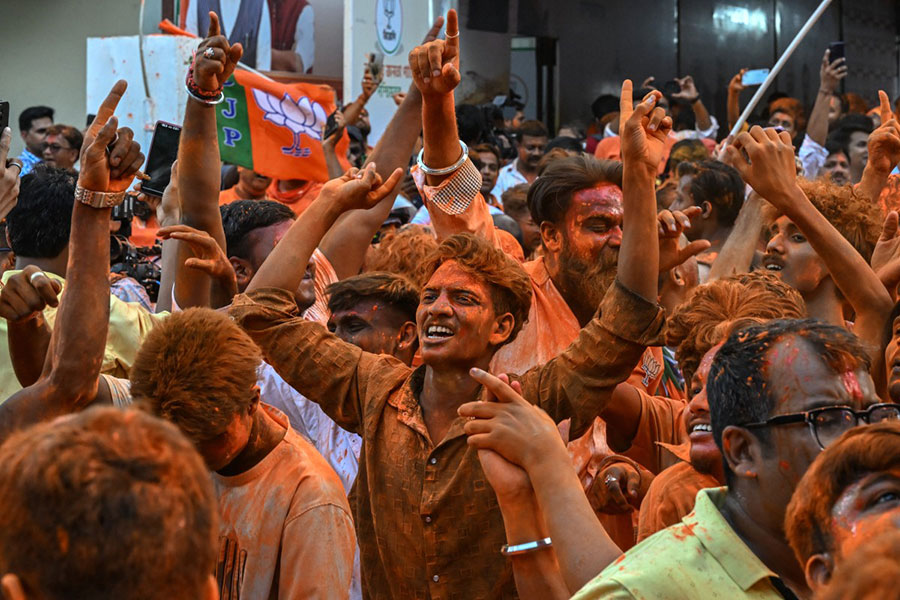
May 5, 2026
New Delhi/Kochi – Results of parliamentary elections in several Indian states on May 4 are still being tallied, reflecting strong sentiment for political change and marking a major shift in regional politics.
Prime Minister Narendra Modi’s Bharatiya Janata Party (BJP) has opened the door to power in West Bengal, an eastern state that the BJP has never ruled. A movie star-turned-politician will take charge of Tamil Nadu, one of India’s economic powerhouses in southern India.
Veteran political commentator Neerja Chowdhury attributed the result to strong anti-incumbency sentiment, especially among young voters and women concerned about their futures.
“It’s an expression of a group that is upwardly mobile and hungry for change,” she told The Straits Times. “They put aside other considerations like identity politics… people are more worried and uneasy about jobs.”
The fall from power of India’s two prominent opposition parties – the All-India Trinamool Congress (TMC) in West Bengal and the Dravida Munnetra Kazhagam (DMK) in Tamil Nadu – portends an uncertain future for the country’s political opposition.
“With regional parties weakened, this is a real crisis moment for the opposition,” Ms Chaudhry noted.
Although the Election Commission of India concluded the counting of votes from electronic voting machines on Monday, the overall trend is clear from the results in West Bengal, Tamil Nadu, Assam, Kerala and Puducherry, which voted on different dates in April.
In West Bengal, at the time of writing, the BJP is set to register a stunning victory with 206 seats in the 294-seat state assembly, ending the 15-year rule of the TMC led by Mamata Banerjee. This is much higher than the 77 seats it won in the 2021 election.
Another unprecedented poll result has emerged in the southern Indian state of Tamil Nadu: a new political party formed by film superstar and debutant politician Joseph Vijay Chandrasekhar, popularly known as Tarapathi Vijay, has taken the state by storm.
His Tamilaga Vettri Kazhagam (TVK) party made a stunning debut, winning 105 of the 234 parliamentary seats just two years after its formation. It displaced power from the 76-year-old party DMK, wresting votes from all traditional party bastions across the state.
Until May 4, West Bengal was one of the last key opposition strongholds against the popular Modi and his party. The state will now be one of 22 states and union territories governed by the BJP alone or in alliance with other parties. India has 28 states and 3 Union Territories with legislative assemblies.
The TMC, which has campaigned around protecting Bengali identity and culture, has described the BJP as an “anti-Bengali” party that is out of touch with the history, culture and ethos of Bengal. The BJP has responded by giving local Bengali-speaking leaders a more prominent role in the campaign stage than in 2021, shedding the “outsider” label.
Bharatiya Janata Party candidates in West Bengal – the vast majority of whom are non-vegetarians – have even carried fish and tasted non-vegetarian food during campaign events to refute allegations that the party may ban meat and fish consumption in the state, something it has done on some occasions in other parts of the country.
On the evening of May 4, Modi addressed supporters at the Bharatiya Janata Party headquarters in New Delhi, quoting Bengali polymath and Nobel laureate Rabindranath Tagore as saying that the BJP would “create a fear-free environment in Bengal.”
He added in a post on
The West Bengal poll results were released after a controversial electoral list revision that saw more than 9 million voters removed. While most people have died or migrated, the process has also had a disproportionate impact on many marginalized people, especially Muslims, who are considered traditional TMC supporters.
In addition to the promise of central government-backed development and welfare schemes, the BJP’s clear mandate in West Bengal is due to its strong consolidation of votes among Hindus, who make up around 70% of the state’s population. On the other hand, the Muslim vote ended up being divided among multiple non-BJP parties.
In Tamil Nadu, 51-year-old superstar Vijay is popular but politically undervalued. He shook up nearly 60 years of two-party rule in Tamil Nadu. As people danced on the streets of Tamil Nadu and whistled like they did when watching a Vijay movie in cinemas, it was clear that he had revived Tamil Nadu’s love affair with its office-film icon.
During the campaign, analysts say fans of the actor turned party cadres and used social media to express concerns about jobs, nepotism and corruption. Despite overall economic growth and declining unemployment, Tamil Nadu’s highly educated and skilled young men and women face dismal job losses, which appears to be fueling a thirst for new political power.
The most obvious repercussions of the TVK campaign were the shock defeat of current Chief Minister MK Stalin by a TVK candidate who had served both Dravidian parties in the past.
“Vijay’s party, which was only 25 months old and not organized at all, defied all established norms. Voters did not give him an absolute majority, but they overwhelmingly supported him in what was essentially a three-cornered contest,” Kannan Rajarathinam, a political observer and biographer of several Tamil Nadu politicians, told ST.
“The most difficult part now is to translate the imagination of voters into reality. Like the other two alliances, Vijay has also made lofty promises. He currently enjoys immense goodwill and people’s confidence. How he delivers on it will determine the success or failure of this goodwill,” he added.
In another southern state, Kerala, the country’s last remaining communist government lost to the Congress-led United Democratic Front (UDF), bringing some relief to the Congress party, which had performed poorly in other states such as West Bengal and Assam, where it was defeated by the BJP. The UDF will win over 100 of the 140 seats in the Kerala Assembly.
Kerala, which prefers to elect its current government every five years, has been re-elected by Chief Minister Pinarayi Vijayan’s Left Democratic Front (LDF) after its globally praised Covid-19 management saved many lives and revived community spirit among the state’s residents.
But this time, the LDF has come under anti-incumbency attacks stemming from accusations of corruption, political overreach, mounting public debt and overconfidence, which observers say were evident even in the campaign slogan: “If not the LDF, then who?” The normally quarrelsome Congress-led alliance has instead launched a united campaign around jobs and development and against the “arrogance” of Vijayan, whom they deride as “Modi in a dhoti”.
Apart from its victory in West Bengal, the BJP also increased its seat share in Assam, winning over 80 of the 126 seats in the state assembly, thereby securing its third consecutive term in the northeastern state.
In Puducherry, a federal territory in southern India, the All India Congress, part of the Bharatiya Janata Party-led National Democratic Alliance, also remains in power and is expected to win 11 of the 33 seats in parliament. The BJP cornered four more.
In Tamil Nadu and Kerala, the two southern states that remain an impenetrable bastion for Prime Minister Narendra Modi, the BJP hopes to win only a handful of seats but has failed to improve its vote share. It leads by two seats in Tamil Nadu and by three seats in Kerala.
The latest poll is one of a series of state elections scheduled ahead of the 2029 general election. Several other states will also go to polls in 2027, including India’s most populous state of Uttar Pradesh, currently run by the Bharatiya Janata Party.
The Indian National Development Inclusion Alliance (INDIA), a multi-party grouping of anti-BJP parties including the Congress and DMK, has suffered multiple setbacks in recent months. One of them is the defeat of the Rashtriya Janata Dal, one of its main voters, in the November 2025 Bihar elections.
Seven MPs from the other main opposition Aam Aadmi Party also defected to the BJP in April 2026.
“Will the Indian bloc now come closer together and accept the leadership of the Congress Party – something they have resisted – because this is a serious crisis for each of them as they prepare for 2029?” Ms Chaudhry added. “Or will Congress act alone?”