The Tamesis
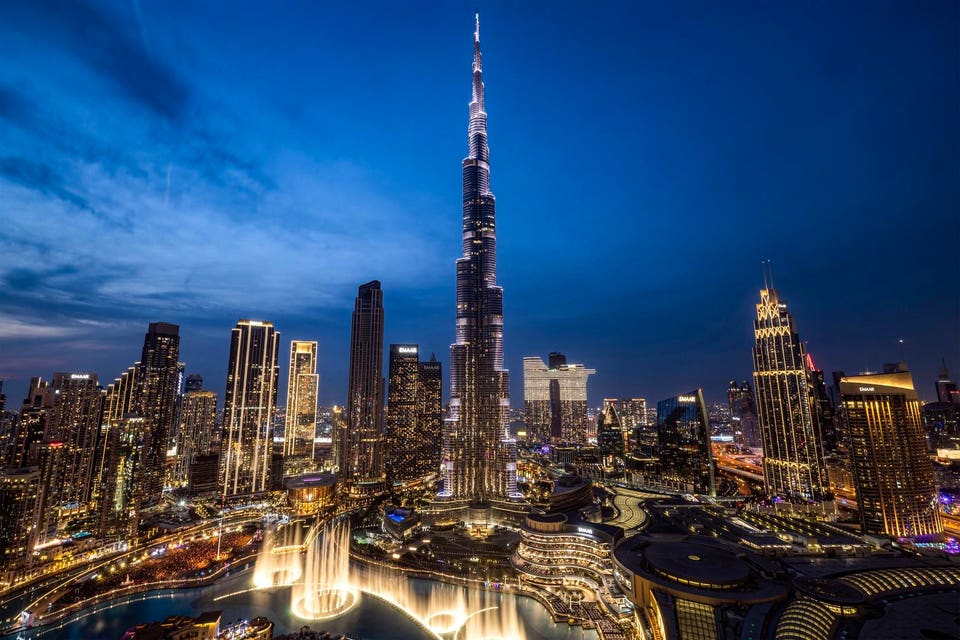
Dubai’s skyline includes the Burj Khalifa.
FADEL SENNA/AFP via Getty Images
As the United Arab Emirates learned during the US-Iran conflict, countries simply cannot hope to escape geography. The two-month war has left the UAE and its neighboring Gulf states both bystanders and targets, facing waves of Iranian drone and missile attacks. Yet if geography dictates immovable terrain, the UAE has shown in recent weeks that it is ready to expand its borders, at least in economic terms, in a dramatic turn toward Asia.
Along the way, the UAE has withdrawn from the Organization of the Petroleum Exporting Countries (OPEC), of which it has been a key member since its inception, and even appears ready to recalibrate relations with its neighbors, especially Saudi Arabia, and downplay the traditional regional roles of the Gulf Cooperation Council (GCC) and the Arab League.
The UAE’s Asia pivot is supported by a series of free trade agreements (India, South Korea, Vietnam, Indonesia) and a surge in two-way non-oil trade between the UAE and China, which is expected to reach $200 billion by 2030. The Asia-Pacific region as a whole relies heavily on fossil fuel imports, and the UAE hopes to supply oil from its eastern flank to the fast-growing region by expanding pipeline capacity. UAE sovereign wealth funds are also increasing their investments in Asia, with $330 billion investment fund Mubadala announcing late last year plans to double its Asia investments to 25% over the next decade. Banks in the UAE are looking for opportunities in the region, as evidenced by Dubai-based ENBD’s $3 billion acquisition of an Indian bank last year, which was hailed as the largest-ever foreign direct investment in the country’s banking sector.
The conflict comes as the UAE, India and Europe were discussing the proposed India-Middle East-Europe Economic Corridor (IMEC), which, if implemented, would provide a seamless network of rail, port and road infrastructure connecting India to Europe. Although China has been shut out of the UAE’s ambitious AI vision, Chinese banks and companies have significantly strengthened their influence in recent years as the UAE tilts firmly toward the United States.
As I argue in my new book, Emerging Markets—The Better Half of the Global Economy, this is part of a broader trend in which capital is flowing from east to east and from south to south for the first time. The UAE’s sovereign wealth fund, with total cash reserves of more than $2 trillion, is setting its sights on Asia. The UAE also wants to be part of Asia’s regional free trade agreement connective tissue and last year applied to join the Comprehensive and Progressive Agreement for Trans-Pacific Partnership (CPTPP).
There’s a cold economic logic behind UAE companies’ pivot to Asia. Like the conflict in Iraq decades ago, the conflict with Iran places the UAE in a dangerous neighbor and raises the worrying specter of a permanently unstable Iran on its doorstep. The UAE’s main goal is to seek strategic depth (in terms of geography) and strategic autonomy (in terms of how it interacts with the world) in a hostile neighborhood. This is the thing about Asia, its vast land and sea hinterland is a huge market and a source of fossil fuel demand, security partnerships (one example is the ongoing discussions with India), technology and talent. There is a strong domestic push to accelerate oil and gas production (with the influence of OPEC production quotas and Saudi Arabia) and create a more balanced non-oil economy, driven by financial services, renewable energy, tourism, and advanced technologies such as artificial intelligence and autonomous driving.
Anwar Gargash, senior diplomatic adviser to the UAE president, noted last week that the UAE’s journey has not been an easy one. “Our resilience and strategic autonomy will ensure we successfully respond to current regional challenges while continuing to drive stability and progress.” Sultan Al Jaber, the head of oil company Abu Dhabi National Oil Company (ADNOC) (along with an alphabet soup of other leadership roles within the UAE agency) reiterated that the country’s decision to withdraw from OPEC was a “thought-out strategic decision” to achieve “our ambitions for a more diversified economy.”
The pivot to Asia, coupled with doubling of strategic and technological ties with the United States and Israel, reaffirms the UAE’s role as a global hub. The twin financial centers of Dubai (DIFC) and Abu Dhabi (ADGM) have seen a sharp increase in global and regional financial participation, driven by more intense offerings in traditional financial services and wealth management as well as digital assets. With Singapore restricting the number of expatriates, the UAE has also emerged as a major beneficiary as some international banks shift some operations elsewhere. For example, a leading Asian bank moved its India-focused private banking team from Singapore to Dubai a few years ago.
What is certain is that the missiles and drones that have rained down since March will inevitably damage the UAE’s carefully crafted reputation as a safe haven. Rebuilding investor and tourism confidence will take time. However, unlike their American or European counterparts, Asian businesses and even tourists appear less uneasy about the prospect of continued instability. Chinese-made electric cars continue to sell well, and the UAE is home to millions of Asian expatriates and workers who will be even more reluctant to leave. This will provide a stable baseline once normalcy returns. When this happens, the UAE will look east to the Arabian Sea and the continent beyond as a source and accelerator of growth.