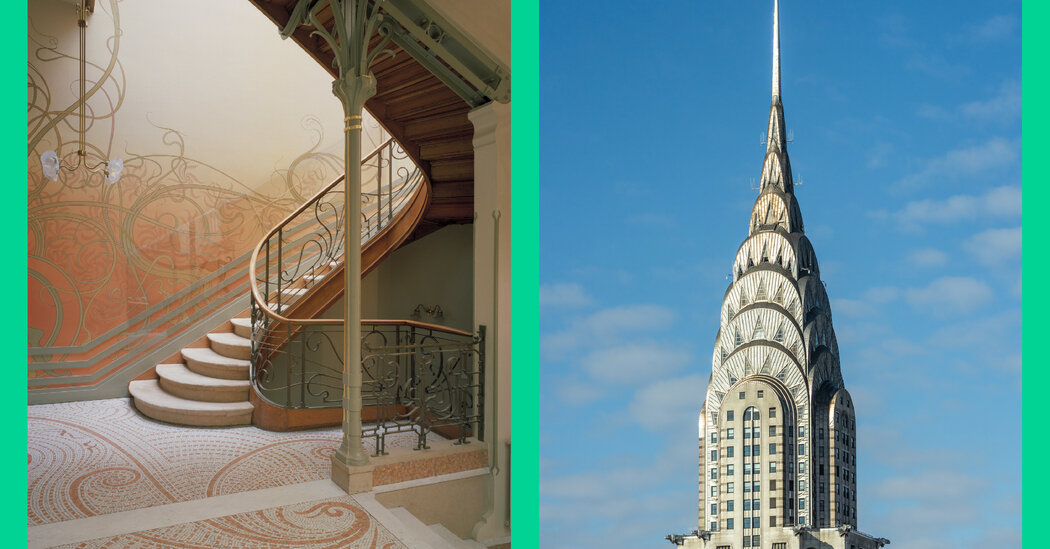
“A popular style from the 1890s until World War I, Art Nouveau drew on nature: organic motifs, plants, reeds, insects and flowers,” says Horsfall Turner, 46. “It’s a very abundant, asymmetrical approach, with sinuous, flowing lines and subdued colors.”
Art Deco
René Lalique’s Bacchantes vase (designed in 1927, made circa 1970).
Early 20th-century rosewood chairs by Marcel Guillard.
AKG-Images/De Agostini/A. C. Cooper
An Eric Bagge textile (1928).
AKG Images
“If Art Nouveau was about abundance, Art Deco was more geometric and economical. Culminating at the 1925 Exposition Internationale des Arts Décoratifs et Industriels Modernes in Paris, it has the excitement of industrialization — chrome, electric lights — mixed with the historical knowledge of Classicism.”
Baroque vs. Rococo
Baroque
A Franz Anton Bustelli figure (circa 1760) for Nymphenburg Porcelain Manufactory.
Piemags/PL Photography Limited/Superstock
Caravaggio’s “Saint John the Baptist” (1602).
Sant’Ivo alla Sapienza (1660) in Rome, designed and built by Francesco Borromini.
Pablo Meilan Campagnale/Getty Images
A Venetian secretary (circa 1730-35) of unknown origin.
Album/Metropolitan Museum of Art, NY/Album Archivo/Superstock
“Kicking off in Italy in the 17th century and then spreading through Europe, it’s characterized by movement, drama and dynamism — for example, manipulating materials to make stone look like liquid. Having learned and understood Classical rules, the Baroque artist says, ‘Let’s go and break them.’”
Rococo
A Derby porcelain centerpiece (circa 1760-65).
Bridgeman Images
A Sèvres porcelain vase (1771).
A German armchair (circa 1750-60) of unknown origin.
Metbot/Alamy
François Boucher’s “The Odalisque” (circa 1743).
Bridgeman Images
A Sèvres porcelain charger (19th century).
Piemags/PL Photography Limited/Superstock
“If Baroque is rough play, Rococo is pretty, light play. It comes from early 18th-century France, and its name is a riff on rocaille, or broken shells. There are lots of shells, seaweeds, ferns — it’s fun, decorative and a bit sexy.”
The Houses of Parliament (1840-70) in London, designed by Charles Barry and A. W. N. Pugin.
Edmund Sumner/View Pictures/View/Superstock
“Coined during Queen Victoria’s reign in England from 1837 to 1901, the name encompasses lots of different styles, from the Gothic Revival to the Arts and Crafts movement. It’s highly ornamental, with rich colors, and full of possibility.”
Lancaster House (1905-10) in Manchester, England, designed by Harry S. Fairhurst.
“During the reign of Edward VII, from 1901 to 1910, there was an emergence from the grip of the Victorian period into something lighter, less upholstered and a little less stuffy.”
Neo-Classical vs. Beaux-Arts
Neo-Classical
A late 18th-century decorative silver vase designed by Robert Adam.
Jacques-Louis David’s “Napoleon Crossing the Alps” (circa 1801).
Tokyo Fuji Art Museum/Bridgeman Images
A vestibule at Syon House (1761-69) in London, also by Adam.
Deagostini/Getty Images
The British Museum (1852) in London, designed by Robert Smirke.
Jon Bower/Loop Images/Superstock
Jean-Julien Deltil’s “Battle of the Greeks” panoramic wallpaper (1828).
“Refers to the 18th- and 19th-century revival of interest in the ancient world of Greece and Rome. Neo-Classical is all about harmony, symmetry and restraint.”
Beaux-Arts
William-Adolphe Bouguereau’s “Dante and Virgil” (1850).
Opéra Garnier (1862-75) in Paris, designed by Charles Garnier.
Jules-Félix Coutan’s Glory of Commerce clock (installed in 1914 at New York’s Grand Central Station).
Don Freeman/Trunk Archive
“Of French 19th-century origin, Beaux-Arts is a neo-Classical style injected with a dash of Baroque. It’s got more swagger and ostentation and is suitable for institutional and public buildings.”
“A Dutch style of abstraction popular from 1917 to 1931. The aim of de Stijl was to create a geometric, philosophical ideal with a limited color palette. It’s a bit more removed from daily life than Bauhaus.”
Bauhaus
Josef Albers’s “Upward” (circa 1926).
Photo: Albers Foundation/Art Resource, N.Y.
A Gunta Stölzl rug design (1927).
The Stapleton Collection/Bridgeman Images
A Le Corbusier, Pierre Jeanneret and Charlotte Perriand chaise longue (circa 1929).
“A close cousin of de Stijl, Bauhaus is named after the German art school that opened in 1919 and promoted a new way of designing, with a focus on functionality. It was keen on embracing modern materials like glass, steel and concrete, as well as applied arts like tapestry.”
 The Tamesis