The Tamesis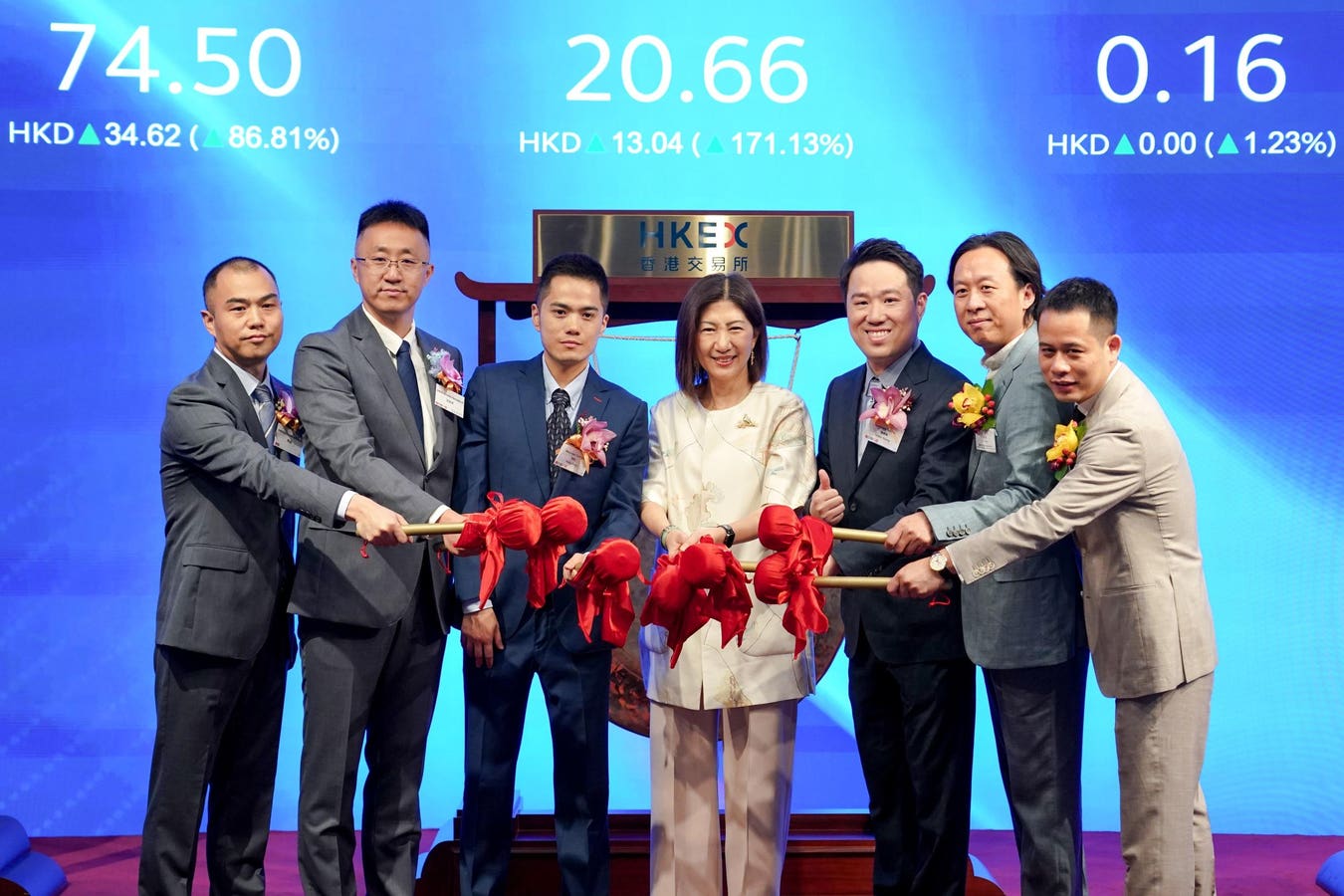
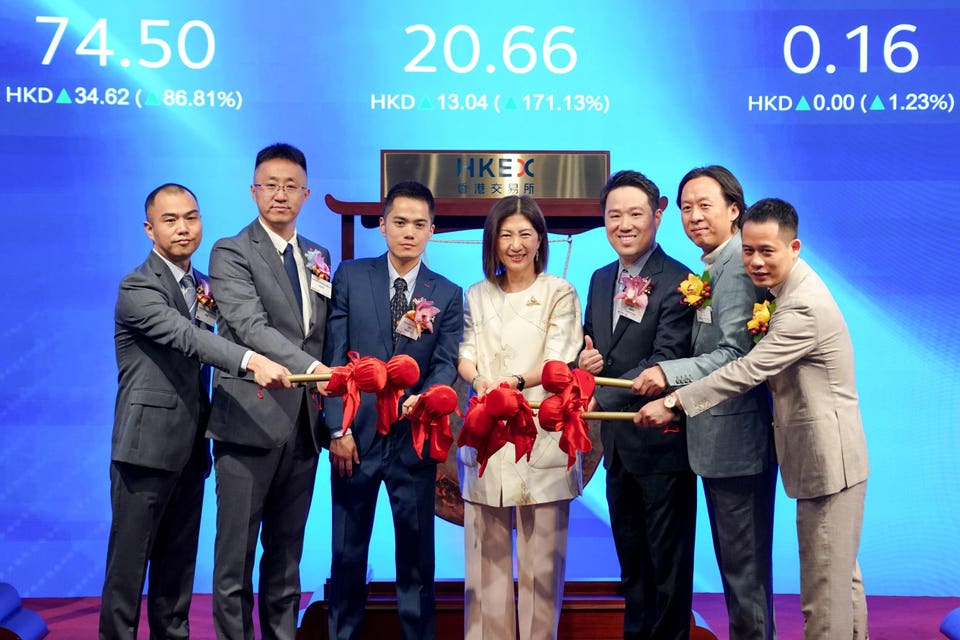
Hong Kong, China – April 17, 2026, Bonnie Chan, CEO of Hong Kong Stock Exchange, Victor Huang, Chen Hang and Zhuhao of Manycore. Zhongxin is one of the “Six Little Dragons” in Hangzhou, and its share price soared on its first day of listing on the Hong Kong Stock Exchange.
China News Service photo source: Getty Images
Manycore’s IPO performance last week marked a breakthrough for Hangzhou’s “six little dragons.” This signals that the public market window may finally open for this elite group of startups.
The “Six Little Dragons” is an informal label for six deep tech startups, including DeepSeek, Unitree Robotics, DEEP Robotics, BrainCo, Game Science and Manycore Tech. All founded in Hangzhou, with artificial intelligence as the common point, they conduct business across cutting-edge technology fields. During my trip to China last month, I had the opportunity to meet directly with some of these teams, and their progress is truly impressive.
Manycore’s Hong Kong IPO is more than just a company story; For Hangzhou itself, this is a critical moment. The city, formerly known as the headquarters of Alibaba Group and NetEase, is now putting its broader tech ecosystem to the test.
Investors are watching to see whether public markets are embracing the broader Hangzhou story. Manycore’s strong debut doesn’t automatically clear the way for the other five cities, but it does provide investors with a public-sector reference point and renewed confidence that the city is more than just Alibaba’s hometown.
Many cores are just the beginning
Manycore Technology is the oldest and earliest listed company among the Six Little Dragons in Hangzhou.
Manycore was co-founded in 2011 by Victor Huang, who previously worked at Nvidia and later returned to China to build a 3D spatial design platform. The company later turned to spatial intelligence, developing artificial intelligence that can understand, generate and reason about 3D physical environments.
Last week, Manycore’s share price closed 144% higher than the issue price on its first day of trading, raising funds of HK$1.22 billion (US$160 million) and valuing the company at US$4.5 billion.
This successful debut is a strong signal of investor appetite for companies with credible, AI-driven growth stories. While Manycore may not be perfectly representative of the rest of the industry due to its unique business model, its performance is still an important indicator of the market.
Could Unitree be next?
Unitree may be one of the most important IPOs not only in Hangzhou but also in the whole of China.
Founded by Wang Xingxing in 2016, Unitree designs, manufactures and sells quadruped and humanoid robots for the enterprise and consumer markets. Unitree shipped 5,500 humanoid robots in 2025, accounting for 32.4% of the global market. Tesla, by contrast, has yet to sell any Optimus Prime humanoid robots.
The company has filed for an initial public offering in Shanghai, aiming to raise 4.2 billion yuan, making it one of China’s largest and most anticipated listings in recent years, Reuters reported. The document is important not only because Unitree is one of the best-known startups in China, but is also becoming one of the most important companies in the humanoid robotics industry.
Unitree will be the first real investment opportunity for public investors to determine whether humanoid robotics technology is worth the sustained attention of the public capital markets beyond viral videos and pageantry.
Unfortunately, their decision to list in Shanghai rather than Hong Kong will result in more limited access for international investors compared to a Hong Kong IPO. The move thus creates a less direct route for global capital to participate in China’s most anticipated initial public offering.
BrainCo is also coming to Hong Kong
Founded in 2015 by Bi Cheng Han, BrainCo develops non-invasive brain-computer interface technology to compete with Elon Musk’s Neuralink through non-surgical methods. Han started the company while studying at Harvard University. According to Bloomberg, BrainCo secretly applied for an IPO in Hong Kong in January 2025.
The company also serves as a reminder that Hangzhou’s ecosystem can attract not only local talent but also global founders.
What happened to DeepSeek?
DeepSeek is an exception in the lineup, as there is currently no sign of an imminent IPO. The company was founded by Liang Wenfeng in 2023, stemming from the computing infrastructure he developed at High-Flyer Quant after studying at Zhejiang University.
DeepSeek is known for developing foundational large-scale language models comparable to OpenAI, Google, and Anthropic. The company recently made global headlines and rocked Wall Street with the blockbuster release of its high-performance artificial intelligence model on a relatively small budget of $6 million.
The Information recently reported that the company is raising funds at a valuation of $10 billion, indicating that the company is still focusing on private financing rather than plans for a public listing.
How about deep robotics and game science?
EEP Robotics DEEP Robotics was founded in 2017 by Zhu Qiuguo, an associate professor at Zhejiang University, and is committed to building artificial intelligence-driven quadruped robots for industrial applications such as infrastructure inspection, search and rescue, energy and security. according to South China Morning PostCurrently, the company has entered the early stages of the IPO regulatory process, but has not yet determined a listing date.
game science The company was founded in 2014 by Feng Ji, Yang Qi and five other former Tencent employees. Game Science is the video game studio behind Black Myth: Wukongwidely regarded as China’s first true AAA blockbuster game. Adapted from a Chinese classical novel journey to the westThe action RPG broke records and proved that Chinese studios could compete at the highest production levels with industry leaders like Sony, Microsoft, and Capcom.
The game’s commercial performance was outstanding, selling over 20 million copies on Steam alone and generating over $1 billion in gross revenue. Within just a few weeks of launch, Game Science ranked 12th among all Steam publishers worldwide.
Despite significant growth and market impact, there are currently no signs of an IPO.
Is Hangzhou the next Silicon Valley?
The bigger story emerging is that the city is no longer defined solely by its reputation as a beautiful lakeside e-commerce hub built around Alibaba, Ant Financial or NetEase. Instead, Hangzhou has developed into a meaningful deep tech ecosystem powered by the “Six Little Dragons” and supported by leading universities such as Zhejiang University.
This evolution is increasingly attracting top talent from China and around the world, greatly strengthening Hangzhou’s position as one of the world’s most important emerging technology hubs, rivaling Silicon Valley.