The Tamesis
Oil prices rose more than 5% on Monday after Iran suspended peace talks with mediators negotiating on behalf of the United States due to Israel’s invasion of Lebanon.
The latest move comes after the United States and Iran carried out strikes over the weekend. The US military stated that in response to the downing of an American MQ-1 drone, it “carried out self-defense strikes against Iranian radar and drone command and control sites located on Goruk and Qeshm Islands in Iran.”
Tehran insisted on Monday that any deal to end the war must cover Israel’s escalating offensive in Lebanon. The Tasnim news agency cited the breakdown of the ceasefire and clashes in Lebanon as reasons for the suspension of talks.
See also: Robots may have naked ambitions, but humanoids need clothes too
After the United States and Israel launched strikes against Iran in late February, Iran effectively closed the Strait of Hormuz, through which a fifth of the world’s oil and liquefied natural gas normally flows.
Although a ceasefire has largely held since mid-April, traffic through the strait has been light and negotiations have dragged on.
While Wall Street had been expected to open higher, a surge in oil prices reversed course, sending all three major stock indexes lower as trading began in New York.
South Korean stocks, Nvidia rise
However, Nvidia shares rose more than 4% after the company launched a powerful laptop chip for Windows machines in Taiwan early Monday, dominating the market for next-generation consumer PCs with integrated artificial intelligence.
The company’s graphics processing units have been praised for processing intensive artificial intelligence applications, but the new RTX Spark chip will be the central processing unit that runs PCs.
These computers will be positioned as tools that can easily run artificial intelligence agents to perform tasks for users.
Nvidia’s announcement drove gains in technology and artificial intelligence stocks in Asian trading.
Seoul led the gains, rising more than 4%, with memory chip giant Samsung Electronics soaring more than 9% and rival SK Hynix rising more than 2%.
“Investors continue to embrace the artificial intelligence boom,” said independent market analyst Stephen Innes.
“The reason is simple. Artificial intelligence remains the dominant engine of market psychology and investors appear willing to trust diplomacy as long as Washington and Tehran continue to exchange draft proposals instead of missiles,” he added.
Investor enthusiasm for artificial intelligence-related stocks has pushed stocks to record highs in recent weeks, even as soaring energy prices caused by war in the Middle East stoked inflation and threatened economic expansion.
The dollar strengthened against its major rivals.
Iran vows to let Japanese ships pass through Strait of Hormuz
In related news, the Kremlin on Monday slammed French and other navies for seizing an oil tanker in the Atlantic, calling it “illegal” and comparing the move to “piracy” after Paris said the tanker violated sanctions.
Kremlin spokesman Dmitry Peskov said: “We consider these acts to be illegal and they are close to acts of international piracy.” He added that “Russia is taking measures to ensure the security of its cargo.”
Meanwhile, Iranian President Masoud Pezeshkian promised Japan on Monday to allow its ships to pass through the Strait of Hormuz, which has been largely closed since the Middle East war began in February.
“We will try our best to provide smooth and convenient passage for Japanese ships,” Pezeshkian told Japanese Prime Minister Sanae Takaichi in a phone conversation, according to the presidential palace.
The European Union has urged Israel to halt military operations in Lebanon after it seized the strategic Beaufort Castle and said it would resume attacks in southern Beirut.
“We call on Israel to cease its military escalation in Lebanon and respect Lebanon’s sovereignty and territorial integrity,” EU spokesman Anouar Anouny said.
OECD: China’s state subsidies have unfair advantage
In other Asia news, an OECD report released on Monday said Chinese companies in 15 key industrial sectors received significantly more state support than their international rivals between 2005 and 2024.
These 15 industries will generate $108 billion in revenue in 2024 alone, according to data compiled by the Organization for Economic Co-operation and Development in its Manufacturing Groups and Industrial Companies (MAGIC) database.
The report added that between 2005 and 2024, “a conservative estimate is that Chinese companies will receive an average of three to eight times more government support than companies in OECD countries.”
“These subsidies are also much higher than the support received by companies in non-OECD economies such as Brazil, India and Indonesia.”
The 38-member Paris-based group said its “conservative” estimates were based on disclosures by the largest companies in 15 industries that underpin various sectors of the global economy.
It considers direct subsidies, tax breaks, and concessional loans from banks and public financial institutions (sometimes below their base lending rates) as public support.
“For Chinese companies, nearly 60% of their global market share growth can be attributed to the subsidies they receive,” the OECD said.
The report added that for more than 20 years, Chinese companies have held huge market shares in industries such as solar panels, shipbuilding and steel, not because they are better than their American or European competitors, but because they have unparalleled state support.
With subsidies, they have more financial leeway to invest in new production sites, more time to achieve profitability and greater support to deal with economic headwinds, the report said. This has led to overcapacity in some industries, depressing global prices and harming the interests of other international players.
“Like doping in sport, the risk is that subsidies help less productive athletes win unfairly at the expense of better, more innovative and more efficient athletes,” OECD Secretary-General Matthias Koeman told a news conference.
“Subsidies increased market share, but this did not lead to significant improvements in productivity or profitability,” Koeman added.
“Companies win market share not by being more efficient or more innovative, but by receiving more subsidies.”
The OECD looked at aerospace and defence, aluminum, car manufacturing, cement, chemicals, fertilizers, glass and ceramics, heavy machinery, semiconductors, shipbuilding, photovoltaic panels, steel, telecommunications equipment, rolling stock and wind turbines.
Key data around 1330 GMT
North Sea Brent crude oil: rose 4.9% to $95.60 a barrel.
West Texas Intermediate crude oil: rose 5.9% to $92.55 a barrel.
Hong Kong’s Hang Seng Index: rose 1.1% to 25,452.47.
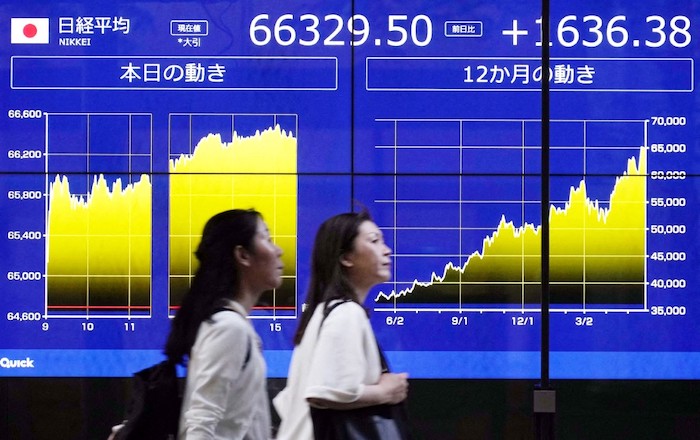
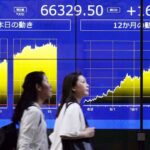
TOKYO – Nikkei 225: up 1.0% to 67,020.75.
Shanghai – Composite Index: rose 0.4% to 4,084.46.
USD/JPY: rose from 159.27 yen to 159.69 yen.
NEW YORK – Dow Jones Industrial Average: down 0.4% to 50,852.35.
NEW YORK – S&P 500: down 0.2% to 7,567.39.
NEW YORK – Nasdaq Composite: down 0.1% to 26,938.29.
LONDON – FTSE 100: down 0.7% to 10,334.31.
PARIS – CAC 40: down 0.6% to 8,132.16.
FRANKFURT – DAX: down 0.4% to 25,014.00.
- AFP Additional input and editing by Jim Pollard
See also:
Humanoid ‘Super Bowl’: Chinese company promotes robots at New Year’s show
Pacific nations climate fund tied to fossil fuels
Samsung employees approve huge bonuses; oil prices fall, stocks mixed
Stocks fall after U.S. strikes Iran ‘landmines’, oil near $100
Huawei says its new advanced chip technology can circumvent U.S. restrictions
Samsung shares rise on UnionPay deal, but legal test looms
AMD will invest more than US$10 billion in Taiwan to improve AI chip packaging
China’s robot orders surge after New Year’s Kung Fu dance goes viral
Chinese scientists’ ‘robotic fish’ could clean up polluted oceans