The Tamesis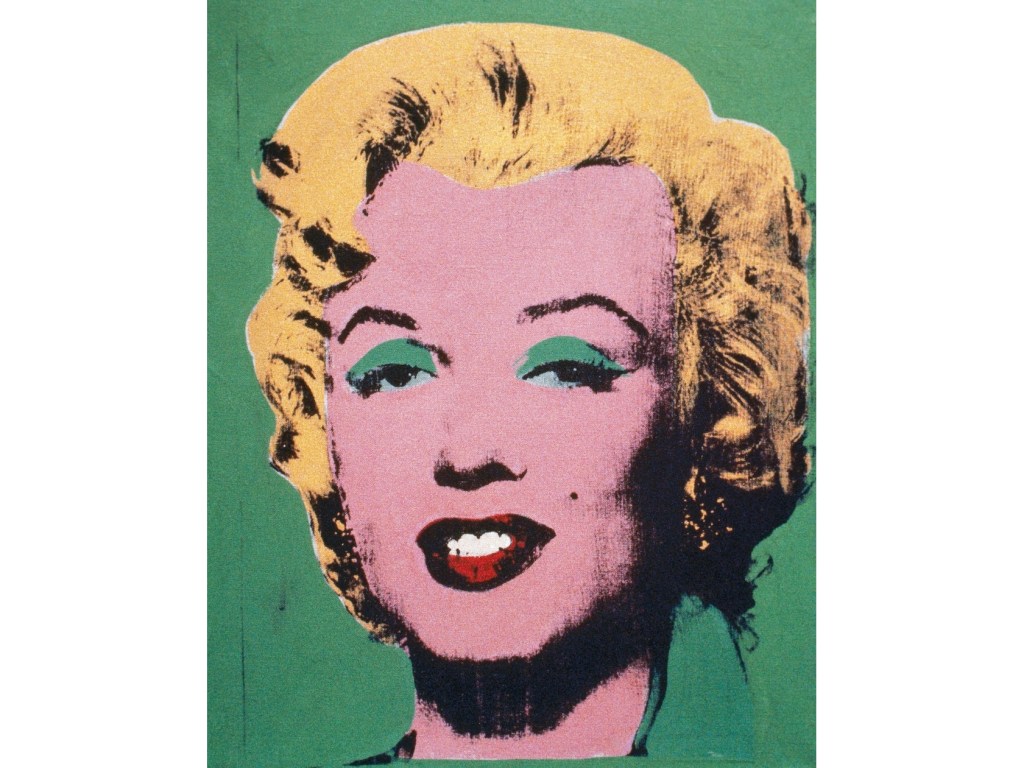
Marilyn Monroe dies; pills nearby Read the front page headline from August 6, 1962, New York Times. Star’s body found in bedroom of her Coast homethe subtitle continues. As an artist who drew his creativity from newspapers to supermarket aisles, Pop artist Andy Warhol was bound to have seen reports of the Hollywood star’s untimely death at the age of 36. The result is one of the emerging artist’s most iconic series.
Beginning in August 1962, as Monroe’s death became the focus of the media, over the next two years Warhol created more than 50 paintings of her using Gene Kornman’s portrait taken for 20th Century Fox as a promotion for her 1953 film, Niagara. One of Warhol’s earliest paintings of Monroe was his modern Madonna. Kim Marilyn (1962), which gleams like a Byzantine icon. Another version is her lipsticked mouth, Marilyn Monroe lips (1962). Another important work of that year, Marilyn Diptych (1962), incorporates two repeats of Monroe—25 in color and 25 in black and white—the latter in which her image slowly fades out, almost as a visual metaphor for her eventual celebrity ennui.
Related articles

Monroe’s death was a pivotal moment for Warhol, who at the time was still a relatively unknown painter. In fact, the day Monroe died happened to be the closing day of Warhol’s first solo exhibition, a repeat of his Campbell’s Soup Can series at the Ferus Gallery in Los Angeles. In the months before the actress’ death, the Pop artist had been playing with image repetition, painting soup cans, Coca-Cola bottles and coffee cans on canvas. “Many artists depict the same subject over and over from different angles, but repeatedly depicting the same subject looking the same destroys the personal value of the artwork,” Victor Bockris wrote in his 1989 biography of the artist.
In addition to experimenting with the possibilities of repetition, Warhol had just begun experimenting with the screen printing process. “The rubber stamp method I had been using to repeat images suddenly seemed too homemade; I wanted something stronger, offering more of an assembly line effect,” Warhol wrote in his book (written in collaboration with Pat Hackett) Popism: Warhol’s 1960s (1980). “You’ll get the same image, but it’s slightly different every time. It’s all so simple—quick and serendipitous. I’m really excited about it.”
Warhol’s studio assistant at the time, Nathan Gluck, suggested that the artist use screen printing as a faster method to produce the rows and rows of dollar bills he was trying to paint. The technique soon spread to paintings of Hollywood stars such as Natalie Wood, Troy Donahue, and Warren Beatty, but these paintings did not elicit the same reaction as celebrities with some form of tragedy or drama, such as Marilyn Monroe, Jacqueline Kennedy, and Elizabeth Taylor. (When Warhol painted Taylor’s portrait in the fall of 1962, she was photographing Cleopatra and halted production multiple times due to life-threatening health issues. ) With the “Marilyn Monroe” series, Warhol took a big step forward in portraiture.
For Marilyn’s paintings, Warhol applied paint to the canvas before silkscreening – the background color as well as the outline of her head and shoulders, eye shadow, lips and face. Slight misalignment of colors and screen-printed images, as well as occasional paint smudges on the screen, contribute to differences between images. In 1967, when Warhol established his print publishing company Factory Additions, “Marilyn Monroe” was his first portfolio of screen prints; the images each required five screens – one to reproduce the photographic image and four more for the color areas.
“At its core, Warhol’s series Marilyn Monroe is a recognition of a culture in which adoration leads to a kind of consumption. We devour and discard the icons we love,” curator Douglas Fogel wrote in the catalog for the 2017 Jumex Museum exhibition “Andy Warhol: Dark Star.” “Yet one can also see a kind of resistance to these greedy dark forces in the errors, cancellations, dislocations, and compulsive repetitions of Warhol’s screenprint surfaces. Paradoxically, there is a humanization of Monroe in these works, as if the transferred record of screenprint alignment leaves a gap in a tightly guarded public image in this textbook case of being swallowed up by fame.”
In the fall of 1962, a few months after the Ferus exhibition, Eleanor Ward gave Warhol his first solo exhibition at New York’s Mews Gallery. In addition to his large Campbell’s soup cans, a painting made of 100 Coke bottles, some paint-by-number canvases and a red Elvis, there is also a series of 20-by-16-inch Marilyn Monroes named after Lifesaver candy flavors, priced at $250 each (all sold). Kim MarilynAlso part of the exhibition, it was purchased by architect Philip Johnson for $800 and later donated to the Museum of Modern Art.
The four 40 x 40 inch paintings of Marilyn are noticeably different from the other works in the series, but not because of Warhol’s choices. In 1964, performance artist Dorothy Podber visited Warhol’s Factory and saw five of them leaning against the wall. She asked Warhol if he could “photograph” them, and he agreed, believing she meant to photograph them. Podber then took a pistol from his wallet and shot four of the Marilyns between the eyes (only Turquoise Marilyn Only survived). Now known as “Shooting Marilyn,” they have been restored, but they can still be identified by the rough spots where the canvas was punctured. The colorful stories add to the legendary color and value of these works. this Photographing Red Marilyn It was sold for $4 million in 1989, the highest price ever paid for a Warhol work at the time. when Shooting Sage Blue Marilyn (1964) sold in May 2022 for more than $195 million, setting what remains an auction record for a 20th-century artwork.