The Tamesis
There was an uneasy calm on the Thai-Cambodian border after officials from both sides agreed to “solidify” a 72-hour ceasefire and take steps to enhance mutual trust.
The two countries ended nearly three weeks of violent border clashes on Saturday, with their second ceasefire in recent months following the worst fighting between the Southeast Asian nations in decades.
Thailand’s defense ministry spokesman Rear Admiral Surasant Kongsiri told Reuters at noon (0500 GMT), about two hours after it came into effect, that the ceasefire was continuing. “So far, there have been no reports of shootings,” he said.
See also: Seoul accuses former Samsung employee of leaking DRAM technology to China
The Cambodian Defense Ministry did not report any clashes, which it said were Thai airstrikes before a ceasefire was announced on Saturday.
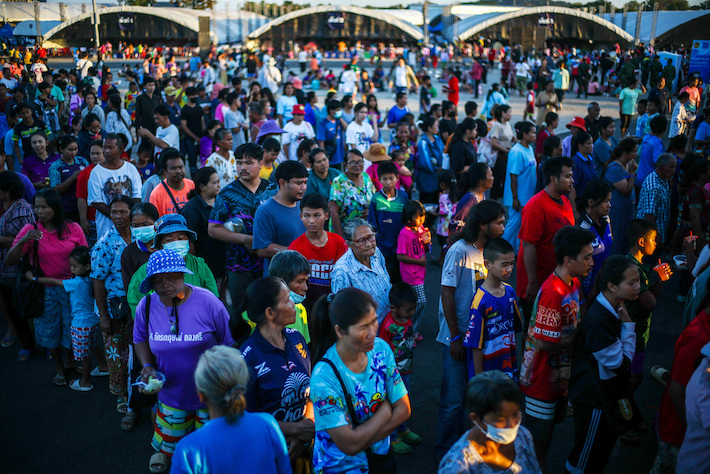
The agreement, signed by Thai Defense Minister Natthaphon Narkphanit and Cambodian Defense Minister Tea Seiha, ended 20 days of fighting that killed at least 101 people on both sides and displaced more than 500,000 people, and included fighter jets, rocket exchanges and artillery attacks.
Thailand’s armed forces are far superior to Cambodia’s, and Thailand has announced the deaths of 21 soldiers and landmine injuries, including at least 10 who lost limbs, but Phnom Penh has been less forthcoming. Twenty-one civilians were reported dead, but no details were provided on military casualties, which were rumored to be much higher during the initial clashes in July or this month.
but one Report The Diplomat reported last week that at least 13 Cambodian soldiers were killed and more than 420 soldiers and border police were treated at a hospital in one province alone, Preah Vihear, which may be the closest major facility to Thailand’s notorious cliff-top historical site, Khao Phra Viharn.
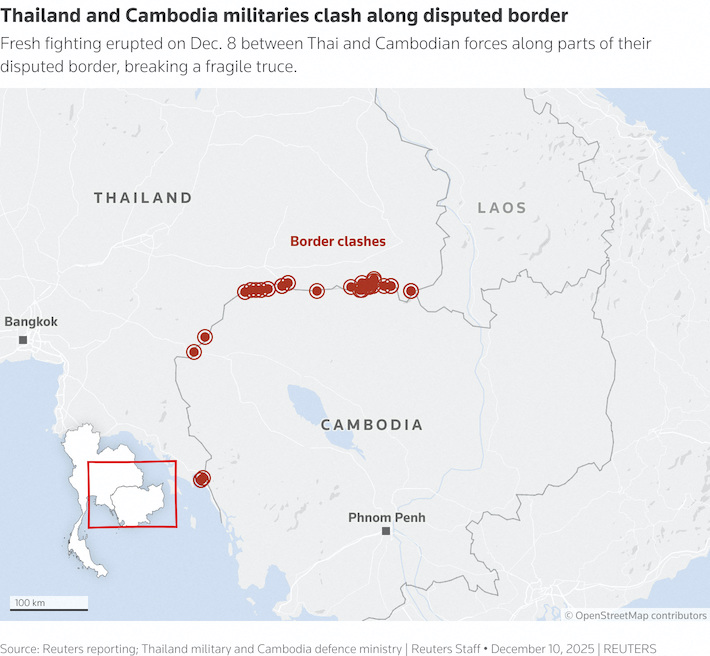
Similar casualty figures are expected in about five other disputed areas where fierce fighting has occurred along the 817-kilometer (508-mile) border. According to reports, these include two locations currently occupied by Thai troops.
Now, the ancient temple on the cliff overlooking Cambodia, listed as a UNESCO World Heritage Site in 2008, is also said to have been severely damaged.
Khao Phra Viharn (Preah Vihear) is a controversial landmark and one with a dark history, reportedly being the site of a notorious refugee boycott. new york times June 1979, and by a cambodia website earlier this month.
This raises the question of whether historical grudges have always been a factor in the minds of Cambodian leaders, as there has been uncertainty about their motives and actions in the border region – erect monument and laying landmines in disputed areas.
“Political diversion and disruption”
Analysts speculate that Phnom Penh wants to “internationalize” the border demarcation dispute rather than leaving it to bilateral negotiations and is also keen to divert attention from the drama. Scam hubs surge across Cambodia.
Thitinan Pongsudhirak, a professor at Chulalongkorn, said the new wave of violence stemmed from “domestic political pressure and rising nationalist sentiments on both sides”, describing it as the worst inter-state conflict in the 58-year history of ASEAN, the regional bloc.
The new Anutin Charnvirakul government is under pressure over its handling of the problem. Hat Yai floods He said the Cambodian regime “also benefits from fomenting nationalist fervor”.
He wrote in a column in the Bangkok Post that “inequality has widened dramatically in Cambodia” as the country’s illicit economy flows to politically connected elites, while Hundreds of thousands of Cambodian workers have to return home Coming from Thailand in July, many people are probably unemployed now.
As such, it has “a strong incentive to deflect public anger outward, painting Cambodia as a victim of bullying by a larger, better-equipped Thailand.”
Jacob Simsresearchers at Harvard University launched a Report at the beginning of this year Said in a recent interview, exposing the explosive growth of fraud hubs in Southeast Asia “Scam Fighter” Erin West These compounds are run by the most powerful people in Cambodia – senators and even members of the Hong family. some have have been sanctioned by U.S. officials.
Air raids on scams
Tensions persist and it is no surprise that the conflict flared up again this month after the collapse of a ceasefire that U.S. President Donald Trump and Malaysian Prime Minister Anwar Ibrahim helped broker in July to halt a previous round of fighting.
This time, the Thai military is determined to fight what it calls border incursions and fraud centers close to the border. A senior general made it clear that they Need to “disable” Cambodia’s military capabilities.
F-16 fighter jets are used to carry out air strikes against military targets, at least six of them building allegedly a scam Destroyed.
In the weeks leading up to this, Myanmar The military has also participated in the operation, demolishing dozens of buildings along Thailand’s northwest border, as military chief Min Aung Hlaing also wants to be seen as taking tough action against criminals targeting the United States, China and other countries.
Across the border with Cambodia, Thai officials said some scam compounds were being used as clandestine military centers housing drones. It bombed six building complexes at different locations, four of which Phnom Penh called “casinos.”
Thailand described the conflict as “a war against an army of fraudsters,” according to Thai media reports. New York Times reportU.N. personnel and activists fear that people who are trafficked and forced to work in some of the buildings could be injured in airstrikes if they are barred from leaving the buildings, the report said.
“Foreign workers are not allowed to leave,” one worker told the newspaper. Another reported that “dozens of people were beaten to death” in the months before the airstrikes.
But Sims, the US researcher, predicted that closing the handful of camps near the border was unlikely to significantly reduce Cambodia’s scam problem, as there are currently “hundreds” of such centers across the country.
Yunnan peace talks continue
For more than a century, Thailand and Cambodia have disputed sovereignty over multiple undemarcated locations along their long border. Sometimes these disputes erupt into skirmishes and fights.
On Sunday, Cambodia’s top diplomat Prak Sokhonn and Thailand’s top diplomat Sissi Kazakhstan flew to Yunnan for talks with Chinese Foreign Minister Wang Yi, as Beijing sought to encourage its southern neighbor to build trust and focus on peace and stability.
“Both sides agreed to maintain current troop deployments and take no further action,” the ministers said in a joint statement on the ceasefire.
“Any reinforcements will exacerbate tensions and have a negative impact on long-term efforts to resolve the situation,” a Cambodian statement posted on social media said.
Thai Defense Minister Nataporn said the new ceasefire agreement will be monitored by the ASEAN Observer Group and direct coordination between the two countries.
“At the same time, at the policy level, there will be direct communication between the defense ministers and the commanders-in-chief of the armed forces of both sides,” he told reporters.
Civilians return, boundary demarcation work will not be affected
ASEAN foreign ministers met in Kuala Lumpur on Monday, ahead of three days of talks between the warring sides at border checkpoints, where the two defense ministers met on Saturday.
They agreed to allow displaced people in affected border areas to return home, while stressing that neither side would use any force against civilians.
Under the deal, Thailand will also return 18 Cambodian soldiers detained since the July conflict if the ceasefire is fully maintained for 72 hours.
However, Saturday’s agreement will not affect any ongoing border demarcation between the two countries, leaving the task of resolving disputed border areas to existing bilateral mechanisms.
“War and conflict will not make two countries or two peoples happy,” Thai Air Force Gen. Prapas Sornjaidee told reporters. “I want to stress that there is no conflict between the Thai people and the Cambodian people.”
See also:
Conflict breaks out again on Thailand-Cambodia border over landmines
Thai police seize $300 million in assets “linked to fraud center boss”
U.S. spends huge sums of money to arrest Southeast Asian fraud leader
Countries seize US$700 million in Prince Group assets in pursuit of “fraudulent billionaire”
US, UK praised for fraud hub sanctioning and seizing $15 billion in Bitcoin
US targets multi-billion dollar fraud network in Myanmar and Cambodia
Thailand and Cambodia agree to ceasefire after five days of clashes
Thailand PM suspended; court to review case seeking dismissal of her
Cambodia’s fraud hub has tense relations with countries near and far
U.S. sanctions Cambodian Karen warlord’s money laundering ring
Online fraud hub spreading like global cancer from Asia: UN
Weak ASEAN countries “face the risk of evolving into fraud countries”