The Tamesis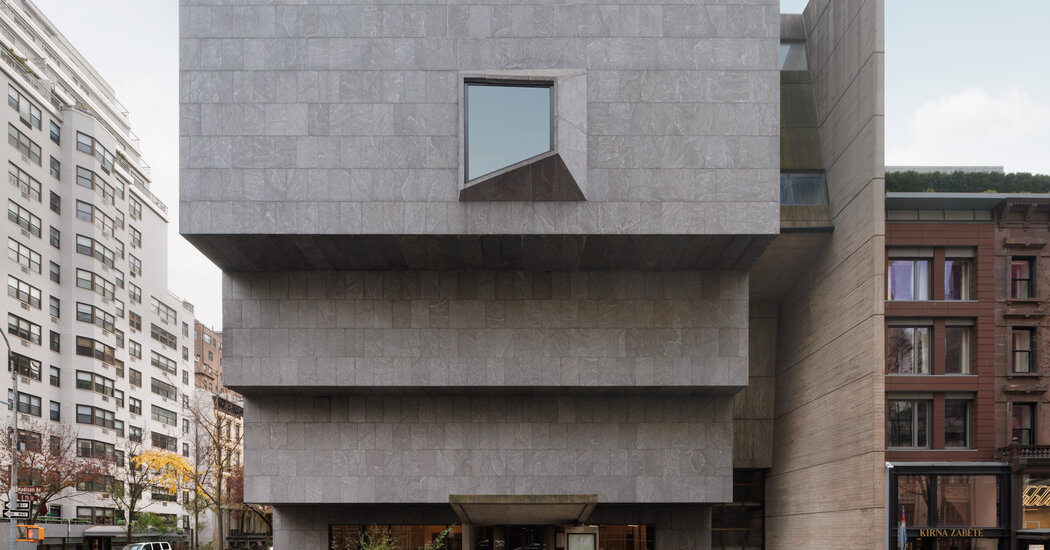
Architecture and Design
[–>
Brutalism
The term “Brutalism” has nothing to do with the word “brutal,” says the American architecture critic Alexandra Lange, 53. It takes its name from the French word for raw concrete (béton brut), the material with which the style is most associated. As the London-based architect Jayden Ali, 27, puts it, Modernism, which roughly spanned the 1910s to the ’70s, sought lightness; by contrast, Brutalism, which emerged in Britain in the 1950s and was taken up internationally in the ’60s and ’70s, is all about heavy, blocky forms. “It evokes a sensation that’s unsteady,” he says.
City Planning
The idea of the city as a rational machine — with strict zoning, high‑rise housing and green space — was shaped by Modernist architects such as Le Corbusier and Walter Gropius in the interwar period. It spread around the world as governments rebuilt cities after World War II and invested in public housing and social services.
“Five Points of a New Architecture”
The title of a 1929 manifesto by Le Corbusier, whom the Danish architect Bjarke Ingels, 51, calls “the grandfather of Modernism.” In it, Le Corbusier outlines five architectural principles of Modernist architecture: pilotis (slender columns that raise a building above the ground); a roof garden (“instead of wasting the roof’s surface, you double the building’s footprint,” Ingels says); a free plan and free facade (which allow interior and exterior walls to function independently of a building’s load-bearing system); and banded windows (long, horizontal windows that provide ample light and panoramic views).
Functionalism
A subset of Modernist architecture that emerged after World War I, Functionalism posited that buildings should be whittled down to their simplest expression and that every component should serve a clear purpose. Ali notes that the movement — which had the most impact in the Soviet Union — didn’t always follow its own rules. “You can’t discount the artist’s or the fabricator’s hand in its production,” he says. “It always has aestheticism attached to it.”
Integrated Pulls
Some of Modernism’s smallest details ended up changing the way homes and furniture are designed today. One clear example, says the New York-based designer Adam Charlap Hyman, 36, is “a pull that’s integrated into a door or cabinet.” This style — a groove that allows a door or drawer to be opened without any hardware — has its roots in the Bauhaus, Scandinavian design and traditional Japanese joinery. Now it can also be found at your nearest Ikea.
International Style
So named by the architectural historian Henry-Russell Hitchcock and the architect Philip Johnson for an exhibition at the Museum of Modern Art in 1932, the International Style is defined by thin rectilinear planes and a lack of color and adornment. Having emerged in Europe after World War I, it went global in the 1950s and ’60s. For every downtown neighborhood filled with office towers and glass facades, you have the International Style to thank.
Lubetkin, Berthold
The Russian-born architect moved in the 1930s to London, where he became a key figure in British Modern architecture. Less famous than Oscar Niemeyer, Ludwig Mies van der Rohe or some of his other peers, Lubetkin designed housing complexes like the Dorset Estate (with his partners Francis Skinner and Douglas Bailey) in the borough of Tower Hamlets, where Ali lived as a child. “Social housing is an important aspect of Modernism,” he says. “It becomes design for the general populace.”
Rationalism
An architectural and design movement that emerged in Italy in the 1920s and ’30s under the rule of Benito Mussolini’s Fascist regime, Rationalism (or Architettura Razionale) sought to find a middle ground between neo-Classicism and Futurism. In a series of articles in 1926, seven young Italian architects, known as the Gruppo 7, laid out their manifesto, proclaiming, “We do not intend to break with tradition.” Piero Portaluppi’s Villa Necchi Campiglio in Milan is considered a key example of Rationalist architecture.
Reinforced Concrete
Concrete — a combination of cement, water and aggregate — has been around since ancient times. But concrete reinforced with steel rebar, developed in the mid-19th century, paved the way for Modernism’s defining curved facades. It also liberated walls from having to hold up buildings. “It gives this three-dimensional stability and allows for sculptural form making,” Ali says.
Situationism
Every aesthetic movement needs a foil. For Modernism, it was Situationism. Promoted by avant-garde artists in Europe between the late 1950s and the early ’70s, Situationism rejected Modernism’s mass production and systematization in favor of “the unique and the incidental and the happenstance,” Ali says. The style’s most famous proponent, the French philosopher Guy Debord, defied conventional maps, going so far as to create (with the Danish artist Asger Jorn) a new map of Paris titled “The Naked City” (1957), a collection of disjointed neighborhoods with arrows indicating people’s drifting movements between them.
These interviews have been edited and condensed.
More in Architecture and Design
[-1–>[0–>See the rest of the issue