The Tamesis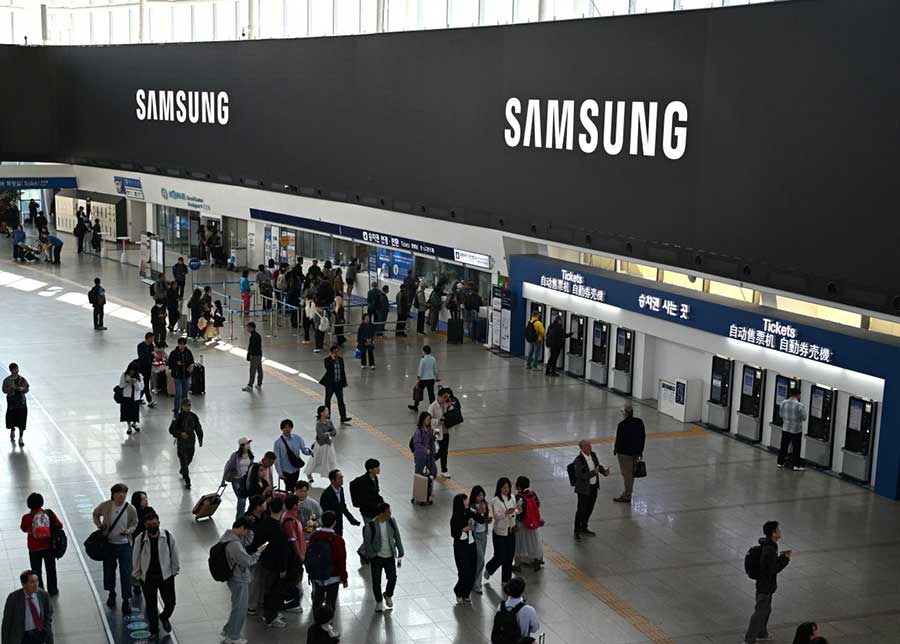
May 14, 2026
Seoul – Samsung Electronics is moving closer to a possible general strike as its largest union presses ahead with plans for an 18-day strike that could disrupt production at the heart of South Korea’s chip industry.
That risk became more pressing early Wednesday when the last talks brokered by the National Labor Relations Board failed to achieve a breakthrough. The union has set the timing and duration of the strike, leaving little room for a quick compromise unless either side makes significant concessions.
At issue is the union’s demand to institutionalize performance bonuses equal to 15% of operating profits and to remove the current cap on bonuses.
The dispute has attracted attention at home and abroad due to Samsung’s clout as the world’s largest maker of memory chips. The company is at the center of South Korea’s export engine and the global artificial intelligence chip supply chain. Any prolonged strike could have an impact on production, exports, investor sentiment and the company’s supplier network. JPMorgan also warned in a recent report that a prolonged strike could hit Samsung’s annual operating profit.
Semiconductor factories operate around the clock, and even limited disruptions can impact production schedules. Uncertainty over high-bandwidth memory and other AI-related chips could also affect delivery schedules and customer confidence.
Song Heon-jae, an economics professor at Seoul National University, said the shutdown of production lines could cause losses of “tens of billions of won or tens of millions of dollars per minute” and as much as 1 trillion won ($670 million) per day. Industry observers estimate direct losses from the general strike at 20 trillion won to 30 trillion won.
That puts emergency arbitration – one of the government’s most powerful industrial dispute tools – in the spotlight. Under South Korea’s labor law, the labor minister can invoke emergency arbitration when a strike is deemed likely to endanger public life or seriously damage the national economy. Once initiated, the union must cease the strike and prohibit it for up to 30 days while labor authorities conduct mediation or arbitration.
Cheong Wa Dae signaled late Wednesday that it would take a cautious approach, saying the government would continue to support dialogue between Samsung and its unions despite the collapse of talks after mediation.
“There is still time before the planned strike,” presidential spokesman Kang Youzhong told reporters in response to calls for the government to initiate emergency arbitration. “Although the post-mortem mediation process has ended, the government will support both labor and management to resolve the issue through dialogue.”
Kang did not directly answer whether the government would consider emergency arbitration, saying only that “there is still time for labor-management dialogue.”
Prime Minister Kim Min-seok also held an emergency meeting of relevant ministers regarding the Samsung labor dispute and ordered the government to closely manage the situation in view of its potential impact on the national economy. He directed officials to actively support both sides in continuing negotiations “so that the dispute does not under any circumstances lead to a strike”.
South Korea has used emergency arbitration only four times: in 1969 during the Korea Shipbuilding Corporation (now HJ Shipbuilding and Construction) strike; in 1993 during the Hyundai Motor strike; and in 2005 during the Asiana Airlines and Korean Air pilot union strikes.
For the government, the choice is politically and legally delicate. A strike at Samsung could pose national economic risks, but emergency arbitration is a special tool for limiting workers’ rights to collective action.
Separately, Deputy Prime Minister and Finance Minister Koo Yoon-cheol wrote on X that “a strike cannot occur under any circumstances,” while Labor Minister Kim Young-hoon said the government will do its best to arrange further negotiations before the dispute leads to a strike.
Legal and labor experts have sharply differing views on whether the government should invoke emergency arbitration.
Park Ji-soon, a professor at Korea University School of Law, said fixed bonuses tied to operating profits are “extremely unusual,” adding, “Samsung Electronics’s general strike will have a huge impact on the national economy. The government needs to consider invoking emergency arbitration as a last line of defense.”
Jung Heung-jun, a professor at Seoul National University of Science and Technology, disagrees, saying emergency arbitration should only be used in exceptional circumstances. “It is currently difficult to consider the Samsung union’s strike as illegal, so it is inappropriate to apply for emergency arbitration,” Zheng said.
Court rulings could also affect the space for unions to take action ahead of planned strikes. The Suwon District Court is reviewing Samsung’s request for an injunction against what the company calls illegal labor actions.
If the court accepts some of the requests, unions could face restrictions on how to conduct strikes or hold rallies at work sites. If the request is rejected, the union could gain further momentum before May 21.
The court could rule as early as Thursday and no later than May 20, the day before a planned strike.
Samsung union representative Choi Seung-ho said: “Even if the partial ban is accepted, the strike itself will not be a problem.” He also said that emergency arbitration “will only delay the strike slightly” and give the union “more time to prepare.”