The Tamesis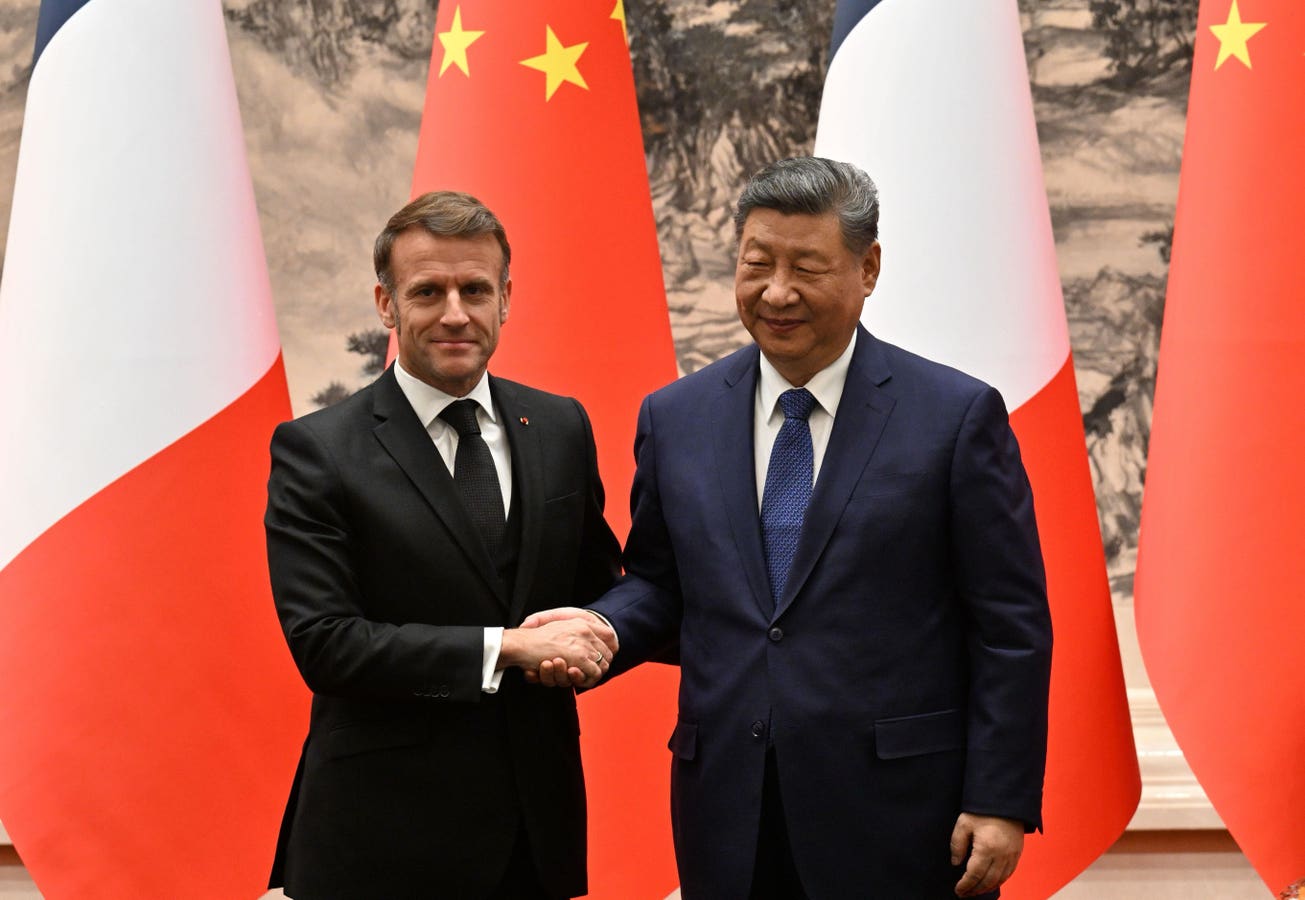
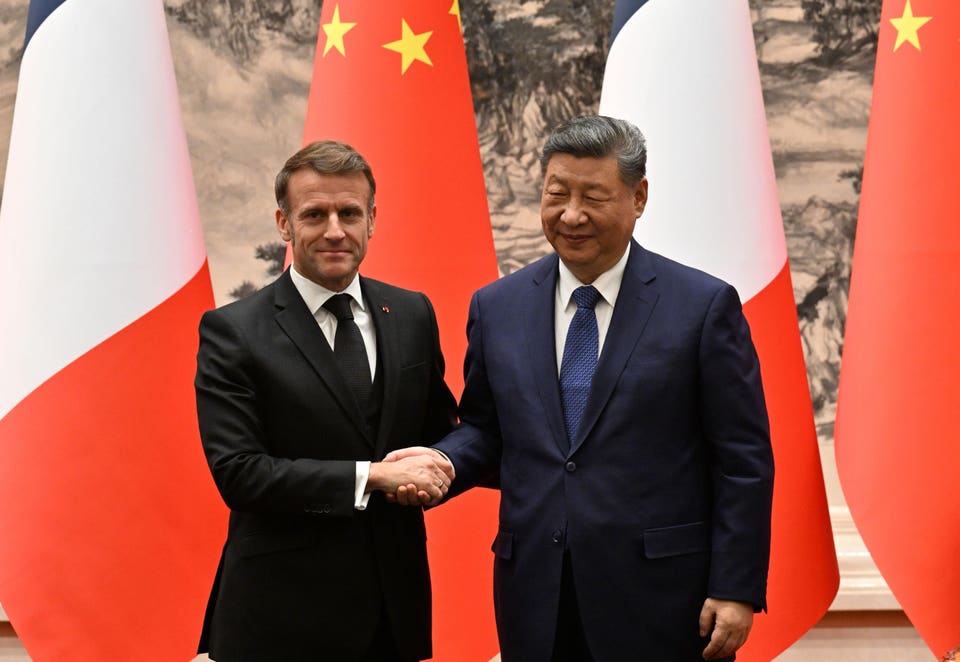
BEIJING, CHINA – DECEMBER 4: French President Macron and Chinese President Xi Jinping (right) shake hands after holding a joint press conference at the Great Hall of the People in Beijing, China, on December 3, 2025. Macron’s official visit to China comes amid continued tensions in trade relations between China and the EU. Has Macron made more progress in his relationship with Xi Jinping than Trump?
Getty Images
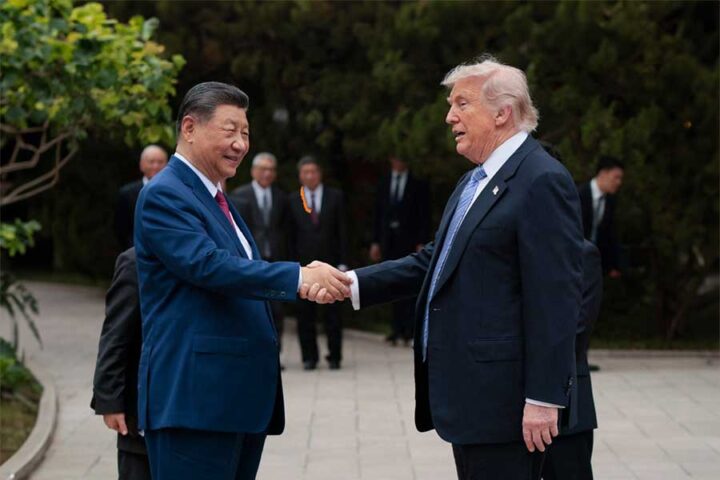
Trump’s much-anticipated trip to China is viewed by some as a potential “Nixon moment,” a dramatic geopolitical reset that could stabilize relations between the world’s two largest economies. Instead, the trip revealed the opposite. Washington entered the negotiations with overconfidence, believing that China needed detente more than the United States. Beijing understands that the United States may be in a classic case of imperial overreach: simultaneously dealing with diplomatic and trade tensions with Europe, complex conflicts between Russia and Ukraine, and, most importantly, war in the Persian Gulf region, leading to growing economic uncertainty related to energy market shortages. In this scenario, America’s peer rival China has little strategic incentive to make meaningful concessions or make life easy for Trump, and the United States has even less to offer.
The results are predictable. The low-hanging fruit has been picked, while the structural problems remain unresolved. China agreed that the tolls in the Strait of Hormuz were unacceptable, and at the same time promised to purchase 200 Boeing aircraft (a smaller number than expected), purchase U.S. energy (the supply plan is unclear), and made goodwill commitments. The visit brought about spectacle rather than any strategic shift. China has made no meaningful concessions on industrial policy, critical minerals, technology exports, or broader geoeconomic ambitions.
America’s Divided Alliance
Trump’s trip comes against the backdrop of an overall deterioration in relations between the United States and its allies. Washington’s increasingly confrontational posture toward Europe, including tariff threats, technology regulatory disputes and pressure related to energy exports during the Hormuz crisis, has had real economic and political consequences across the Atlantic. The consequences are important because U.S. power has historically depended not just on military might or economic clout but also on the cohesion of the Western alliance and European support for Washington’s foreign policy.
At the same time, disputes over Greenland, energy exports and the Strait of Hormuz have reinforced a growing perception in Europe that reliance on the U.S. system poses strategic risks. Britain and France refused to send their navies to join the US Navy in confronting Iran, or even to keep the global commons of the Strait of Hormuz and the Persian Gulf open. As in its Gaullist past, France was particularly outspoken on this point.
The real Nixon moment?
This tense atmosphere sets the stage for Macron’s trip to Beijing in December 2025, which will be more strategic than Trump’s own diplomacy with Xi Jinping. In the short term, Macron’s trip did not fulfill his highest ambitions. Macron did not help Washington or Kyiv: China did not change its position on Ukraine in any meaningful way. Despite Macron’s inducements, Beijing remains unwilling to pressure its de facto ally Russia to support European security priorities. France’s efforts to rebalance trade relations with China have produced few concrete results. A major Airbus deal at the heart of the deal has been cut as Beijing retains influence in parallel negotiations with Washington.
However, focusing solely on immediate results misses the broader significance of the visit.
The immediate importance of Macron’s trip is not obvious. Given current geopolitical conditions, the fact that policymakers in Paris and Brussels are willing to go to Zhongnanhai in the first place is important. This alone illustrates the extent of strategic separation uncertainty currently affecting European perceptions of the United States. Macron is the thought leader of “soft divorce”.
For years, talk of Europe’s “strategic autonomy” was dismissed in Washington as rhetorical gestures or long-term ambitions. This is no longer the case. Strategic autonomy increasingly affects foreign and economic policy.
France’s decision to withdraw US video conferencing platforms from parts of the public sector in favor of domestic alternatives reflects a broader technological decoupling that has begun across Europe. European regulators are aggressively targeting U.S. companies’ market dominance in cloud services, artificial intelligence, digital advertising, app stores and social media infrastructure. The broader goal is increasingly clear: reduce structural dependence on U.S. platforms before geopolitical tensions deepen. In every area of European targets, China is happy to step in as an alternative supplier or as a leverage point in European and American negotiations.
France is also willing to court China rather than the United States on key energy policies. One of the most overlooked aspects of Macron’s trip to Beijing is the expansion of cooperation around civilian nuclear energy and industrial investment. At a time when many economies are rethinking energy security, grid stability and industrial decarbonization while eschewing the nuclear option, France and China remain the world’s strongest supporters of nuclear power. Greater coordination between China and France on nuclear supply chains, financing and industrial cooperation reflects a broader search in Europe for alternatives that are neither entirely dependent on U.S. hydrocarbons nor entirely subservient to China’s manufacturing dominance.
Much of the intellectual framework behind this shift comes from former Italian Prime Minister Mario Draghi’s report on European competitiveness. Draghi’s warning is straightforward: If Europe remains technologically dependent on foreign powers while lacking the industrial scale of its own, it risks long-term decline. China can help.
Strategic shifts and global geopolitical competition
All of these conflicts, from technology to Iran to Beijing, reflect the same fundamental conflict: France under Macron is actively building an independent pole of global influence and refuses to see the world as a binary competition between China and the United States. Washington under Trump sees this not as a stand-alone initiative but as an obstacle and is increasingly willing to use tariffs, energy threats and diplomatic pressure to bring Paris back into line. If relations between the two countries are not repaired soon, the United States may begin to exert pressure on France to change its foreign and domestic policies.
France’s enduring influence in its African overseas territories and former colonies has been a core component of French foreign policy for decades. This core element of Gaullist doctrine enables France to both maintain a dynamic energy strategy and play an outsized role in international geopolitics. It also drew backlash and condemnation.
In the former African colony of Niger, French influence has ensured dominance of the country’s uranium industry and fueled France’s enviable civilian nuclear power development. However, Mali’s strong resistance to such influence also opens the door for Russian influence to rebound in Africa. Initially led by the Wagner Group, a private military company, the company’s revolt against Putin in 2023 was a strategic challenge for Washington and often condemned by Beijing. Across French-speaking Africa, in Mali, Chad and elsewhere, strong resistance to France’s fading post-colonial influence is evident in attempts to unilaterally maintain its dominance. Amid these failures of unilateralism, Paris recognizes that for its strategy of natural resource development and foreign policy abroad to succeed, it will require at least the acquiescence of another global actor. If China becomes a new partner, Washington’s sense of betrayal will be palpable.
China, for its part, is happy to encourage French ambitions and defuse disputes. Multiple actors in the international system have the power to push back against Washington, which benefits Beijing. This reconciliation is most evident in the enduring dispute over France’s Pacific territory of New Caledonia, also known to its natives as Carnac.
TOPSHOT – French gendarmes guard the entrance to the Vallee-du-Tir district in Noumea on May 14, 2024, during a protest related to a debate in the French overseas territory of New Caledonia. The area’s major mineral deposits made it strategically valuable to Paris.
AFP via Getty Images
The nickel has some influence
The French overseas territory of New Caledonia is included in the United Nations list of non-self-governing territories and is an important part of global energy flows and France’s industrial strategy. As is the case with uranium mines in Africa, France has maintained a system that allows it to maintain strategic control over resource-rich territory.
The tiny island, which has been occupied by France since its colonization in 1853, hosts some of the world’s largest nickel deposits, accounting for about 10% of global reserves. The French continued to be involved in the region for decades, with nickel a mainstay of the local economy, while many indigenous Kanaks remained poorer and less educated than settler communities of European descent.
China is both the largest purchaser of New Caledonia’s nickel and the world’s largest nickel refiner. Nickel is an important front in China’s global quest to maintain an international monopoly on critical mineral refining and inputs into materials critical to nearly every major computing, green energy, military, aerospace and next-generation industrial technology imaginable.
Complaints about persistent and growing inequalities in opportunity, education and employment, and disagreements over their political solutions, sparked riots as early as 2024. As the violence continued, at least 15 people were killed, hundreds were injured, more than 2,000 people were arrested and pro-independence leaders were transferred to prisons in mainland France.
Shortly after Macron’s visit to Beijing in December 2025, France changed New Caledonia’s political solution. Three days after Macron met Xi Jinping at the Great Hall of the People in Beijing, France announced that New Caledonia would retain French status within a new framework of “a country within France.” May 19thIn 2026, the French Senate approved changes to the frozen electoral rolls, which was the last straw that triggered the crisis in 2024 and triggered riots.
The best publicly available data do not show a dramatic shift in local opinion on contentious issues such as civil rights and independence in more than a year. What has changed is that China no longer openly exploits anti-colonial rhetoric about Kanak. As with France, China has not hesitated to exploit anti-colonial rhetoric. In short, China believes that maintaining this French outpost is more effective for its global energy strategy than undermining French rule.
In the spring of 2027, Macron’s term will end and he is said to be leaving French politics. As the vanguard of a nascent EU foreign and energy policy, this neo-Gaullist policy will likely be his most enduring but controversial legacy. It could poison U.S.-European relations for decades to come.
Instead, France appears to be relying, at least in part, on a rapprochement with China, something the EU itself has warned against. As a modern-day Talleyrand, Macron’s highest aspiration to inject his own strength and solve global problems such as Ukraine, the African Sahel, Syria, Lebanon or Iran has been frustrated, even degenerated into petty squabbles, or backfired. Whether Macron’s trip to China is a true “Nixon moment” beyond Trump’s trip to meet Xi Jinping, or is more likely to prove to be another misstep, it will be subject to litigation along with the rest of his legacy