The Tamesis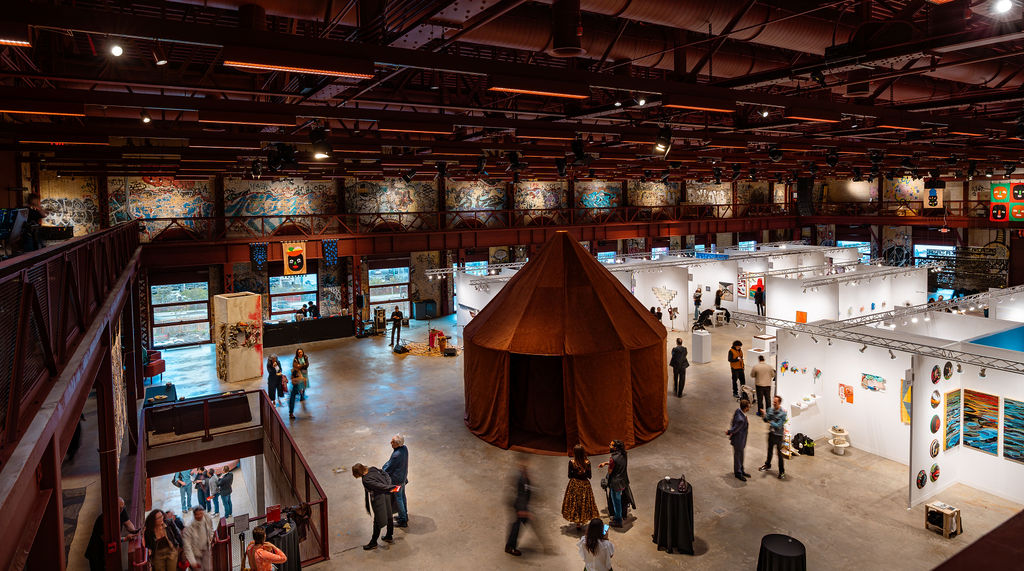
The new art fair “Conductor,” presented by Powerhouse Arts, opened in Brooklyn on Wednesday night with the expected biennial preview attendance instead of a typical fair opening. Within a few hours, more than 800 people walked through Powerhouse Arts, weaving between booths that offered the unexpected.
There are 28 galleries and 20 special projects spread throughout the building, with installations often extending from traditional booths into shared spaces. This is the first full version of the show following last year’s trailer, and putting it together wasn’t easy. “Some galleries that wanted to participate had to pull out at the last minute because of the war in Iran, which was very difficult,” said fair director Adrianna Farietta. Still, the result is an inclusive fair, with many works worth serious viewing and layouts worth wandering through. You’ll turn a corner and find yourself standing staring at a large installation, or enter a quiet, solitary environment.
Related articles
The jubilant rhythm of the exhibition has been completely transferred inside house of silenceIt is a tent-like structure designed by Turkish artist Vuslat and architect Sana Frini. From the outside it looks like a simple yurt form, while inside it feels like an oasis. The floor absorbs sound, and the only light comes from a hole in the top of the tent. Opposite the low built-in seat is a large canvas painted with eyes, a horse’s head, seemingly disembodied limbs and a coiled snake. It’s built around the idea of a portable home, something you can take with you and not return. People duly ducked in, stayed for a few minutes, and left visibly calmer.
Another project that has attracted attention is retorno (2022), Juan José Barbosa-Gubo, produced by Praise Shadows. It is built around a hand-carved boat that the artist sourced from the Amazon and then reworked with carved acrylic, cement leaves, and wood pieces. The piece stretches across the floor, nearly eight feet long, and appears to either be swallowed by the jungle or grow out of it. I wasn’t the only one who slowly circled it throughout the evening, trying to figure out where it began and ended. Elsewhere in the booth, Barboza-Gubo presented a complex puzzle of translucent geometric shapes inspired by mosaic tiles he found among the ashes of a burned-out building in Iquitos, a suburb of the Peruvian rainforest.
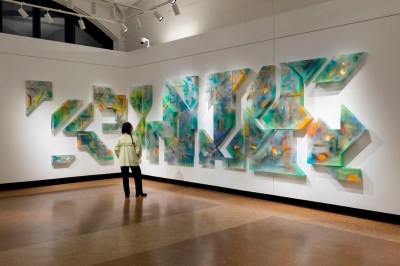
Juan Jose Barbosa-Gubo, Desbord mural. Photo: Mel Tain. Presented by Praise for Shadow Gallery.
At a booth at the WhereArt.Works space in Riyadh, fabric works made through printing and layered photography were priced low enough to feel like an attempt to build a market from the ground up rather than chase it. “It’s a great way to test the market and see what the demand is,” said Justin Gilyani, who runs the space, describing a model built around coaching and salons as well as sales. The model itself is as important as the work, with an emphasis on coaching, salons, and slow growth.
Meanwhile, Beya Gille Gacha, on display with Keijsers Koning, attracted a steady audience with sculptural pieces made from glass beads, wax, fiberglass, concrete and sage-shaped living elements. The work sits low to the ground, gathering organic and industrial materials without easing the tension between them. Gacha will be unveiled at the Cameroon pavilion in Venice, one of the most focused displays at the show, making it easy to read even in a crowded room.
Khaled Jarrar’s contributions come into play in different areas. his An orange tree with two scars (2026) is a relatively compact wall work, constructed with grouting and glaze, but it carries the weight of his wider practice, drawn directly from his experiences in the Palestinian West Bank. Even among larger installations, it commands attention, in part because of its restraint.
There is a lot of overlap with the Venice Biennale audience. Several of the artists shown here will be traveling next week, including Ebony G. Patterson, Annale Davis and Tammy Nguyen in the main exhibition, as well as pavilion participants such as Beya Gille Gacha (Cameroon), Rojo Negro (Mexico) and Bugarin + Castle (Scotland).
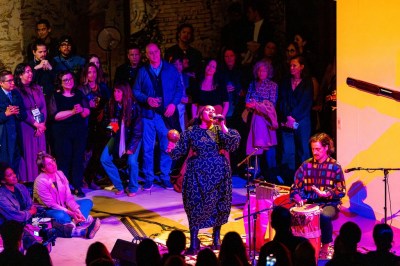
Lido Pimienta performs at the Conductor’s Opening Night.
Gina Kurovich
The night ended with Lido Pimienta singing, accompanied by ferocious percussion and clever delay pedals that allowed her voice to echo and distort throughout the hall. For this first release, the Conductor is still figuring out its shape. But its spirit is strong, and the opening night at least clarified one thing: the conductor is less interested in traditional rows of stalls and more interested in creating environments where work, environment and audience are all a bit blurred.