The Tamesis
Oil prices edged higher on Thursday, while most Asian stocks fell after fresh U.S. strikes and retaliatory attacks on Iran tested an uneasy ceasefire in the Middle East war.
The strike was the most serious since a ceasefire was agreed in April, but oil prices remained below $100 a barrel later in the day.
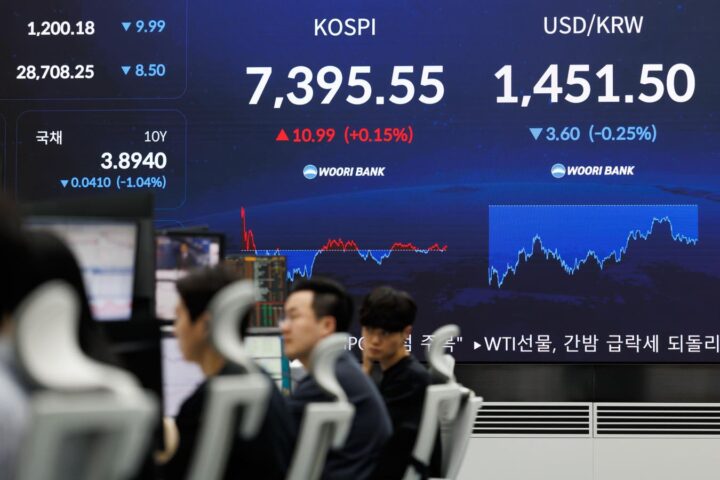
Asian stock markets fell across the board on Thursday, with major benchmark stock markets in Hong Kong, Taipei and Sydney all closing down more than 1%.
SEE ALSO: Samsung workers approve huge bonuses; oil prices fall, stocks mixed
Tokyo and Seoul posted more modest losses, while Shanghai was the only major exchange to buck the trend, closing 0.1% higher.
In early European trading, London fell nearly 1% and Paris fell 0.4%. Frankfurt is flat.
Global stocks posted strong gains on Wednesday as investors bullish on artificial intelligence ignored conflicting headlines about Iran, sending stocks lower.
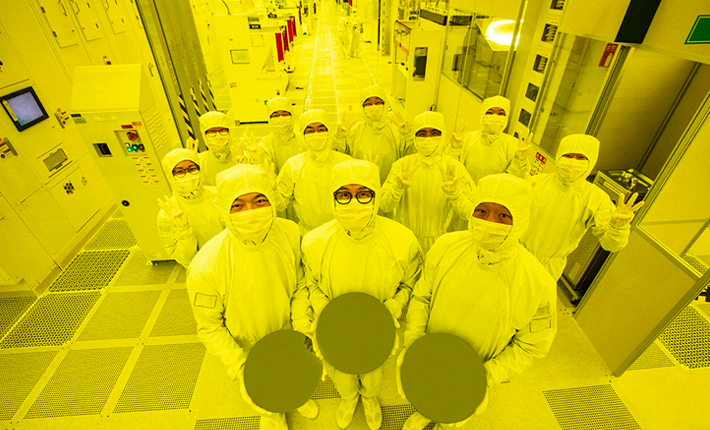
In Asia, Korean chipmakers SK Hynix’s market value exceeds US$1 trillionalongside regional tech giants Samsung Electronics and TSMC and U.S. chipmaker Micron Technology.
The surge in tech stocks coincides with an ongoing surge in energy prices that threatens several major Asian economies that rely on oil shipments from the Middle East.
Economists warn that if the war causes inflation to worsen, the central bank may have to raise interest rates, increasing borrowing costs and potentially dragging down economic growth.
Iran, U.S. no concessions on Strait of Hormuz and nuclear weapons
The military shot down four Iranian drones and attacked a control center in the southern port area of Bandar Abbas, a US official told AFP, calling the actions “well thought out, purely defensive and designed to maintain the ceasefire”.
Tehran’s state media said Iranian forces opened fire on four ships trying to cross the strait, while Kuwait said its air defenses responded to missile and drone attacks.
“Following this morning’s attack by invading US forces using aerial projectiles against a location on the outskirts of Bandar Abbas Airport, the US air base that was the source of the attack was targeted at 4:50 am (0120 GMT),” the Guard said, according to Iranian state broadcaster IRIB.
The Kuwaiti Guards gave no details on the base’s location, but the Kuwaiti military said its air defense systems were responding to an “enemy” attack on Thursday.
The clashes have called into question negotiations aimed at formally ending the war that began with a February 28 attack by the United States and Israel on Iran.
A key focus of the proposed deal is also to restore full traffic to the Strait of Hormuz, which Tehran has effectively closed, leaving global energy markets facing constraints on the massive oil and gas supplies that normally pass through the strait.
New attacks were also reported in Lebanon, another front line in the war.
Trump also said separately Warning to OmanU.S. allies and mediators in the conflict were asked about a possible short-term arrangement that would allow Iran and Oman to control the Strait of Hormuz.
“No, the Strait will be open to everyone,” Trump said. “This is international waters and Oman will act like other countries or we will have to blow them up. They understand that and they will be fine.”
Oman has played a mediating role in the war but has itself come under attack from Tehran. But the United States and Iran have shown no willingness to compromise on the Strait of Hormuz or Iran’s nuclear program.
The U.S. Treasury Department on Wednesday also announced sanctions on Iran’s Persian Gulf Straits Authority, Tehran’s new agency charged with collecting fees for passage through the Strait of Hormuz.
EU takes tough stance on foreign competition
Meanwhile, the European Union said on Thursday it had begun an in-depth study Investigation into Chinese e-commerce giant JD.com’s acquisition of a major German electronics retail groupsuspected to be driven by state subsidies.
The latest EU investigation into a Chinese company comes as Brussels debates strengthening its stance against Beijing to protect companies from unfair foreign competition.
The European Commission, the competition watchdog of the 27-nation bloc, said a preliminary investigation showed “JD.com may have accepted foreign subsidies that distorted the EU’s internal market.”
Brussels said the investigation would assess whether such subsidies allowed Chinese companies to offer high prices to Germany’s Ceconomy, thereby skewing the outcome of the takeover process.
It will also investigate whether post-transaction assistance improved the competitive position of the combined entity.
JD.com said the acquisition would not be funded through subsidies and denied receiving any aid related to the deal, which “could lead to competition distortions in the EU”.
JD.com announced in July last year that it had signed an agreement to acquire Ceconomy, the parent company of two major retailers, MediaMarkt and Saturn, valuing the German group at 2.2 billion euros ($2.6 billion). That drew close attention from Berlin, which also launched an investigation into whether the purchase posed a risk to national security.
MediaMarkt and Saturn have a network of more than 1,000 e-stores, many in Germany but also in several other European countries, as well as online sales platforms.
EU boycotts Chinese investment
The EU investigation was launched under rules adopted in 2023 to address unfair competition by foreign companies receiving state aid.
China’s attempts to invest in Europe are increasingly facing resistance, with local companies saying they face unfair competition from rivals that receive heavy subsidies.
Brussels recently opened up a foreign subsidy Investigating China’s Nuctech Groupspecializing in the production of security inspection equipment.
other Investigation into Chinese rail giant CRRC This resulted in its subsidiary being replaced by a Polish manufacturer involved in the consortium building a metro line in Lisbon.
Thursday’s announcement comes ahead of a special meeting of the European Commission on Friday that will focus on how the 27-nation bloc should deal with China to create a level playing field.
China’s booming exports have generated huge trade surpluses for many European countries, putting political pressure on the continent’s leaders to protect local industries.
The committee has 90 working days to make a decision on the JD investigation.
Temu fined €200 million by EU for illegal products
A slap in the face from the EU Chinese online retailer Temu fined €200 million ($232 million) Thursday for allowing the sale of illegal products, including dangerous baby toys and defective chargers.
“The company failed to seriously identify, analyze and assess the systemic risks of illegal products offered on its platform and the resulting harm to EU consumers,” the EU said.
The EU regulator said there was a “high likelihood” that European consumers would encounter illegal items on Temu, and that the company had “seriously underestimated how often EU consumers were likely” to see such products.
Temu is very popular in the EU and has 130 million users after entering the EU market in 2023.
But the company has been under intense scrutiny since the EU launched an investigation in October 2024, with Temu initially found in July last year to have breached landmark rules on the risk of illegal products.
“Temu is a very important player on the European market,” EU technical commissioner Henna Virkkunen told reporters, adding that its size meant a “significant proportion” of EU consumers would be exposed to such illegal products.
Thursday’s fine is only the second to be levied for content under the EU’s powerful Digital Services Act (DSA), following a €120 million fine imposed on Elon Musk’s X platform in December.
According to the DSA, the world’s most popular digital platforms, including social media apps and online retailers, must conduct risk assessments to understand the dangers they pose and how to combat them.
The EU has slammed Temu’s 2024 risk assessment, saying it “failed to meet standards”, citing findings that baby toys such as rattles contained chemicals that exceeded legal safety limits, and chargers that failed basic safety tests.
The European Commission said Temu failed to properly assess the design of the platform and how it “amplified the risk of the spread of illegal products”.
The DSA is part of the EU’s powerful legal arsenal aimed at curbing what the bloc sees as excesses by big tech companies, with fines of up to 6% of a company’s annual global turnover. Temu had revenue of $61.7 billion last year.
The EU could have imposed a higher fine on Temu, but an EU Commission official said the amount was proportional to the breach because it involved a year-long risk assessment and the conclusion was “unambiguous”.
Temu must now pay the fine and submit a plan to the EU by August 28 that includes what actions it will take to address the breach. If Temu fails to comply, it faces regular fines.
Key figures around 0830 GMT
North Sea Brent crude oil: rose 2.5% to $96.65 a barrel.
West Texas Intermediate crude oil: rose 2.4% to $90.84 a barrel.
Hong Kong’s Hang Seng Index: fell 1.3% to 25,006.16 points (closed).
TOKYO – Nikkei 225: down 0.5% to 64,693.12 (close).
Shanghai – Composite Index: up 0.1% to 4,098.64 (close).
LONDON – FTSE 100: down 0.9% to 10,412.29.
USD/JPY: fell from 159.53 yen to $159.52.
- AFP Additional input and editing by Jim Pollard
See also:
Stocks fall after U.S. strikes Iran ‘landmines’, oil near $100
Huawei says its new advanced chip technology can circumvent U.S. restrictions
Samsung shares rise on UnionPay deal, but legal test looms
AMD will invest more than US$10 billion in Taiwan to improve AI chip packaging
China consumer spending and factory output fall in April
Xi Jinping warns Taiwan could cause ‘conflict’ as Trump summit begins
China DeepSeek says new V4 AI model can run on Huawei chips
Chinese AI circuit board company raises US$2 billion, becomes Hong Kong listed company of the year
China’s top streaming site criticized for AI actor ‘database’
Bytedance’s viral video model shows China’s growing control over AI