The Tamesis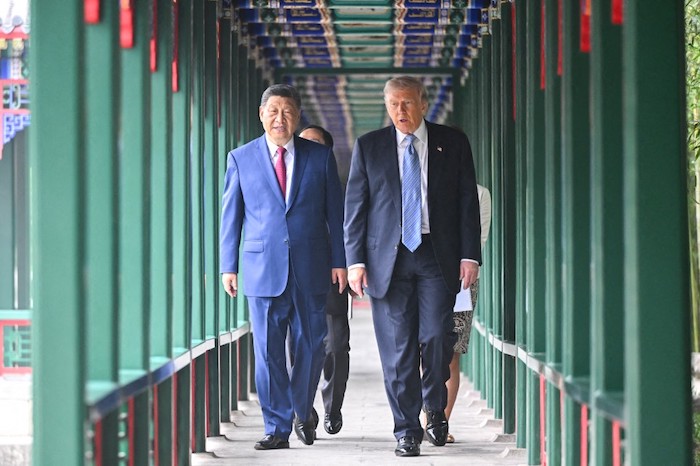
Asian stocks fell on Friday and oil prices rose as talks between the United States and China failed to make progress on reopening the Strait of Hormuz.
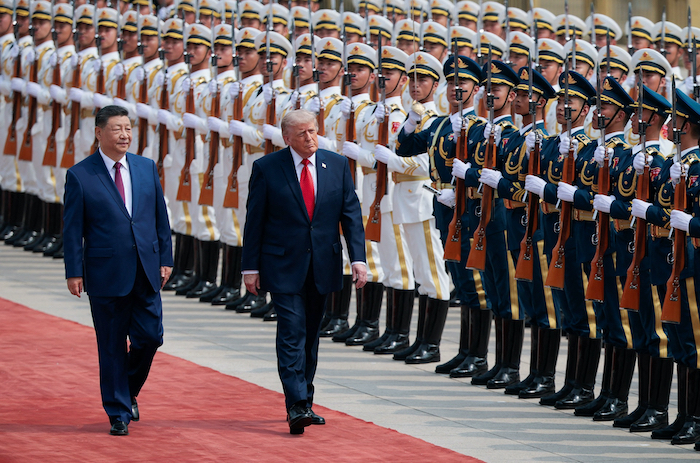
US President Donald Trump said he had a “great trade deal” with Chinese President Xi Jinping but gave few details before boarding Air Force One to fly back to Washington.
That has investors worried about continued inflationary pressures, which could undermine global economic growth. Oil prices rose more than 2%, with the international benchmark Brent crude oil contract near $108 a barrel.
See also: Xi Jinping warns Trump that Taiwan could cause ‘conflict’ as summit begins
Gains in crude oil futures also pushed up government bond yields, including in Britain, where Prime Minister Keir Starmer faces a new threat to his leadership.
In Asia, Tokyo stock markets closed down 2%, while Hong Kong and Shanghai stock markets fell more than 1%.
Japan’s 30-year bond rate rose to 4% for the first time since 1999, while the dollar strengthened against sterling and the euro.
Stocks in London, Paris and Frankfurt were all down around 1.5% in midday trading.
Investors were disappointed as highly anticipated talks between Trump and Xi failed to produce major breakthroughs on Middle East wars or trade relations.
Futures contracts pointed to a weak opening on Wall Street, a day after the S&P 500 and Nasdaq hit record highs again on a rally fueled by technology stocks.
“The growth prospects of artificial intelligence and optimism about its accelerated revenue generation outweigh geopolitical challenges,” said Ipek Ozkardeskaya, senior analyst at Swissquote.
Trump did not reveal details of a trade deal with China but told Fox News that Beijing has expressed interest in buying U.S. oil and soybeans. Xi Jinping reportedly agreed to buy “200 large” Boeing planes, he said.
Weak results
“The meeting … focused on warm words and symbolism without delivering results,” said Susannah Streeter, chief investment strategist at Wealth Club.
“New uncertainties are pouring in as diplomatic efforts to resolve conflicts in the Middle East run into trouble,” she added.
Trump arrived in Beijing late on Wednesday to seek deals in areas such as agriculture, aviation and artificial intelligence, as well as curbing differences over a range of tense geostrategic areas – notably war in the Middle East.
He told Xi Jinping, whom he described as a “great leader” and a “friend,” but the Chinese president struck a softer tone. But the US leader said the visit had brought “a lot of good”.
“We have some great trade deals that are good for both countries,” he said after walking with Xi among the rose bushes at Zhongnanhai Garden. Zhongnanhai is the central leadership compound next to the Forbidden City in Beijing.
“We’ve solved a lot of different problems that no one else has been able to solve,” Trump added, without providing details.
Thursday’s warm handshakes and pomp were somewhat overshadowed by a pomp and circumstance. Xi Jinping’s blunt warning Taiwan has been a geopolitical hotspot for much longer.
Chinese state media reported that Xi Jinping told Trump that mistakes on the sensitive issue of Taiwan could plunge the two countries into “conflict.”
Trump did not mention Taiwan in his Fox News interview, and the U.S. leader did not comment to reporters when asked about it during the visit.
However, Secretary of State Marco Rubio told NBC on Thursday that “U.S. policy on Taiwan has not changed.” He said Beijing raised the topic but “we always make our position clear and then we move on to other topics”.
Taipei responded on Friday, thanking Washington for its “repeated expressions of support.”
“Both sides want to reopen the strait”
The White House said the two leaders “agreed that the Strait of Hormuz must remain open to support the free flow of energy.”
Trump said he had received an offer from China to help open the Strait of Hormuz, and Xi Jinping had effectively guaranteed that China was not prepared to provide military aid to Tehran, which essentially closed the strait in March.
“He said he would not provide military equipment … and he said it very strongly,” Trump told Fox.
“He wants to see the Strait of Hormuz open and says ‘If I can help in any way, I’m willing to help,'” Trump added.
Xi Jinping later said that this was a “milestone visit” and that the two sides had so far established a “constructive, strategic and stable new bilateral relationship.”
Asked whether the two leaders had discussed Iran, China’s Foreign Ministry issued a statement on Friday calling for a “comprehensive and lasting ceasefire.”
“The waterway should be reopened as soon as possible in response to the international community’s call,” the statement added.
Talks planned on AI ‘guardrails’
There were no announcements about advanced Nvidia chips for artificial intelligence, although CEO Jensen Huang was among the business leaders on Trump’s business delegation.
Chinese tech companies are barred from buying California-based Nvidia’s most advanced artificial intelligence chips under U.S. export rules that Washington says are designed to protect national security. China pushes tech companies to buy locally made chips.
U.S. Treasury Secretary Scott Bessent told CNBC that discussions were underway to put in place “guardrails” around the use of artificial intelligence, adding that the world’s “two AI superpowers are going to start talking.”
However, investors had hoped for more progress in reopening the strait, where tanker traffic has come to a near standstill since the war began, sending energy prices soaring.
Iran ‘willing to negotiate more’
Trump told Fox News on Thursday that he “will not be more patient” with Iran.
Iranian Foreign Minister Abbas Araghchi said on Friday that he had “received a message” from the United States that it was willing to continue talks and that he was open to any support, including from China.
“We have again received a message from the Americans that they are willing to continue negotiations and continue to interact,” Araghchi told reporters, a day after Trump said Xi Jinping was willing to help China reopen the Strait of Hormuz.
“We are grateful to any country that is in a position to help, especially China,” Araghchi said after attending a meeting of the BRICS group in New Delhi.
“We have a very good relationship with China. We are strategic partners and we know [the] The Chinese have good intentions, so anything they can do to help diplomacy will be welcomed by the Islamic Republic. “
Matt Britzman, senior equity analyst at Hargreaves Lansdown, told AFP: “The U.S.-Iran diplomatic impasse has brought supply concerns into focus.
“Even if resolved next month, oil market may remain undersupplied [to] Inflationary pressures remained high in October, creating another headache for consumers, central banks and ultimately investors,” he added.
Key data around 1050 GMT
North Sea Brent crude oil: rose 1.8% to $107.67 a barrel.
West Texas Intermediate crude oil: rose 2.3% to $103.50 a barrel.
TOKYO – Nikkei 225: down 2.0% to 61,409.29 (close).
Hong Kong – Hang Seng Index: down 1.6% to 25,962.73 (close).
Shanghai – Composite Index: fell 1.0% to 4,135.39 (closed).
LONDON – FTSE 100: down 1.3% to 10,243.08.
Paris – CAC 40: down 1.1% to 7,990.62.
FRANKFURT – DAX 30: down 1.3% to 24,143.19.
USD/JPY: rose from 158.33 yen to 158.37 yen.
See also:
China DeepSeek says new V4 AI model can run on Huawei chips
Chinese AI circuit board company raises US$2 billion, becomes Hong Kong listed company of the year
China’s top streaming site criticized for AI actor ‘database’
Bytedance’s viral video model shows China’s growing control over AI
New DeepSeek model delayed online to test China’s AI chip strength
Nexperia’s Chinese subsidiary’s chips “nearly fully localized”
China beats U.S. again in global patent battle, Huawei maintains lead
China now requires chipmakers to use at least 50% domestic equipment
China’s big technological secret: Dutch chip-making machine replicated in laboratory
Chinese AI firms form alliance with chipmakers to ditch foreign technology