The Tamesis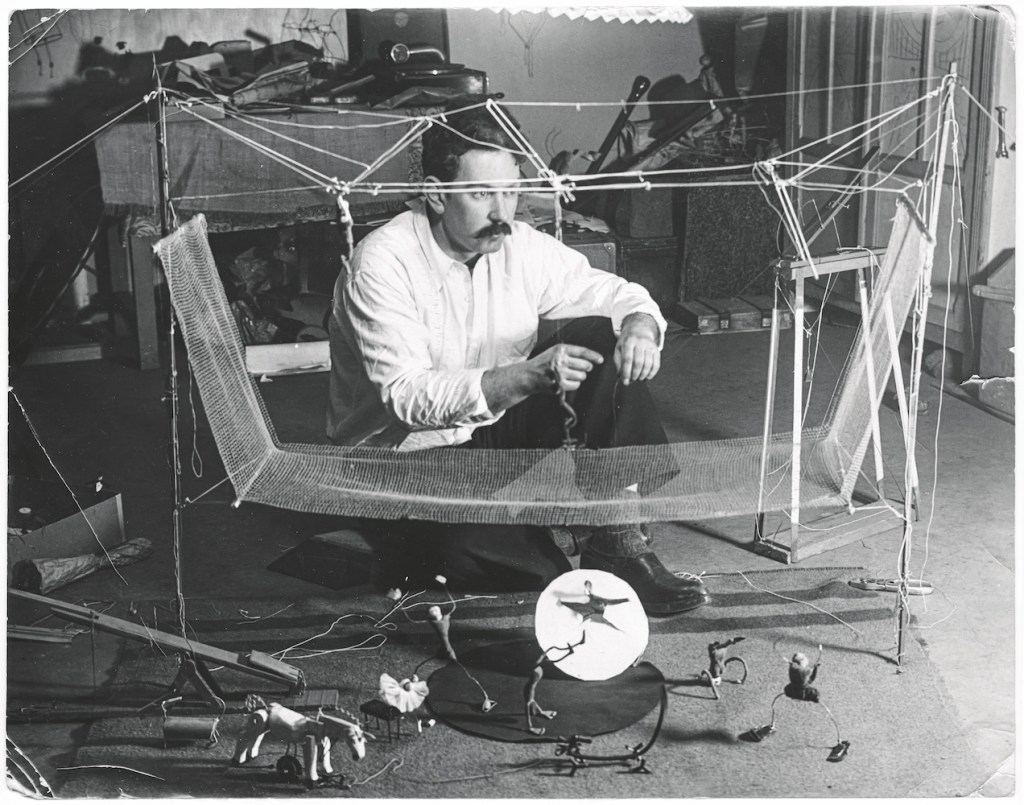
Calder returned to Paris in 1937 and set up a studio in his garage, equipped with a car turntable, probably to facilitate viewing and adjusting his sculptures. In the same year, he was commissioned to create mercury fountain Spanish Pavilion at the Paris International Fair. The work includes mercury mined in Almaden, Spain, a material that symbolized the Republic’s resistance during the Spanish Civil War. it Exhibited alongside works by Picasso Guernica and miro’s reaperreflects the political engagement of these artists.
Returning to New York in 1938, Calder began building a large studio on the grounds of an old dairy farm in Roxbury and soon converted the adjacent icehouse studio into a living space known as the “Great Room.” In the same year, his first retrospective exhibition “Calder Mobility“, on display at the George Walter Vincent Smith Gallery in Springfield, Massachusetts. The exhibition included 61 pieces of jewelry and was opened by designer Alvar Aalto and painter Fernand Léger. A year later, Calder was commissioned by the Museum of Modern Art in New York Lobster trap and fish taila mobile unit installed in the main stairwell of the museum’s new building on West 53rd Street.
In the late 1930s and early 1940s, Calder’s work was exhibited at the Pierre Matisse Gallery in New York. These exhibitions include large-scale bolted stables, kinetic sculptures, and exquisite jewelry pieces that highlight the breadth of his studies of movement, balance, and materials. In 1943, the gallery exhibited his first work, “Constellations,” a series of painted wooden assemblages that marked another turning point in his career. Developed during World War II, when access to metals was restricted, “Constellations” consist of geometric and organic elements arranged in a complex network, suspended, mounted or placed on surfaces to create miniature universes. The position of each component is critical to the rhythm and dynamics of the piece; improper placement can diminish its visual impact. Through these works, Calder expressed a personal, almost cosmic vision, transforming his sculptural elements into an experience that emotionally and spatially engages the viewer, bridging the physical and the conceptual.