The Tamesis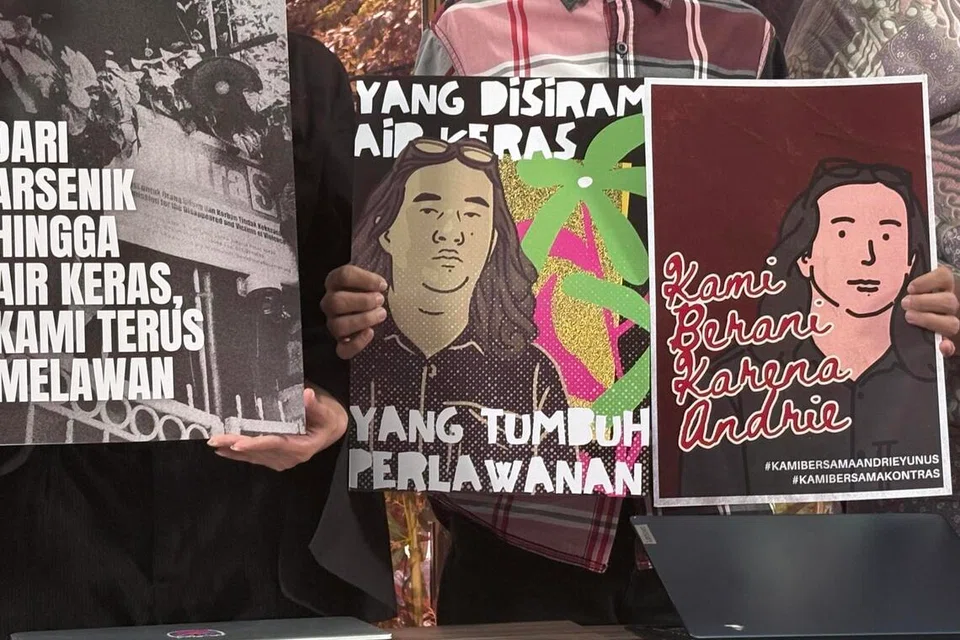
March 18, 2026
jakarta – cruel Prominent Indonesian human rights activist attacked with acid raising concerns about past attacks on activists and putting pressure on law enforcement to bring those responsible to justice.
The incident comes amid growing reports of intimidation against activists and journalists, drawing widespread domestic and international attention. Analysts told The Straits Times that the authorities’ response will be closely watched by the public.
Dr Ian Wilson, senior lecturer in politics and international relations at Murdoch University in Perth, Australia, said: “I think a lot of people abroad are looking at this as a litmus test of how serious this government is in handling cases like this.”
The attack on Andrie Yunus, deputy coordinator of human rights watchdog Kontras, struck a raw nerve, partly because almost all of the incident was caught on camera: CCTV footage seen by ST shows Andrie Yunus riding his motorcycle in the Menteng neighborhood in central Jakarta on the night of March 12 when a passenger on a passing motorcycle sprayed him in the face and upper body with sulfuric acid. Mr Andry immediately screamed in pain and was helped by passers-by.
According to a March 16 statement from Cipto Mangunkusumo Hospital, Andri suffered burns to 20% of his body as a result of the attack and had to undergo surgery after his right eye was injured.
As of this writing, Mr. Andry is in stable condition in the hospital’s advanced care unit.
The attack, while shocking, is not unprecedented. According to data from Amnesty International Indonesia, cases of attacks and intimidation against human rights defenders and organizations have continued to increase over the past three years, and the number of victims will reach 188 by 2025, an increase of 82.5% from 103 in 2023.
Notably, in March 2025, Tempo, a news outlet known for its strong investigative reporting, received a package containing: Pig head and mouse carcass.
Kontras has been at the center of many threats since its founding in 1998, the most notorious of which was the 2004 murder of its former coordinator Munir Said Thalib on a flight to Amsterdam, the Netherlands.
The attack on Mr Andry is most similar to that suffered by former Corruption Eradication Commission senior investigator Novel Baswedan.
On April 11, 2017, he was walking home after dawn prayers at a local mosque when two men on a motorcycle passed by and sprayed him with acid.
“I think Indonesia has been experiencing a decline in freedom of expression for a long time,” Dr Firman Noor, senior political researcher at the National Research and Innovation Agency, told The Straits Times.
“We are also experiencing stagnation in terms of the quality of our democracy. This is further evidence that our democracy is indeed experiencing a severe decline.”
Andri first came into the national spotlight in March 2025, when a video of him interrupting lawmakers reviewing a new military law at a luxury hotel in Jakarta went viral.
“We demand that the deliberations on the military law revisions be stopped because they do not comply with the proper legislative process. These deliberations are conducted behind closed doors,” he said at the time.
Mr Andry has since been at the forefront of opposition to the law. Many civil society organizations believe that changes to the military law passed a week later could lead to an overexpansion of the military’s role in civilian life.
On the night of the attack, Mr Andri was riding home after recording a podcast on remilitarization at the Menteng office of the Indonesian Legal Aid Foundation (YLBHI).
“We know that this attack was not just an attack on Andrie Yunus, but on civil society and the public as a whole,” Kontras activist Jane Rosalina said at a press conference at the YLBHI offices on March 16.
The attack sparked a strong response at home and abroad, with statements from politicians and party leaders unusually aligned with demands from civil society.
The Third Committee of Parliament, which oversees legal affairs and human rights, held a press conference on March 16 and called for a thorough investigation into the attack.
“We strongly condemn the acid attack because it was not just an ordinary crime but a crime against democracy,” Habib Brochmann, chairman of the Third Committee, told a news conference.
Prabowo government spokesperson Angga Raka Prabowo also issued a statement on March 14, condemning the violence and calling on law enforcement agencies to bring the perpetrators to justice.
All eyes are now on law enforcement, particularly whether the mastermind behind the attack will be revealed.
Dr Wilson said: “In these cases there is not a very good record to reveal what exactly happened here as it is safe to assume that the perpetrators were doing this on behalf of someone else.”
In the Norwell case, for example, more than two years after the attack, police had arrested only two suspects. They, all serving police officers, admitted carrying out the attack because they believed the former police officers themselves had betrayed the force by investigating corruption allegations within the organization.
The two police officers were found guilty in 2020 and sentenced to 1.5 years and two years in prison respectively.
Yusril Ihza Mahendra, the coordinating minister for law and human rights, highlighted public concerns and urged police to identify the “intellectuals” behind the attack on Mr Andry, not just the perpetrators of the attack.
Jakarta police said on March 16 that they had found evidence that at least four people were involved in the attack. The suspects allegedly followed Andry for several hours before the attack. As of this writing, police have not released the identity of the suspect.
Dr Firman said the stakes in the case were particularly high because Indonesia was currently President of the United Nations Human Rights Councila position it is lobbying hard for in 2025.
The attack has attracted the attention of UN officials: UN High Commissioner for Human Rights Volker Turk called it a “cowardly act of violence”, while UN Special Rapporteur on human rights defenders Mary Lawler called the attack “horrible”.
“There is no alternative but to resolve this case once and for all,” Dr. Firman said, adding: “If this case fades away or is resolved unfairly, Indonesia’s reputation will be damaged.”