The Tamesis
Taiwan has been on high alert since China conducted large-scale military exercises in Taiwan a few days ago.
Coast Guard officials said Navy and military officials maintained operations at the Maritime Emergency Response Center while monitoring Chinese naval exercises.
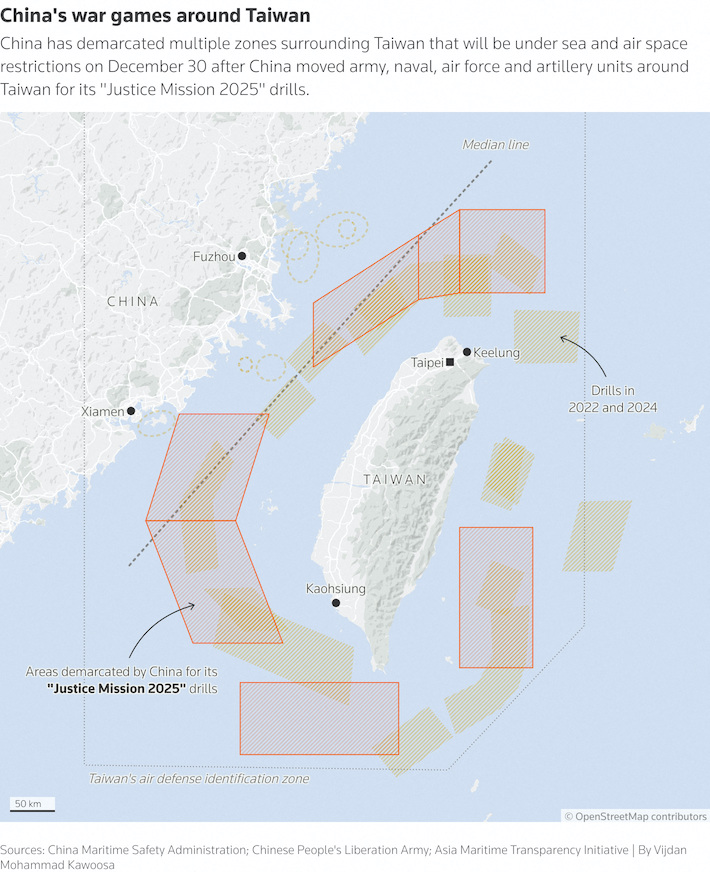
this Exercise called “Justice Mission 2025” China has fired dozens of rockets at Taiwan and deployed a large number of warships and aircraft near the island, a show of force that has alarmed the region and Western allies.
See also: Chinese AI chipmaker Bitren Technology shares rise 76% in latest Hong Kong IPO
Beijing announced late Wednesday that it had completed the drill and said its military would remain on high alert and continue to increase combat readiness.
Taiwan’s Ministry of National Defense responded that as there are still a large number of Chinese aircraft and ships in its response area, Taiwan’s armed forces will maintain “appropriate emergency response mechanisms.” It did not elaborate.
“The Chinese Communist Party’s aggressive and militaristic provocations endanger regional security and stability and have been condemned by democratic allies in the international community,” the statement said.
Xi Jinping: The trend of reunification is unstoppable
Chinese President Xi Jinping struck a familiar tone on Taiwan in his speech New Year’s Speech Beijing’s announcement came shortly after it reiterated last year’s warning against what it sees as forces seeking Taiwan’s independence.
“Compatriots on both sides of the Taiwan Strait are connected by blood, blood is thicker than water, and the historical trend of the reunification of the motherland is unstoppable,” he said in a speech broadcast on CCTV.
China claims democratically governed Taiwan as its own territory and has not ruled out using force to bring it under Chinese control. Taiwan denies China’s claims and denounced the latest drills as a threat to regional security and a blatant provocation.
Taiwan’s Maritime Affairs Commission director Guan Bi-ling said Chinese ships began leaving Taiwan late Tuesday night.
“The maritime situation has calmed down and ships are gradually leaving port,” she posted on Facebook late Tuesday.
Taiwan Coast Guard officials told Reuters that all 11 Chinese Coast Guard ships have left waters near Taiwan and are continuing to evacuate. A Taiwanese security official said military and coast guard emergency response centers remained active.
Two security officials in the region earlier told Reuters there were more than 90 Chinese navy and coast guard ships in the region, many of them deployed in the South China Sea and East China Sea near Taiwan.
The officials, who spoke on condition of anonymity because of the sensitivity of the matter, said the scale of China’s maritime deployments had steadily increased since the beginning of this week.
200 fighter planes, launching 27 missiles
China is in the midst of a busy season for military exercises.
Taiwan’s Defense Ministry said on Wednesday that 77 Chinese military aircraft and 25 navy and coast guard vessels were operating around the island in the past 24 hours. The Guardian later stated that this involved 200 fighter planes Over the past two days, a total of 27 missiles were fired at Taiwan, with several missiles reportedly landing within 27 nautical miles of Taiwan’s coast.
Taiwan officials said that 35 of them crossed the center line of the Taiwan Strait.
As the military exercise unfolded, U.S. Ambassador to China David Perdue posted a photo on X of himself with the ambassadors of the “Quad” countries, which includes the United States, Australia, Japan and India.
In the post, he called the Quad a “force for justice” committed to maintaining a free and open Indo-Pacific region, but did not elaborate on what was discussed at the meeting or when it would be held.
The State Department said Perdue meets regularly with diplomats and Chinese officials to advance the U.S. president’s agenda. “In accordance with these routine meetings, he met with the Quartet’s ambassadors in Beijing on December 19,” a State Department spokesman told Reuters.
Domestic flights canceled
The exercise, China’s most extensive military exercise to date, forced Taiwan to cancel dozens of domestic flights and send aircraft and warships for surveillance. Soldiers conducted rapid response drills, including setting up roadblocks at various locations.
China considers the exercise a “necessary and just measure” to safeguard national sovereignty and territorial integrity, Zhang Han, spokesman for China’s Taiwan Affairs Office, told reporters at a weekly press briefing on Wednesday. She added that this was a “stern warning against Taiwan independence separatist forces and external interference.”
Xinhua, China’s official news agency, published an article summarizing “three key points” of the exercise. The drills began 11 days after the United States announced a record $11.1 billion in arms sales to Taiwan.
The article quoted Zhang Chi, a professor at the National Defense University of the Chinese People’s Liberation Army, as saying that the simulated “encirclement and suppression” demonstrated the People’s Liberation Army’s “ability to suppress and contain separatist forces and exclude external interference, which can be summarized as ‘internal blockade and external blockade'”.
Lyle Goldstein, director of the Asia Project at the U.S. think tank, said that despite the increasing intensity of China’s military exercises, Beijing is unlikely to launch a war at the expense of its reputation. defense priorities.
“They often threaten and intimidate, but no matter what, ultimately (a war) will be very costly to China,” Goldstein said.
- Reuters Additional input and editing by Jim Pollard
See also:
TSMC, South Korean companies “can send chip manufacturing tools to Chinese factories”
China’s big technological secret: Dutch chip-making machine replicated in laboratory
Trump says he will impose high tariffs on China if it occupies Taiwan
Taiwan’s TSMC joins trillion-dollar club amid AI boom
War risks in China lead Taiwan Semiconductor Manufacturing Co., Ltd. to move its wafer fabs to the United States and Japan
As AI boom and climate change impact, another chip shortage looms
China unhappy with U.S. supply of “dangerous” weapons packages to Taiwan
Taiwan invasion ‘could cost up to $1 trillion a year’