The Tamesis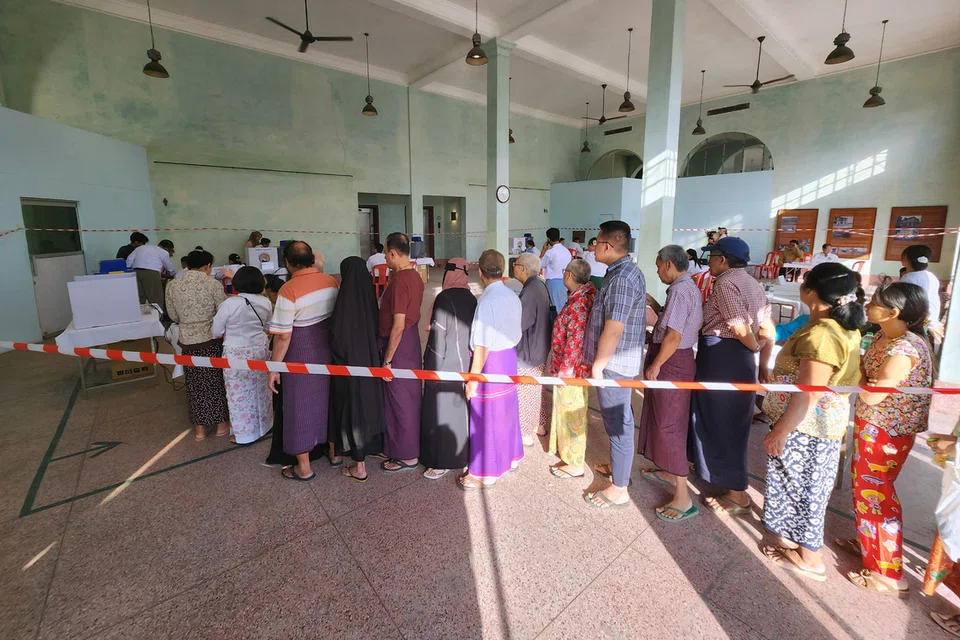
December 29, 2025
Yangon – Gallery owner Su Htwe was hospitalized after giving birth to a baby boy in 2020, during Myanmar’s last general election.
Despite the pain of her C-section and the fact that her newborn was in intensive care, she went to the polls to cast her vote.
Five years later, when the country began its first general election since the 2021 military coup on December 28, she was determined not to vote. Her immediate family also did not vote.
The 33-year-old mother of three said: “We don’t believe this election can change the country… We don’t recognize it as a fair election at all. It’s not a real election.”
While the December 28 vote went relatively smoothly, reports of explosions in cities such as Mandalay and Bago, as well as the town of Myawaddy near the Thai-Myanmar border, highlighted security concerns amid ongoing clashes between the army and resistance forces.
While the junta is calling for elections to seek legitimacy and recognition, voting will be held in 265 of the country’s 330 townships, home to about 50 million people.
Much of the country is controlled by ethnic armed groups such as the Kachin Independence Army, which controls much of the north, and the Arakan Army, which controls western Rakhine State. Civilian resistance also seized territory from the military.
For the first time, the country’s general election will be held in three phases. The first phase covers 102 towns and villages on December 28. Residents of the other 100 townships will vote on January 11, and residents of the remaining townships will go to the polls on January 25. Results are expected to be announced after the final phase.
On December 28, voters who showed up at a polling station next to the landmark Sule Pagoda in Yangon told The Straits Times that they voted because they felt they had to.
One 19-year-old girl, Stephanie, who asked not to be named, said she planned to study abroad and did not want to get into any trouble if authorities discovered she had not voted.
Mr Tin Myint Khine, 63, a retired teacher, said he voted because he wanted to change the status quo. “I do have expectations, but whether it actually happens remains to be seen.”
At polling stations, voters slowly trickled in to cast their votes, with more people waiting in line than at the 2020 election. Soldiers with guns were seen outside the station.
The military said the election was conducted in the interests of the people and aimed at opening a new chapter of hope in building peace and rebuilding the economy.
But critics balked at the suggestion, condemning the military’s actions.
Myanmar political analyst Naing Min Khant said it was unrealistic to expect positive or democratic results from the election.
He added that the polls were “designed as a form of institutional engineering to ensure international legitimacy and managerial elite interests in order to prolong General Min Aung Hlaing’s grip on power”.
Myanmar’s military chief deposed civilian leader Aung San Suu Kyi and her elected civilian government in a 2021 coup. She remains in custody and is serving a 27-year sentence after being found guilty of corruption and breaching the Official Secrets Act.
The charges against the 80-year-old are widely believed to be politically motivated.
Likewise, Dr. Hunter Marston, an adjunct fellow at the Center for Strategic and International Studies who studies Southeast Asia, is less optimistic about the election, noting that “as long as the military remains in control, the country will continue to experience violent conflict and political instability.”
“The resistance movement will not disappear overnight, and without credible opposition or meaningful rights and political representation, the people of Myanmar will not be satisfied with the current military-brokered political arrangement,” he said.
Suu Kyi’s National League for Democracy (NLD) won a landslide victory in the 2020 election but disbanded in 2023 after refusing to re-register as a political party under military regulations.
With the popular National League for Democracy withdrawing, the military-affiliated Union Solidarity and Development Party (USDP) remains largely unchallenged. It has the largest number of candidates, nearly 5,000, and is contesting in all townships.
The FDP is one of only six parties that competes nationally, with the others competing only at the state or regional level. A total of 57 political parties will participate in the election.
The People’s Party, led by Ko Ko Gyi, a 65-year-old former democracy activist, is one of six parties competing across the country. He said the party was involved to give a different political voice to the people.
“If we reject elections, what is the better option? That is why, in my opinion, elections are not the best option, but they are the least damaging option,” he added.
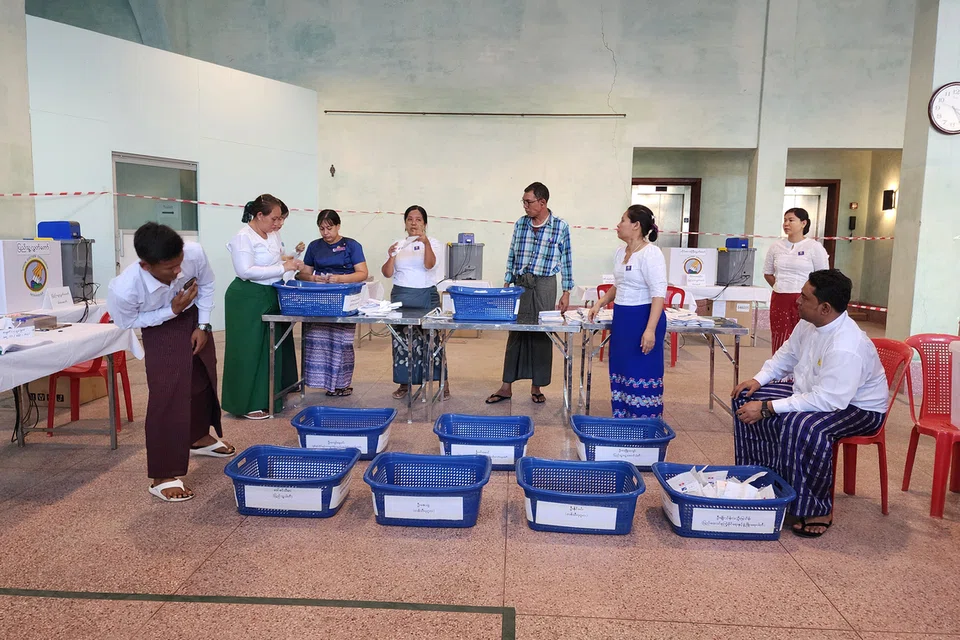
Election officials count early voting ballots in Yangon on December 28. Image: The Straits Times
Countries that have sent election observers to Myanmar, including China and Russia, support the election as a way for the Myanmar military to achieve a more stable political landscape.
Ms Debbie Stothard, founder of the Myanmar Alternative ASEAN Network, which promotes democracy and human rights in Myanmar, said the junta hoped to persuade some global actors to return to “business as usual” even though it had lost territorial control over half of the country.
“The international community should prepare for more political and economic chaos as the military continues to commit atrocities following fake opinion polls, this time with the support of a ‘democratically elected’ military-controlled parliament,” she told The Straits Times.
According to ACLED, an independent global conflict monitoring agency, Myanmar’s military carried out 2,602 aerial and drone attacks in 2025 as of November 28, killing nearly 2,000 people. The number has surged since 2022, when the military carried out 363 such attacks, killing 216 people.
A June 2025 United Nations report said that since the 2021 coup, at least 6,800 civilians have been killed in Myanmar and more than 3.5 million people have been displaced by the conflict.
Still, despite reservations about the election, some expressed hope for change.
“I hope a truly democratic government will come to power,” trader Nyunt Oo, 68, told ST. A purple ink mark on his little finger showed he had voted.