The Tamesis
A senior United Nations official has warned that countries around the world need to be more proactive in tackling cybercrime as it poses an increasing threat to all countries.
Jeremy Douglas, Associate Director of Operations United Nations Office on Drugs and Crime (UNODC)In a recent briefing, it was commented that the development of modern technology and digital and cryptocurrency currencies has accelerated various types of organized crime, and cybercrime has become a global phenomenon.
It is estimated that organized crime is currently equivalent to 15% of global GDP, while the scope of cybercrime “may be worth up to $8 trillion per year”. He said this figure includes funds generated in illegal online markets, illegal online gaming, online casino money laundering, scams and different forms of fraud, as well as profits generated by “cyber threat actors” who use malware and other advanced techniques to steal financial information and hold companies and government agencies to ransom.
See also: Trump’s ‘tariffs on countries trading with Iran’ could kill China truce
Douglas was one of several speakers at a forum last week at the Foreign Correspondents’ Club in Bangkok about the Mekong region’s epicenter of fraud, a day after the “Scam Billionaires” Chen Zhi left Cambodia by plane and returned to China.
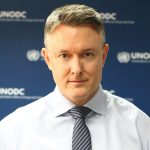
The U.N. official has a deep understanding of crime in Southeast Asia, having worked in Bangkok for nearly a decade before returning to UNODC’s headquarters in Vienna two years ago. He previously managed strategies to combat organized crime, synthetic drugs and precursor chemicals in the region.
He said the ASEAN region is at the forefront of transnational cybercrime risks as criminal gangs enjoy freedom in the territories of autonomous armed groups and special economic zones in parts of Myanmar, Laos and Cambodia, but these areas often lack functional governance.
‘An informed response is needed’
For years, police in Thailand and neighboring countries have been concerned about the regional drug crisis and the production and trafficking of synthetic drugs such as methamphetamine, which, starting in the late 1990s, began to replace “traditional” illegal drugs such as heroin and opium grown in Shan State in northeastern Myanmar and adjacent areas.
Online casinos run by Chinese crime syndicates in the Philippines and Cambodia attracted attention a decade ago, until the Covid-19 pandemic triggered another shift: scams and online fraud were widespread at casinos in parts of Myanmar (torn by civil war for the past five years), Sihanoukville, and the northern border areas of Cambodia and Laos.
He said the drug economy centered on the Golden Triangle had been hugely profitable over the past decade, thanks to a huge increase in methamphetamine shipments across the Asia-Pacific region, particularly Australia and Japan, while returns from the drug trade in some parts of the region had funded the technology now used by casinos and scammers.
“The industrialization of synthetic drugs has funded ‘underground’ banking networks linked to online casinos, which have evolved into scams during the COVID-19 pandemic, The criminal network further reinvests its profits in casino “buildings”, like the king of romans [in northern Laos] and quickly developed into what it is today.
“Now we are seeing a change in the environment, with cyber threat actors using some of the same infrastructure to push malware to infect computer systems and mobile devices to extract financial and other information. There has been investment in technology, particularly during and after COVID-19, and we are now seeing more investment in expanding the types of crimes, innovating and specializing, and expanding scams.”
Douglas said there is a fundamental lack of policy responses to fraud hubs and cybercrime in Southeast Asia. “Unfortunately, it’s working. At the same time, the drug problem continues to grow – and methamphetamine levels are expected to increase again.
“The fact is that there needs to be a major shift in the policy logic and responses in the region. SEZs need to be addressed, they need to be governed. But most importantly, smart responses are needed, not reactive strategies. We need an active public discussion about this.
“At the United Nations, we have transformed our response to this, broadening our approach to a system-wide response to this issue – leveraging the strengths of different parts of the UN system, such as the International Monetary Fund [International Monetary Fund]as multilateral responses are needed. “
Transnational criminal groups operating in Southeast Asia or linked to fraud hubs “have been conducting reconnaissance missions in Africa, Pakistan and the Caucasus in recent years” to find and, in some cases, establish alternative locations where crime hubs could be established.
“There is no getting away from the fact that there are issues that require a multilateral response and a significant global response to this issue – and that response is accelerating.”
He said ASEAN was starting a dialogue about the fraud crisis, but Douglas noted: “We had conversations with the region about the drug problem but it didn’t work out. And the fraud crisis is globalizing,” he said.

A key reason why the “grey economy” thrives is the level of investment in the illicit banking system. douglas says Alvin Chau, Macau’s notorious Chinese casino ownerCurrently serving a sentence in prison, he has invested US$90 to US$100 billion in Southeast Asia.
“Chow’s organization kind of set the stage for what we’re experiencing today. Bangkok is the banking center of the Mekong region. It’s definitely a clear problem here,” he said.
“This country [Thailand] Sadly, the Triangle is overrun with illegal drugs. Policy must change. We need to re-form a consensus on how to respond. “
victimization, suicide
Bhanubhatra JityanA Thai academic from the ASEAN Intergovernmental Commission on Human Rights, who spoke at the same event, said Southeast Asia is vulnerable to organized crime because of its porous borders and good connectivity with neighboring countries, which favors tourism.
Political crises and conflicts enable criminal groups to infiltrate lawless areas, while some of these areas also enjoy digital advancement and have fintech options that criminal groups can exploit.
The border areas are populated by refugees from Myanmar’s civil war and people who need to survive and can easily be forced to commit fraud when threatened with physical violence. But they endured humiliation and despair.
Scammers have created a global chain of victimization, with multiple suicides of people who have been trafficked or who have lost their savings. One of the biggest problems, he said, is that “a lot of people don’t realize how serious the threat is.” [of scamming] yes. And the state’s response has been very slow. “
John Wojcikformer UNODC technical expert and current senior threat researcher Information BroxThese “corrosive ecosystems are becoming more aggressive,” says a company that works to stop technical infrastructure such as toxic websites and Trojan and malware downloads set up by criminals.
U.S.-sanctioned money laundering groups in the region were able to easily move to new websites because their technical support staff developed multiple domain names that could be transferred.
“This is a problem that’s not going away,” Wojcik said, adding that deepfake services, chatbots in different languages, ransomware and phishing devices rely heavily on outsourcing. [that copy people’s emails and data].
“There is a willful blindness to gray technology among service providers and the industry that caters to these scammers,” he said. “And there are certainly willing players who will reinvest in R&D for the future of the business. But no one is holding these service providers accountable.”
See also:
“Fraud billionaire” Chen Zhi arrested in Cambodia and flown to China
Countries seize US$700 million in Prince Group assets in pursuit of “fraudulent billionaire”
US, UK praised for fraud hub sanctioning and seizing $15 billion in Bitcoin
US targets multi-billion dollar fraud network in Myanmar and Cambodia
Cambodia’s fraud hub has tense relations with countries near and far
U.S. sanctions Cambodian Karen warlord’s money laundering ring
Online fraud hub spreading like global cancer from Asia: UN
Thailand cracks down on fraud hub on two fronts, leaving thousands in trouble
UN says Southeast Asian criminal networks rely on Telegram, cryptocurrencies
Weak ASEAN countries “face the risk of evolving into fraud countries”
“US to sanction prominent Cambodian figures linked to fraud hub”
North Korean hackers use Cambodian company to launder stolen cryptocurrency
Cambodia-Chinese company implicated in cryptocurrency fraud and money laundering
Southeast Asian fraud gangs stole $64 billion in 2023, report says
Macau junket king Chow Cheuk-wa was sentenced to 18 years in prison for casino crimes