The Tamesis
Asia’s two biggest polluters, India and China, will reduce their reliance on coal for power generation by 2025, Carbon Brief reported. This is the first time in 52 years that both fossil fuel consumers have seen simultaneous declines.
Coal power generation in India fell by 3% year-on-year, and in China by 1.6%. According to analysis Written by the Center for Research on Energy and Clean Air (CREA) for Carbon Brief.
The declines mean both countries “now have the prerequisites for coal-fired power generation to peak,” CREA reported, adding that the declines could also help global emissions peak.
AF also reports: Trump’s ‘tariffs on countries trading with Iran’ could kill China truce
Weaning the world off coal is seen as crucial to meeting global climate goals, but fossil fuels remain the largest single fuel used to generate electricity.
China and India are among the world’s largest emitters of greenhouse gases. According to CREA data, between 2015 and 2024, the power industries of the two countries accounted for 93% of the increase in global carbon emissions.
But the two countries also lead Asia in clean energy, with record growth in renewable energy last year. Lauri Myllyvirta, chief analyst at CREA, wrote for Carbon Brief that “if China can sustain clean energy growth and India can meet its renewable energy targets,” then 2025 will mark the peak of coal use.
See also: Trump’s ‘tariffs on countries trading with Iran’ could kill China truce
Milihuerta pointed out that China’s current clean energy production capacity is sufficient to prevent China from increasing its coal use.
India also plans to add enough clean energy capacity to peak coal use by 2030, he added. 2025 is the first year that renewable energy growth will help reduce the country’s use of coal for electricity.
Major challenges remain
In order for China and India to keep their use of coal low in energy production, both countries will need to take steps to improve their power grids to support renewable energy. India also needs to increase policy and regulatory support for its planned clean energy projects.
Last year, Reuters report India’s stranded renewable energy generation capacity (projects awarded but unable to come online) has more than doubled due to unfinished transmission lines and legal and regulatory delays.
India also faces the challenge of integrating excess clean energy into the grid, which curbed power generation for much of last year. To meet energy demand, India plans to increase coal power installed capacity by 46% from current levels by 2030.
senior official in power ministry december says India will learn over the next three years how electricity demand grows and how quickly clean energy can be integrated into the grid.
It will also assess the cost of storing excess clean energy in batteries and delivering it to the grid before deciding to add more coal capacity after 2035.
Several Indian utilities have also signed long-term contracts with coal-fired power generators to meet an expected surge in overnight demand.
Still, the contraction in 2025 is only the third time in five years that coal use in India has fallen. This is mainly due to strong monsoons that increase hydropower generation and dampen electricity demand.
Reuters said the rapid growth in renewable energy generation is also a direct result of record-breaking rapid supply of electricity from solar and wind farms and the highest power generation from dams in more than six years. report last month.
As India continues to push for clean energy capacity expansion, clean power generation from all sources is expected to continue to climb, and India’s coal’s share of the power generation mix and total coal use are likely to be further reduced.
China is the key
Meanwhile, China’s coal use decline in 2025 is driven by continued growth in renewable energy and essentially flat electricity demand.
Last month, the International Energy Agency famous Global coal use will decline by 2030, largely due to declines in China.
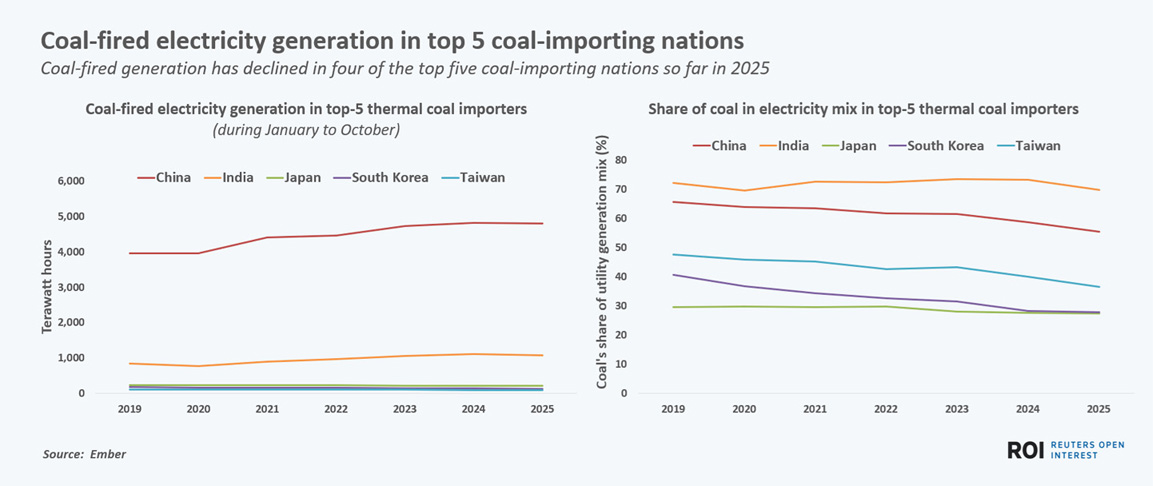
Keisuke Sadamori, head of energy markets and security at the IEA, said: “China… consumes 30% more coal than the rest of the world and is the main driver of global coal trends.”
The International Energy Agency pointed out that this also means that electricity demand grows faster than expected, or China’s renewable energy grid integration speed slows down, which may lead to global demand exceeding expectations.
Yet despite these concerns, the combined decline in coal use in India and China is significant for global efforts to reduce emissions.
“While many challenges remain, the decline in coal power production marks a historic moment,” said CREA’s Myllyvirta.
- Vishakha Saxena, Reuters
Also read:
India’s green transition in trouble
Asia’s multi-billion dollar carbon boom?
China Trillion Watt Solar Energy Journey
Solar power surge, data centers fuel China’s battery boom
China’s fossil fuel power generation to fall for first time in a decade
In the first half of 2025, renewable energy ranked first in coal power for the first time
US says hidden radios found in Chinese solar highway technology
New tax cuts will accelerate India’s shift to solar and wind energy
Solar boom booming in Indonesia, Australia and Africa
China lays down laws for solar panel manufacturers: ending overproduction
China’s desert greening projects alter groundwater levels: study
If climate warming continues, Asia-Pacific will face $500 billion in annual flood losses