The Tamesis
January 15, 2026
Seoul ——2026 has just begun, and we have already seen major countries such as the United States and China exerting influence on the world. The rest of the year is likely to see more of the same. Countries around the world, including South Korea, are watching with concern as these superpowers once again take overt geoeconomic and military actions.
To understand this great power competition, it is helpful to consider three key areas. The first is the global financial system, in which the United States still dominates. Secondly, in advanced manufacturing in specific fields such as semiconductors, competition among major powers is fierce, and South Korea plays an increasingly important role. Third, basic manufacturing, of which China is a powerful country.
financial battlefield
Let’s start with finance. What are often considered the most boring parts of the global financial architecture—payments systems and other basic financial services—are now at the center of intense geoeconomic competition. The United States’ ability to influence other countries through control of the global financial system is unparalleled. This ranges from imposing sanctions on Iran and Russia, forcing HSBC to disclose Huawei-related transactions, and persuading SWIFT to disconnect various entities from their messaging systems. The United States and its allies control an overwhelming share of the global financial services industry, exceeding 80% of the world. This dominance makes finance one of the most powerful geoeconomic tools available to Washington.
However, the U.S. position is more fragile than generally understood. China has not ignored their need to develop their own payment and settlement system. They are leveraging CIPS (Cross-Border Interbank Payments System) to achieve this. A successful CIPS would both insulate China from possible financial pressure from the United States and allow Beijing to make the system available to other countries that wish to reduce their dependence on the United States. Given South Korea’s close economic ties with the United States and China, it may be a natural country to want to use both systems.
While alternative payment systems still cannot replace the U.S.-centric global payments system, they highlight the growing incentives to fragment the global financial system. Policymakers in Washington are relieved that the dollar remains as central as ever—and from some perspectives even more so. They argue that the yuan and other alternative currencies are unlikely to compete with the dollar for most uses in the short term. While this assessment is accurate, it also misses the point.
Much of the loss of U.S. power does not require the dollar to keep pace with its competitors, but only the existence of a small viable alternative financial architecture. Currently, the U.S. coalition can almost completely cut off the supply of financial services to target countries or companies. The alliance’s power stems from its ability to have an almost complete monopoly on the market for these services, which are essential to the functioning of all economic sectors. The target has few options. But power quickly disappears as viable alternatives emerge, even if they serve only a small fraction of global transactions.
Semiconductor chessboard
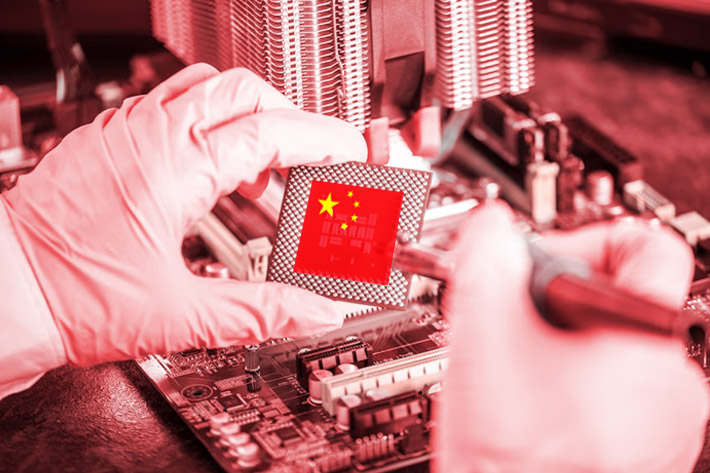
Now let me talk about semiconductors. Advanced semiconductors and financial architecture share some important characteristics. Like finance, they are a fundamental input to many different economic sectors, so controlling semiconductors could have far-reaching consequences. Somewhat in common with finance, they are not easy to produce, which means controlling key suppliers may leave targets with only poor alternatives.
But there are important differences. Basic financial services is a relatively stable technology that has been around for a century. The technology will change and adapt – for example, stablecoins and central bank digital currencies – but its main functions are well known. Semiconductors are completely different. There is considerable uncertainty about what products will be needed for artificial intelligence and other advanced technologies, largely because end uses such as large languages or world models are still in their infancy.
Semiconductor supply chains are also more fragmented across companies and countries than the basic financial architecture. This geographical and corporate dispersion makes controlling the semiconductor industry more difficult in practice. Manufacturing requires collaboration between equipment suppliers in the Netherlands, materials producers in Japan, designers in the United States, and manufacturers in Taiwan and South Korea. China is also expanding its domestic capabilities to produce advanced semiconductors,
South Korea, which is home to major semiconductor companies such as Samsung and SK Hynix, will have to deal with pressure from China and the United States on the dissemination of these products and control of intermediate steps in production. If South Korea succeeds in keeping up with or even surpassing the manufacturing of advanced semiconductors, it will significantly increase its geoeconomic potential.
First, both the United States and China must carefully consider the reaction of South Korean producers to any import and export control policies. Second, third-party countries may find South Korea to be a valuable source of diversification of this critical input, thereby reducing their current overreliance on the United States or, in the future, on China.
Manufacturing and tariffs collapse
Let me finally talk about basic manufacturing. These products differ significantly from semiconductors in that simple substitutes are often available. Multiple countries can manufacture steel, textiles, consumer electronics, and other standard goods with relative ease. Therefore, buyers are less concerned about losing contact with any one producer. China has built a huge manufacturing base and is indeed one of the world’s largest exporters of such goods.
Chinese manufacturers have recently faced pressure from U.S. tariffs, as well as growing concerns in many countries, especially in Europe, about overreliance on Chinese inputs. Supply chain disruptions and geopolitical tensions during the pandemic have heightened such concerns. The manner in which tariff policy is implemented in these areas is confusing and often contradictory. They were designed partly as a negotiating tool, partly out of misconceptions of a massive and immediate impact on the trade deficit, and partly intended to spur a renaissance in U.S. manufacturing.
While I expect more action in this area in 2026, it’s likely to be as chaotic and haphazard as what we witnessed in 2025. South Korea, a major exporter of cars and other manufactured goods, will be significantly affected by this uncertainty, and there are no clear signs of relief in sight. Korean manufacturers must prepare for an unstable trade environment in which rules can change with little notice and where trade deals are short-lived.
weather the storm
For South Korea, the challenge is clear: maintain strategic flexibility while building resilience. In the financial sector, this means ensuring access to multiple payment systems and continually improving its domestic payments technology. In the semiconductor field, this means continuing to invest in cutting-edge capabilities that make Korean companies an integral part of major powers and third-party countries. In basic manufacturing, this means diversifying markets and preparing for continued trade turmoil with the United States.
The geoeconomic competition between the United States and China is not a passing phase but may be the defining feature of the coming years. South Korea’s success will depend on how skillfully it navigates these treacherous waters.
Matteo Maggioli
Matteo Maggiori is the Moghadam Family Professor of Finance at the Stanford Graduate School of Business and co-founder and director of the Global Capital Allocation Project. The views expressed here are the author’s own. —Ed.