The Tamesis
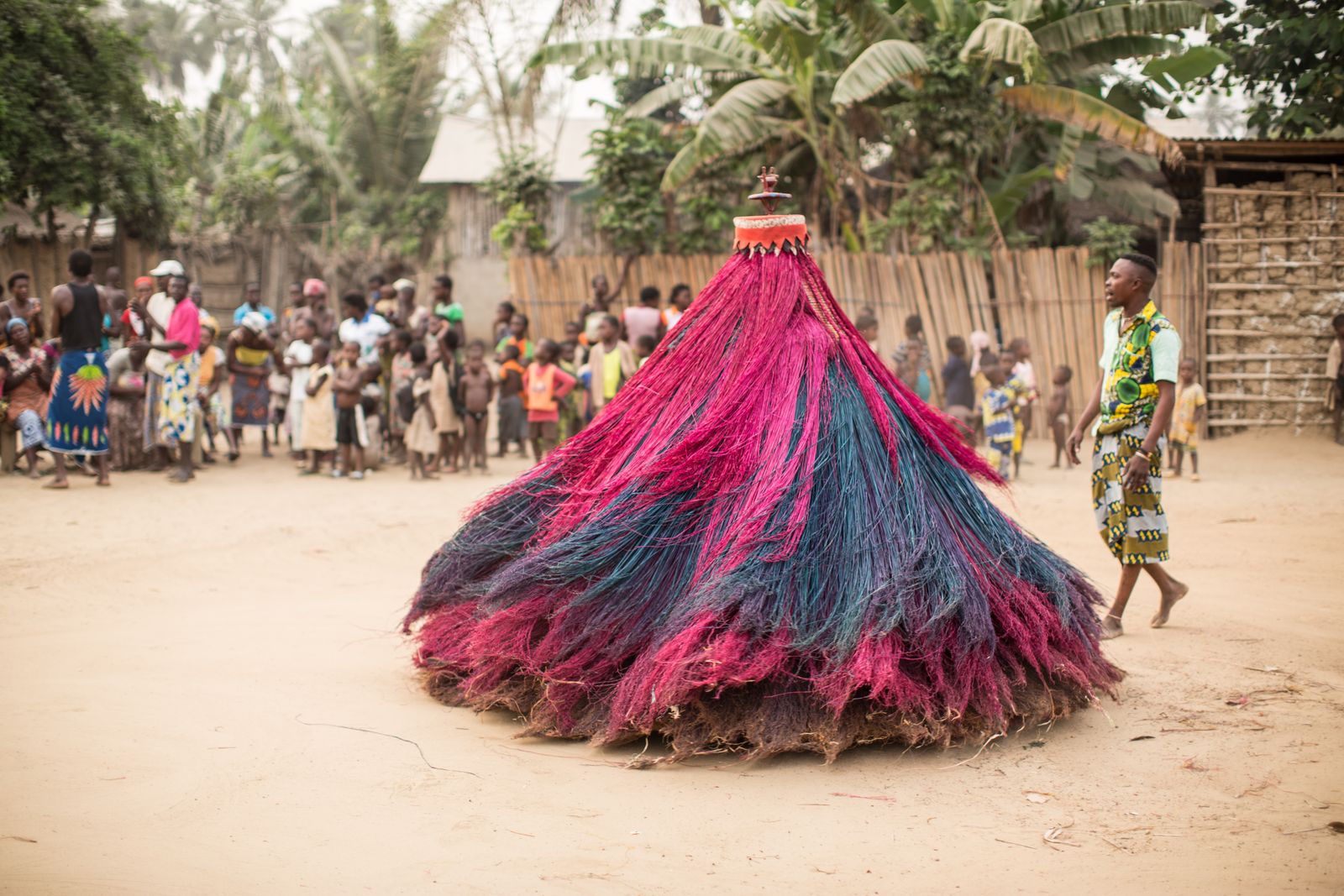
A village in Benin Ouida has its golden moment, deepening the red color of the dusty earth beneath my feet. I sat on a bench and watched as a towering conical structure, carpeted with raffia and dried pink and blue leaves, spun on its axis. These moving leaves are chased by male villagers to the sound of maracas and pulsating drums. They lunged forward to strike at the spinning object, then backed away again, as if testing its limits.
I was watching a ritual for Zamboto, a haystack-like figure understood to be the literal embodiment of the Vodun spirit, the “night watchman” who patrols the community to ward off malevolence. This ritual has been practiced for centuries among the Ogu and Yoruba communities in Benin and Nigeria, and it has spiritual and social power. It was clear to me that this trip was both carefully organized and deeply personal: a 15-day journey through Benin, Togo and Ghana, and my first time in West Africa. As the drumming continued and we were invited to peek inside the structure (to prove there was no one inside, although I suspected someone was hiding among the leaves), I realized that I stood somewhere between observer and returner, trying to understand what it meant to witness something that my own ancestors might have practiced.
Voodoo is a polytheistic religion that originated from the Fon, Ewe and Yoruba tribes in Benin, Togo, Ghana and Nigeria in West Africa. It focuses on the worship of gods and has long been criticized by the West. However, it was more of a way of life than animal sacrifice. Spiritual and public practices that shape everyday life. My presence in West Africa also had a deeper meaning than journalistic curiosity, an almost cellular appeal. After growing up in a white family, I took a series of DNA tests 10 years ago and learned that half of my ancestry can be traced to Nigeria, Benin and Togo, a fact my parents kept from me until the father who raised me died of cancer in 2015. They chose not to talk about my mother’s affair.
Now, I stand in Benin, a place that carries my legacy, watching the rhythm of the crowd and the call of the gods, thinking about the father who raised me—and the other person who doesn’t know I exist.