The Tamesis
As I stood in the Whitney Museum’s sixth-floor gallery for the opening of this year’s Biennial, I noticed the eyes of security cameras, as round and iridescent as soap bubbles, staring right at me. It’s implanted in a rectangular body the color of aged plastic, decades-old desktop computers and exposed bones. There’s also a small embedded LED screen that marks the hour, month, date and year, but it’s unclear exactly what’s going on. I was walking away, confused, when an old woman’s voice spoke, full of warmth and experience. “It’s a combination of too little sleep, too much housework and a very young child,” she says cheerfully. “Not to mention the super moon!” I laughed in surprise at first, and a feeling surged into my heart, but it was quickly suppressed by vigilance.
Related articles

Work, Legacy (July 10, 2022)Cooper Jacoby’s The Terror reveals an emerging genre of horror permeating popular consciousness: measurement and quantification. Jacoby did this by scraping text from deceased creatives’ social media and feeding it into an AI model. The data collected without consent was remixed by generative artificial intelligence and voiced by friends of the artist. LED monitors record how much time has passed since the death of the work’s subject. In this case, it’s three years, six months, 206 days, and 10 hours. The work is by turns gruesome, uncomfortable, and maybe even profane. It’s also a stunning commentary on what Big Tech has been doing for years: scraping our data and using it to animate AI models to make “art,” “writing,” defunding the humanities, directing missiles to detonate over schools, and more.
Jacoby is not the only artist at the Biennale or in the public grappling with the changing face of technology. Social scientists have long noted that digital technologies are associated with qualities such as transparency, objectivity, rationality, and the future. Think millennium aesthetics: tabletops designed so people can see the machinery inside, pop stars dancing in white spaces, haloes of light erupting from advertisements. Each in their own way is committed to creating a new, clean future aboard Spaceship Earth. However, after dozens of technological disruptions, convincing the public that these technologies are ushering in a bright future has become difficult, if not downright laughable. As the world wakes up to our age of technocapitalism of constant surveillance, data extraction, and ubiquitous biometric technology, artists are beginning to peel away the sterile shell of technology to reveal the beasts hidden within the machines.
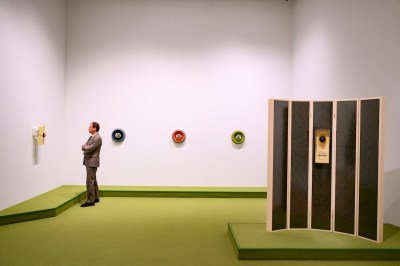
Installation view of the 2026 Whitney Biennial, left to right: Jacoby Cooper, Legacy (January 21, 2016)2024; Mutual Life (24.2 years), 2025; Common life span (76.4 years)2026; Living together (38.9 years old)2025; Legacy (July 10, 2022), 2026.
Darian Deciano/BFA.com
In a fifth-floor gallery at the Whitney Museum, three bodies levitate a foot above the ground, supported by a metal rod driven into their backs. The feet were dangling, the head was drooping, and the eyes were closed, except for the pale impression of the eyelids, which looked more like the features of a death mask. One of the figures was naked, missing a nose, and his skin was dotted with strange textures and vague shapes. Two other corpses were dressed in witch cloaks – the thin plastic cloaks sold at Spiritual Halloween. For this work, the title is For Satan and Other Invisible Evils in America: Experiments in Public Sculpture (Witches 1-3)Isabelle Frances McGuire used high-fidelity 3D medical scans of human body interiors to model the characters. Because the scan captures the interior, the exterior is just a residual form. Like Jacoby, McGuire seems to be thinking about twisted stand-ins. Designed to illustrate the Salem Witch Trials, this is also a scene of accusation. There are people here who are human; there are people here who are not. But here again is the incredible power of digital measurement—a kind of technological evil—to blur the lines between the real and the imposter.
CCTV cameras return in Gabriela Ruiz’s 2026 sculpture Homo Machina (Human Machine aka Gay Machine). The piece looks like a carnival game: a fiberglass machine cast in sticky green with budding growths, a screen, a screaming face petrified in chrome, and a chimera fetus in the womb with its tail in its mouth. The camera’s image is transmitted to monitors symmetrically distributed throughout the work: come closer and see yourself in the monitored funhouse mirror. In other words, the image of the self is captured and consumed in an endless cycle, producing something non-human.
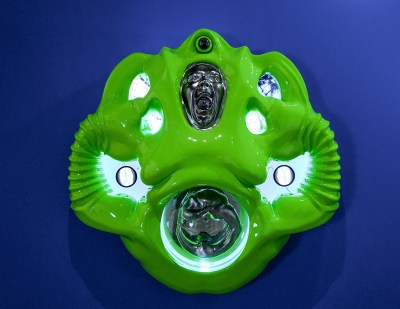
Gabriella Ruiz, Robot2026.
Jason Lowry/BFA.com
Both artists and their audiences seem to be beginning to engage with the question of what it means to be human. As the digital philosopher Yuk Hui pointed out in a recent article, we have gone through a long period in academia (and, I think, the arts) less interested in fixed boundaries between humans and non-humans and more concerned with issues of entanglement. (Remember how much we loved mushrooms?) However, the sudden emergence of generative artificial intelligence has transformed the discourse landscape. Our entanglement with technology is less romantic than the Gaia hypothesis, which posits that the Earth is one big organism and we are just different parts of the same body. Instead, as these artists propose, the mingling of humans and technology is grotesque and terrifying.
It’s hard not to associate these pieces with Collarbone and Bryan Johnson. Collarbone is a “looksmaxxer” who went viral this year for his extreme views on beauty, while Brian Johnson has been on a quest for immortality for years. (Last year, Johnson went viral for pumping blood into the veins of his teenage son, an incident that brought to mind an Internet urban legend about tech founders harvesting the blood of young people.) Both figures represent the true face of technological entanglement: a belief that biometrics, biohacking, and a scientific view of the body and its perfection will pay off. However, the mindset required to submit to this quantified view of the self is so brutally contradictory that it quickly becomes nihilistic. The idea behind Looksmaxxing is to hack the gene pool and convince women that the looksmaxxer is the ideal partner, but Collarbone says he is now infertile because of the treatment he received. Meanwhile, Johnson’s quest for more life becomes so vampiric that if his experiments were the plot of the novel, we would criticize the author for his severity. Both Collarbone and Johnson are driven by the same technical body horror as the aforementioned artists. However, their coping mechanisms are very different: they welcome technology with open arms, hoping to survive. But free from what?
I think I understand now why measurement is so scary to the current generation. Recently, at a dinner party, I met a young tech worker who was trying to convince me to use artificial intelligence in my writing. I tried to explain to him why I didn’t: I really enjoyed writing. I don’t want to not do it. He tried to appeal to my sense of efficiency: Can’t I simplify my work and publish more? I told him he was missing the point. My work is not just a result for me, but a process, a way of spending time on earth. He wanted to know how I would survive the coming era of mass unemployment if I refused to compromise. I said I would find a way. He asked if the AI could be a collaborator who could help me hone my ideas. I told him that I had friends who served just that purpose and that I valued their opinions. But what if an AI was as smart as your friends?he continued. What if he could turn the dinner host, a good friend of mine, into a model who thinks and talks like her? Where does the debate start?
“But I have her!”
“What if she dies?”
“Then I’ll be completely devastated!”
“What makes her so special? If I built that model, how can you be sure it’s not her?”
“She won’t show up to me.”
“So that’s a body? What if we made a body? Are you sure she exists?”
At that moment, I felt a deep sense of strangeness. The red carpet spread out under my feet, and kind faces looked down at me. Is he serious? I want to know. It’s telling, of course, that what started out as a discussion about productivity shifted almost immediately to the heart of the matter: mortality, immortality, and fungibility. If we can be measured so precisely, what’s to stop us being modeled or recreated? Maybe not an exact replica, but close enough? No wonder figures like Collarbone or Johnson cling so tightly to their veins, hoping to stave off obsolescence by embracing quantification. Yet even this dream of alternatives—my friend as a chatbot, as an inanimate doll—is a dull fantasy, a satisfying futuristic sci-fi scenario. No, the future won’t be clean, nearly perfect, or controlled, not even in a magical way. As the artists at this year’s Biennale have hinted, it’s going to be weird, bloody and disgusting.