The Tamesis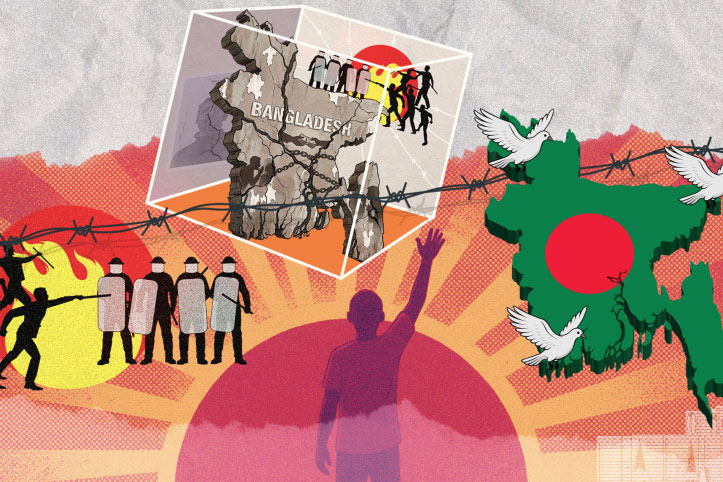
January 21, 2026
Dhaka – As the 13th general election approaches, the call for a “new Bangladesh” has once again taken center stage in political campaigning. The phrase often appears in speeches and rallies, along with promises of good governance, an end to corruption, the restoration of democratic norms, and equal rights for citizens. However, these promises are familiar to voters. For decades, similar guarantees appeared in election after election, only to disappear as power changed hands. A long history of unfulfilled promises has left many voters deeply skeptical.
Against this backdrop, if the promise of a ‘New Bangladesh’ is to go beyond slogans and have real meaning, it is important to focus on some of the key issues that ordinary Bangladeshis actually expect a winning party or coalition to address.
One of the most pressing expectations is decisive action against chandabazi (or extortion and bribery). These practices affect almost every sector of society and have become a daily burden on citizens. Businesses of all kinds, from street vendors to factory owners, from transport operators to developers and landowners, from schools to public service offices, are deeply affected by this system and are in desperate need of relief. Street vendors, for example, often face harassment and are forced to pay police, corporate officials and political strongmen just to maintain their status and avoid being evicted or having their goods confiscated. Those who resist often face threats, false cases or illegal detention. The Bangladesh Hawkers Federation claims that vendors on Dhaka’s sidewalks are extorted about Tk 3,000 crore every year, which is equivalent to more than Tk 80 million every day.
In the transportation sector, almost all commercial vehicles, including trucks, buses and minibuses, are regularly forced to pay extortion money to local political cadres. Markets, transport terminals and launch stations operate under a so-called “token” system, which is really nothing more than an organized extortion controlled by powerful groups. A report released by Transparency International Bangladesh on March 5, 2024 revealed that nearly Tk 1,059 crore in extortion money is paid to private buses and minibuses alone every year.
Furthermore, almost no project, public or private, can move forward without paying bribes or extorting money. According to the committee that prepared the White Paper on the Economic Situation of Bangladesh, of the Tk7.2 billion invested in development projects through the annual development plans during the 15 years of Sheikh Hasina’s regime, an estimated Tk1.61 billion to Tk2.8 billion was lost to corruption, including political extortion, bribery and inflated project costs. The report further estimated the amount of bribes paid to government officials at Tk 77,000 crore to Tk 98,000 crore. Meanwhile, politicians and their associates obtained Tk 70,000 crore to Tk 1,40,000 crore through extortion and colluded payments. Chadbazi and bribery have long been a major source of public dissatisfaction, closely linked to political corruption and poor law enforcement, and citizens are demanding firm action to finally address these issues.
Another serious issue that has emerged recently is the dramatic increase in mob violence, ethics policing and online abuse. While mob violence existed in the past, its scale and nature have changed significantly since August 2024, becoming a frequent and alarming phenomenon across the country. Data from human rights group Ain o Salish Kendra shows that at least 97 people were killed in mob attacks between August and December 2024, while at least 198 people were killed in mob attacks in 2025.
Reports in national and independent media indicate that mobs are no longer targeting individuals. They now attack homes, properties, political party offices, cultural institutions, religious minorities and places of worship. Many of these incidents appear to be organized and designed to intimidate communities, exploit religious or ethnic tensions, and destabilize social and political groups. On the evening of December 18, 2025, a group of people vandalized, looted and set fire to the offices of The Daily Star and Prothom Alo, two of the country’s most widely circulated newspapers. On the same night, the cultural organization Chhayanaut was also vandalized and set on fire.
Several recent incidents have further highlighted the scale of the problem. In August 2025, two men were beaten to death in Sirajganj for allegedly stealing cattle. In July 2025, Hindu houses in Rangpur were vandalized following a Facebook post. In Lamonier Hat, a 70-year-old barber and his son were attacked in June 2025 after being accused of hurting religious sentiments. In March 2025, a man’s eyes were gouged out by thugs in Bora. In the same month, an Uber driver in Dhaka was beaten to death after being mistaken for a robber.
What is troubling is the rise of so-called “moral policing”, where groups of men harass young girls and women because of their dress, lifestyle choices or behaviour. At the same time, women who speak out for their rights are increasingly facing severe abuse both online and offline. This includes defamation of character, being labeled immoral or promiscuous, body shaming and threats of violence against them and their families. Such attacks are often part of a coordinated effort to silence women and prevent them from participating in public life. Police data shows that a total of 21,936 cases related to violence against women and children were filed in 2025.
Together, these developments illustrate how mob violence and aggression, both online and offline, is eroding Bangladesh’s social fabric, fueled by rumors, unresolved anger, and misinformation spread rapidly through social media, while weak law enforcement contributes to a culture of impunity. The breakdown of the rule of law has also become a major obstacle to doing business in Bangladesh, disrupting supply chains, increasing operating costs, keeping prices high, fueling inflation, and discouraging local and foreign investment. As insecurity and uncertainty increase, citizens and businesses alike must bear its cumulative costs.
Restoring the rule of law and dismantling the entrenched system of bribery and extortion must therefore be at the heart of any claim to build a “new Bangladesh”. Political parties must understand that without a credible commitment to curbing mob violence, protecting citizens from arbitrary intimidation, and impartial law enforcement, their slogans will remain hollow and public trust will continue to erode. The party or coalition that wins the upcoming election will be judged not by its words about change but by whether it ultimately demonstrates the political will to effect change.
Abu Afsarul Haider is an entrepreneur. You can contact him at [email protected].
The views expressed in this article are solely those of the author.