The Tamesis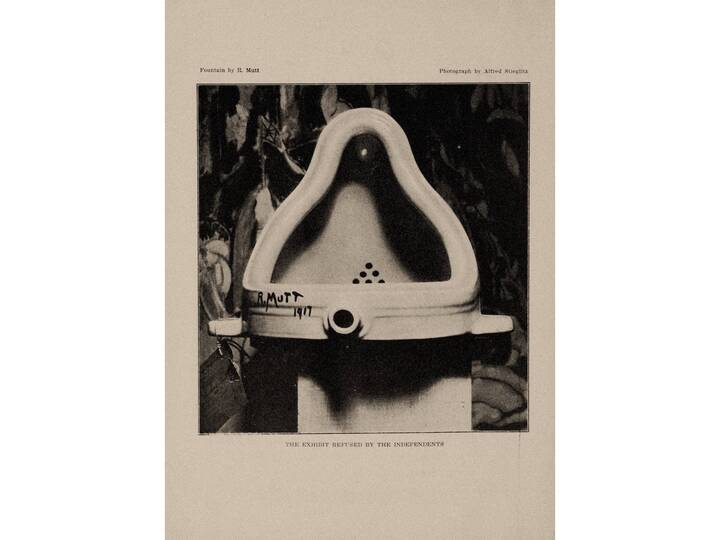
When does something become a work of art? A canvas once it’s been painted? A block of marble once it’s been carved? For Marcel Duchamp (1887–1968), the answer was much more direct and far more radical: Anything—indeed, everything—could be art if an artist deemed it so. “An ordinary object,” he said, can be “elevated to the dignity of a work of art by the mere choice of an artist.” This notion, which found expression in his iconic Readymades, would prove to be the most revolutionary innovation of 20th-century art.
Duchamp’s Readymades—realized between 1913 and 1923, the year he claimed to have quit making art—were mass-produced goods plucked from the everyday, either alone or in combination. Duchamp’s very first Readymade was an example of the latter: the front fork of a bicycle bolted upright onto a four-legged stool, allowing the attached wheel to spin freely. That object was joined in 1914 by another when Duchamp went to the Bazar de l’Hôtel de Ville, the legendary Parisian department store, and brought home a towerlike metal bottle-drying rack festooned with prongs, known as a hérisson (“hedgehog”) due to its spiky appearance.
Related Articles
Still, Duchamp didn’t treat either as art. Initially he viewed the bicycle wheel as an amusing diversion; he “enjoyed looking at it, just as I enjoy looking at the flames dancing in the fireplace.” By the same token, he left the bottle rack alone. In fact, Duchamp didn’t coin the moniker Readymade until a 1915 sojourn to New York City.
Duchamp’s journey to New York was necessitated by the outbreak of World War I. While deemed unfit for military service due to a rheumatic heart condition, Duchamp was an otherwise healthy-looking young man out of uniform, attracting the ire of fellow citoyens who considered him an unpatriotic shirker. Duchamp was insulted, threatened, and even spat upon, leading him to leave Paris.
Upon arriving in New York, Duchamp was immediately struck by its modernity and absence of class consciousness. Maybe the resultant sense of freedom led Duchamp to believe that there were no boundaries in art, or perhaps it was the cornucopia of stuff spilling out from shops on every block, but for whatever reason, the Readymade notion became crystalized in a letter Duchamp wrote to his sister, Suzanne, back in Paris.
Mentioning the bicycle wheel and the bottle rack, he added that he’d “bought some objects of similar taste” while in New York. “I will treat them as ‘readymade,’” he noted. “I sign them and . . . then apply an . . . inscription.” He asked Suzanne to go to his studio and sign the bottle rack “Aprés Marcel Duchamp,” to create a “distant ‘Readymade.’” Unfortunately, by then she’d pitched it into the garbage along with the bicycle wheel while cleaning out her brother’s space.
Duchamp’s missive also referenced a Readymade conceived as such: A snow shovel with “In Advance of the Broken Arm” and “Aprés Marcel Duchamp“ written on the handle. While many consider the words an ironic warning about the dangers of leaving a sidewalk uncleared during winter, Duchamp meant it to be nonsensical, telling Suzanne, “Don’t try too hard to understand it in the Romantic or Impressionist or Cubist sense—that does not have any connection with it.“
The piece originated in an encounter with a hardware store in November 1915, as Duchamp walked along Columbus Avenue with Suzanne’s husband, the artist Jean Crotti (1878–1958). Both men marveled at the surfeit of shovels stacked by the door. Impressed by this demonstration of America’s manufacturing might, Duchamp took one back to his studio, inscribed it, and hung from the ceiling.
Readymades didn’t emerge in a vacuum, however. In 1912, Georges Braque (1882–1963) had glued strips of fake-wood wallpaper onto a pencil-and-gouache still life titled Fruit Dish and Glass, done in the Analytic Cubist style he’d developed with his colleague/competitor/collaborator Pablo Picasso (1881–1973). By inserting this common, mass-produced material into his composition, Braque blurred the line between ordinary things and works of art. Picasso went even further with Glass of Absinthe (1914), a small sculpture topped with an actual absinthe spoon—the perforated utensil made to hold a sugar cube while the liquor is poured over it. Between them, Braque and Picasso had formulated appropriative strategies that would be used over the ensuing decades.
Duchamp’s bicycle wheel, however, differed significantly from Picasso’s spoon, as the latter served a representational role. Readymades, by contrast, were chosen with studied neutrality, “based on a reaction of visual indifference,” as Duchamp put it. This attitude also distinguished Readymades from Surrealist objets trouvés inspired by Freud’s theory of fetishism (the sexual fixation on shoes and other clothing), the most famous of which was Salvador Dalí’s Lobster Telephone (1938).
Duchamp soon introduced a flood of Readymades, and while their selection was random, they shared one key distinction: All had been useful items rendered useless by Duchamp to question art’s efficacy. Articles divorced from functionality in this fashion included Traveler’s Folding Item (1916), a cover for an Underwood typewriter, which Duchamp chose because he “thought it would be a good idea to introduce softness in the Readymade.”
Trap (1917), a coat hanger with four hooks screwed into a board, started out destined for a wall but was left unattended on the floor instead. After regularly tripping over it, Duchamp decided, “The hell with it, if it wants to stay there and bore me, I’ll nail it down,” making it a Readymade. Similarly, Duchamp suspended the eponymously titled Hat Rack (also 1917) well out of reach of anyone’s chapeau.
Hat Rack resembled a spider, or at least Duchamp suggested as much in a 1918 photograph of Readymades casting shadows on his studio wall. In the photo, Hat Rack is seen nestled within the weblike Sculpture for Traveling (1918), a net of rubber shower caps cut up and glued together that Duchamp took on a trip to Buenos Aires.
Several Readymades were unrealized. One, Emergency in favor of twice, existed solely as an unfathomable phrase mentioned in a letter from Duchamp to his sister. Another involved lower Manhattan’s Woolworth Building. In a note to himself from 1916, Duchamp wrote, “Find inscription for Woolworth Bldg as readymade,” though he never settled on one. The structure was the tallest in the world at the time, making Duchamp’s plan all the more audacious.
The Readymades have usually been divided into “assisted,” or altered in some fashion, and “unassisted.” Technically, all inscribed or mixed Readymades were assisted, though the term was more easily understood in those works evincing Duchamp’s facture. An early example is Pharmacy (1914), in which he added two spots of color and his signature to a cheap, kitschy print of a winter landscape. (The splotches reminded Duchamp of apothecary bottles, hence the name.)
Two other Readymades, Apolinère Enameled (1916–17) and L.H.O.O.Q (1919), likewise displayed Duchamp’s hand. The first, a lithograph-on-tin advertisement for Sapolin Enamel, pictured its label above a scene of a young girl painting a bedstead. By subtracting and adding letters from the brand, Duchamp created an homage to the French poet and critic Guillaume Apollinaire (1880–1918), though he spelled the name wrong (he later said he hadn’t known Apollinaire all that well). Duchamp also penciled in the back of the young girl’s hair in a mirror depicted in the ad.
For L.H.O.O.Q, Duchamp scribbled a Vandyke beard on a postcard of the Mona Lisa before adding the title—which, when the letters are sounded out in French, mean “She’s got a hot ass”—underneath. Although Apolinere Enameled possessed unsavory erotic undertones with its image of a child caressing a phallic bedpost with a brush, L.H.O.O.Q. made the subtext text in its gender-bending send-up of the Old Masters.
Some of Duchamp’s Readymades were produced as gifts for, or with input from, his chief benefactor, Walter Arensberg, a steel-fortune heir. Paris Air (1919), 50 cc of the titular substance sealed in a pharmaceutical ampule, was one such present for Arensberg, while a steel comb cryptically inscribed with “3 or 4 drops from [of] height have nothing to do with savagery” in French was a collaboration with him. So, too, was With Hidden Noise (1919), a ball of twine sandwiched between two brass plates. It was sent to Arensberg with instructions to unscrew the top, secrete an object known only to him in the center of the twine, and then close it back up. The title was a nod to the rattling sound produced by the mystery artifact.
Arensberg was also involved in the creation of Duchamp’s most infamous Readymade: Fountain (1917), a urinal turned upside-down that was entered into the inaugural exhibit of the Society of Independent Artists under the boldly emblazoned signature R. Mutt. Fountain was installed out of sight from the rest of the show, prompting Duchamp to remove it. It soon graced the cover of the Dada journal The Blind Man, in a photo taken by Alfred Stieglitz to accompany an essay by Duchamp defending Mutt.
Essentially a test of artistic freedom, Fountain was conceived by Duchamp along with Arensberg and the painter Joseph Stella, who together went to the J. L. Mott Iron Works at 118 Fifth Avenue to purchase the urinal. Arensberg was also a board member of the Society of Independent Artists (as was Duchamp) and thus obliged to answer for Fountain. In one instance, the painter George Bellows angrily confronted Arensberg, demanding to know whether “horse manure on a canvas” would be acceptable for the show, to which Arensberg replied that it would.
Just about every aspect of Fountain has been debated, from the origin of Duchamp’s pseudonym (which he said came from the popular comic Mutt and Jeff) to the place of its procurement to whether it was really Duchamp who had submitted it. Some have argued that it was actually the wildly bohemian Baroness Elsa von Freytag-Loringhoven, a notion based on another letter to Suzanne in which Duchamp said a female friend had brought in Fountain.
Whether the baroness was involved or not, it’s true that other Readymades were produced by a woman—or at least a fictional one in the form of Duchamp’s drag alter ego, Rrose Sélavy. In terms of code-switching, Rrose Sélavy was the counterpart to thebearded Mona Lisa in L.H.O.O.Q. Her name—a pun on Eros, c’est la vie (“Eros, that’s life”)—was originally spelled without the extra R but was changed in 1921 when Duchamp wrote it on L’Oeil Cacodylate, a collage by Francis Picabia (1879–1953). Picabia had created it while laid up with an eye infection and had asked friends visiting him to add their names to it, much as they would to a cast.
Duchamp, elegantly coiffed and dressed in the latest fashions, appeared as Rrose in photos taken by the American photographer and artist Man Ray (1890–1976). Rrose was soon connected to several Readymades, most famously Why Not Sneeze Rose Sélavy? (1921), a birdcage containing a thermometer and cuttlefish bone stuck into a jumble of marble cubes. The last, ordinarily used to remove built-up lime scale inside teakettles, was purchased from a hardware store, and their cool-to-the-touch temperature, along with the thermometer, were meant to evoke catching a cold. The cuttlefish bone, meanwhile, symbolized the bird that had literally flown the coop. Duchamp’s title also alluded to the physiological similarity between a sneeze and an orgasm.
Another Readymade ascribed to Rrose, Fresh Widow (1920), features a scale model of a French window with panels of black leather covering the glass. Beside its evident wordplay between widow and window, Fresh Widow is notable because it is one of the few Readymades to survive intact, as almost all of the rest were lost or destroyed over time (though editioned replicas were made in the 1960s).
The Readymades, then, were as perishable as the objects used to make them, which was always part of Duchamp’s intent. More than most artists, he understood how the Industrial Revolution had transformed society, not only in the way it replaced the handcrafted with the machine-built, but also in the way it challenged assumptions about cultural permanence. Since the definition of a work of art depended on its unique character, Duchamp wondered how it could survive against an avalanche of snow shovels. In the age of AI, that question seems as relevant as ever.