The Tamesis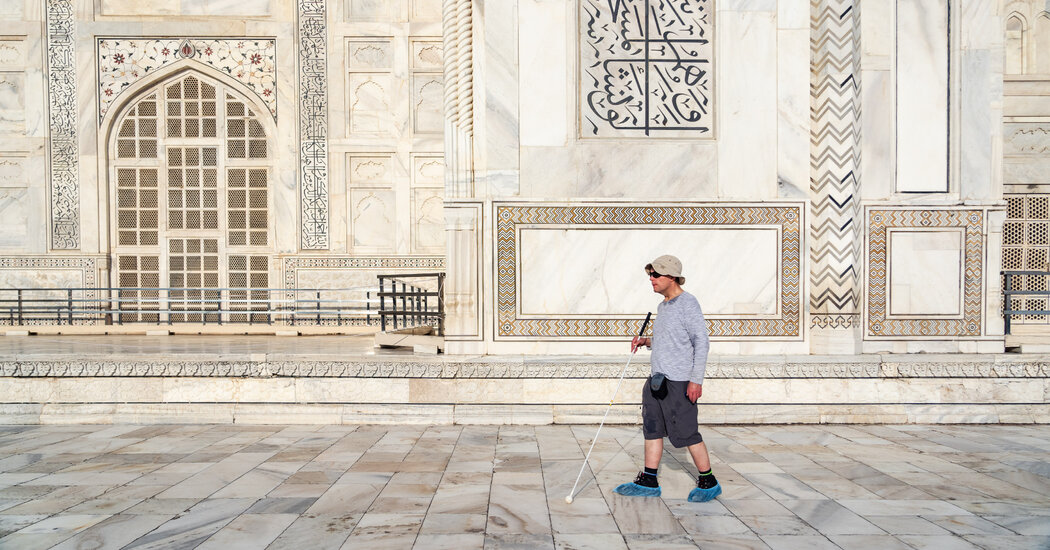
Luke walked beside me, one hand curled around my arm, the other tapping a gentle rhythm with his white cane. We were crossing the Taj Mahal’s grounds just after sunrise, the air already balmy and faintly perfumed. From the scattered murmur of tourists, Luke said he could sense a grand, open space around us. I described the Persian-style gardens — reflecting pools, clipped shrubs, stone walkways in perfect symmetry. Then I read aloud a sign: “Don’t make direct eye contact with monkeys.”
Near the mausoleum’s entrance, the ground changed — rough sandstone yielding to cool marble, smooth beneath our feet. I guided Luke’s hands to the white facade …
[–>
As his fingers roamed, Luke recalled the photographs he’d seen as a child, before retinitis pigmentosa, a hereditary eye disease, gradually narrowed his vision and then, at 18, took it away.
“I get the impression of something opulent and magnificent,” he told me.
Inside, we joined the flow of tourists circling the tombs of Shah Jahan and his beloved, Mumtaz Mahal. Their voices echoed beneath the dome, drawn out into long, soft reverberations. In the past, this space carried recitations of the Quran — with acoustics meant to evoke the sound of paradise.
Luke tilted his head toward the ceiling. “It’s almost like you’re inside a speaker,” he said.
I closed my eyes and listened.
[–>
What does it mean to travel somewhere new and not be able to see it? That question led me on a 10-day journey through northern India’s Golden Triangle with Traveleyes, a British tour company that pairs visually impaired and sighted travelers.
So much of the language we use around travel — sightseeing, scenic vistas, must-see lists — assumes that the world is best, or only, understood through the eyes. But as the writer Pico Iyer wrote to me in an email before the trip: “Travel is not about seeing the sights so much as opening oneself up to the unfamiliar — a matter of perception and vision in a deeper sense.”
For years, whenever I returned from a trip abroad, a friend of mine would ask: What did it smell like? I always fumbled for a meaningful answer. What layers of experience — what deeper kind of vision — had I been missing?
Amar Latif, a British entrepreneur, founded Traveleyes in 2004 to address the lack of accessible travel options for blind and visually impaired people. After losing most of his sight by age 18 because of retinitis pigmentosa, Mr. Latif struggled to travel independently. Mainstream tour companies often rejected him, insisting he bring a caregiver and excluding him from more adventurous activities like hiking and skiing. Those exclusions pushed him to create something of his own: a company that would allow blind travelers to explore the world without relying on friends or family. “Friends and family switch off,” he told me. “They’re not as eager to describe things.”
Traveleyes runs on a simple but radical model: It pairs blind and sighted travelers as equal companions. Sighted participants assist with navigation and describe visual details — in exchange for a discounted trip — while blind travelers bring a fresh perspective that often deepens the experience for both. The company promises “a truly multisensory travel experience,” with itineraries designed to engage all five senses.
Destinations include Cuba, Eswatini and Britain’s Lake District, among many others, and trips often include immersive, tactile experiences: paragliding in the Canary Islands, kneading pizza dough in a Tuscan farmhouse, handling museum artifacts typically kept behind glass. On Lake Titicaca in Peru, locals built a miniature reed island for Traveleyes visitors to explore by touch. In Xi’an, China, they were granted rare permission to feel the terra-cotta warriors. To me, India — with its sensory onslaught of honking horns, potent smells, vivid colors, spices and heat — seemed like the perfect place to experience travel in its fullest, most immersive form.
After I booked my trip, Traveleyes sent me a “Sighted Guide Pack” — a short primer. “Don’t be nervous!” it began. “Guiding may seem daunting, but once you get into the swing of it, nothing could be easier.”
No prior experience was required — just a friendly attitude and a willingness to describe what you saw. Each day, I’d be paired with a different visually impaired traveler — referred to as a “V.I.” — and together we’d find our rhythm.
I met the group at a hotel in New Delhi. Among the travelers were two women — one visually impaired — who had met on a previous Traveleyes trip; this was now their sixth journey together.
On our first day I was paired with Daniel, a 38-year-old software consultant from Oxford. It was his 12th Traveleyes trip; he’d previously visited Romania, Bhutan and Jordan. Daniel had several eye conditions, including nystagmus, which causes involuntary eye movement and makes it difficult to focus or judge depth. He often held his phone just inches from his eyes.
On a visit to Old Delhi, I guided Daniel barefoot through a Jain temple, fragrant with wafting incense and filled with soft instrumental music, and into the adjoining bird hospital, a rather crowded and grimy convalescent home for the winged and wounded. He gripped my arm lightly, reading shifts in elevation through subtle cues in the movement of my body. I told him when steps were coming, how many and in which direction. For tight entryways, I walked ahead, with my guiding arm behind me. I felt like I was getting into the swing of it.
Strolling in pairs through the tight, noisy streets of Old Delhi, our group of 18 made for a curious sight. It struck me how rare it is to see so many visually impaired travelers moving together — especially in a place that feels overwhelming even for the sighted. We navigated uneven pavement, wove around men carting guavas and sacks of cement.
[–>
As our tour bus crawled through Delhi’s snarling traffic, Daniel reflected on how blind and visually impaired people make sense of the world. “Everyone builds the world in their own way,” he said. Some rely on the spatial qualities of sound, others on scent, or even the feel of air moving around them. “Even sighted people use some combination of these elements,” he pointed out. “But when you’re deprived of one, you compensate with the others — and everyone does that differently.”
[–>
The next day, on our drive to Agra, I was paired with Candie, a blind woman from Seattle who works in taxpayer advocacy at the Internal Revenue Service. Born with glaucoma, she could once detect light and the presence of large objects, but her vision gradually deteriorated. A decade ago, at 40, she had one eye removed and now has an ocular prosthesis.
“The whole sights thing doesn’t thrill me,” she said. What excited her were immersive, hands-on experiences — zip lining, rappelling down waterfalls, white-water rafting. On a previous Traveleyes trip to Peru, she rode a rickety train and leaned out the window, arms in the wind as if she were on a roller coaster. In Costa Rica, she tried surfing.
Candie said she wanted to hear about “the reality of India.” She preferred descriptions of people — their behavior and appearances — over scenery. “Tell me what they’re doing,” she said. “Even if it’s just someone lying on a bench or sleeping on the sidewalk — that’s more interesting to me than, ‘There’s a tree over here with yellow leaves.’” I peered out the bus window. Along the roadside were barbers who’d hung mirrors on fences, shaving customers perched on low stools, and flower vendors threading marigold garlands. I told Candie how cars here drive on the left, and how clearly marked lane lines were almost universally ignored. Vendors had strung multicolored snack packets across the fronts of their stands like strands of vibrant beads.
“Oh, that’s interesting,” she said.
We passed six-story apartment blocks with laundry fluttering from open windows.
“Hmm,” she said. “In a lot of places in the States, you can’t do that.”
At a truck stop cafeteria where we had lunch, I described the triangular structure of a samosa and the ingredients in dal, then used clock-face references to guide Candie to each item on her tray. She paid for the meal, carefully handling the rupee notes — colorful, textured bills adorned with traditional Indian motifs and Gandhi’s portrait at the center. I described those to her, too.
I was beginning to notice how speaking these details aloud sharpened my perception. Things I might have otherwise overlooked or skimmed past — the kind of prosaic elements that quietly define a place, like the black-and-white stripes on New Delhi’s curbs or the mandala murals painted on highway overpasses — became more visible to me when I put them into words. In naming them, I was also etching them into memory.
In Agra, we joined the early-morning crowds jockeying for photographs of the Taj Mahal at dawn, its pale, glowing silhouette mirrored in the long reflecting pool. “They took a bunch of blind people to watch the sunrise — kind of funny,” Ann, a visually impaired traveler from England, said wryly. We toured the site in pairs; one sighted guide told me she described the domed mausoleum to her partner as a giant Hershey’s Kiss.
One visually impaired traveler recalled his time inside the mausoleum as being deeply moving. “I heard this low, generic hum — almost like an ‘om’ — filling the space from people quietly talking,” he told me. “I realized that everyday conversation had created this peaceful resonance, like a background chant. Sighted people probably wouldn’t even hear it; they’re too busy snapping photos.”
We eventually arrived in Ranthambore, a town in Rajasthan near a national park that was once the private hunting grounds of the Jaipur royal family. Today, it’s considered one of the best places in India to spot wild Bengal tigers. Before our safari, in the hotel gift shop, I placed a tiger figurine in Candie’s hands. She ran her fingers along its long torso and stout legs, tracing the raised stripes.
“Oh wow,” she said. “It’s much longer than I’d thought!”
We toured the park in an open-topped bus, its diesel engine rattling as we bounced along rutted dirt tracks that wound through dry forest, open meadows and rocky outcroppings. Every so often, our driver stopped at the sight of antelope, sambar deer or a quick-moving mongoose. Channeling David Attenborough, I narrated for Candie as a peacock fanned his feathers in a slow, deliberate courtship display.
[–>
The next day, I experienced my own version of that thrill aboard an auto rickshaw in Bundi, a hillside town known for its blue-painted houses and ancient step wells. I was paired with Chris, an accessibility specialist for the British government. Highly expressive with his eyes, Chris explained that he had optic nerve hypoplasia, a congenital condition that left him with a “pinhole-camera-type view of the world.”
I closed my eyes as we climbed toward Bundi’s palace, perched above the town. The sudden jolting turns, the rush of wind, the blare of horns and the shifting smells — spices, incense, street food, exhaust, cow dung — turned the ride into a visceral blur of motion, sound and scent. I felt every brake, every bump and sway.
Chris described it much the same way. “I feel all the micromovements — it’s like a 1970s fairground ride,” he said as we twisted up the road. “A bit edgy. A bit bumpy. It jolts and pivots. It’s got that amusement park atmosphere.”
As our group strolled in pairs through the center of Bundi, weaving between loitering cows and whizzing traffic, our local guide, Munish, paused at a street stall where a smiling man was stirring a drink made from a vivid green paste. He was, Munish explained, a government-authorized vendor of bhang, a traditional, cannabis-infused beverage.
Inexperienced but curious, a few of the V.I.s decided to try it. Later, Chris described how the high distorted his sense of time and space. Lying in his hotel room, the hum of the air-conditioner seemed to harmonize with the sound of the shower. Together, they sang.
[–>
Over the course of the trip, I’d heard a few visually impaired travelers grumble that some of the sighted participants were being too heavy-handed in their approach to guiding — “overwarning and overcautioning,” as one put it. As we boarded the bus to Udaipur the next day, Suzie announced that some V.I.s felt as if they were being “passed around like furniture,” with items taken from their hands as if they were children. The issue was clear: Sighted guides sometimes forget that their V.I. companions are independent adults. “I’m another human being,” Susan, a V.I. from San Francisco, told me. “I’ll say what I need. When someone sees themselves as a helper, the whole relationship gets skewed.”
Traveleyes promotes guiding as companionship, not caregiving — someone to explore with, to share a drink at the hotel bar with, not someone to manage. But the lines can blur when you’re also escorting someone to a bathroom stall.
“It’s a little like a complex dance routine,” Chris told me. “You have to learn each other’s moves and try not to tread on each other’s toes, but you also have to give each other room to learn and grow.”
On our long drives across the Rajasthani desert, past sand-colored cliffs and craggy outcroppings, Munish offered insights into Indian society — the caste system, arranged marriage, the law of karma. “If I can’t buy a Ferrari in this life, that’s fine,” he quipped, introducing the concept of reincarnation. “I’ll wait. I’ve got plenty more chances.”
One afternoon, he shared a well-known Hindu parable about six blind men who encounter an elephant for the first time. Each tries to describe it while touching a different body part. One, feeling a leg, insists the elephant is like a massive cow. “No, it’s a giant snake,” says another, gripping the trunk. A third, stroking a floppy ear, imagines a flying carpet.
They argue, each convinced his perception is correct.
The moral, Munish explained, is that everyone experiences the world differently, and that no single viewpoint captures the whole picture. Understanding others’ perspectives, the parable teaches, is part of seeing the fuller truth.
I thought about this later, on our train ride to Jaipur, when I asked Candie to share some of her most memorable moments from the trip. One had taken place in Delhi, just after she stepped off the bus at Humayun’s Tomb, a 16th-century Mughal mausoleum. She felt a small hand tap gently against her arm. Instinctively, she reached out and gave it a squeeze. The hand squeezed back.
What struck her was the texture — rougher than any child’s hand she’d ever touched. She realized it must have belonged to a young beggar.
For Candie, that brief moment of contact was transporting — a brush with the unfamiliar. “I just wanted to hang out with them and find out as much as I could about their lives,” she told me. What had shaped those hands? What had they endured? What did survival look like, day to day?
It reminded me of something Mr. Latif told me about the difference between how blind and sighted people experience travel: For blind travelers, it’s like reading a book; for sighted ones, it’s more like watching a film.
Sighted people tend to rely on immediate visual cues — architecture, color, landscape — forming quick, vivid impressions, like a movie that lays everything out on the screen. For blind travelers, Mr. Latif explained, the world reveals itself more slowly, through layers of sound, touch, scent and spatial awareness. It’s a more immersive, interpretive process — like reading a novel, where the story unfolds through detail and imagination.
“And the book,” he said, “is often better than the film version.”
On the last day of our tour, in Jaipur, we visited a jewelry workshop and the Amber Palace, a hilltop fort of mirrored halls and ancient ramparts. Later, we stopped at a community-run elephant park, the kind of modest place where you can feed bananas to the animals.
Suzie guided Candie up to one of the elephants.
[–>
Candie reached out, wrapped her arms around the elephant’s thick leg and slowly traced her hands along its limber trunk. I asked what it felt like.
She paused. “Honestly,” she said, “like a tall, obese man with a big, hairy leg.”