The Tamesis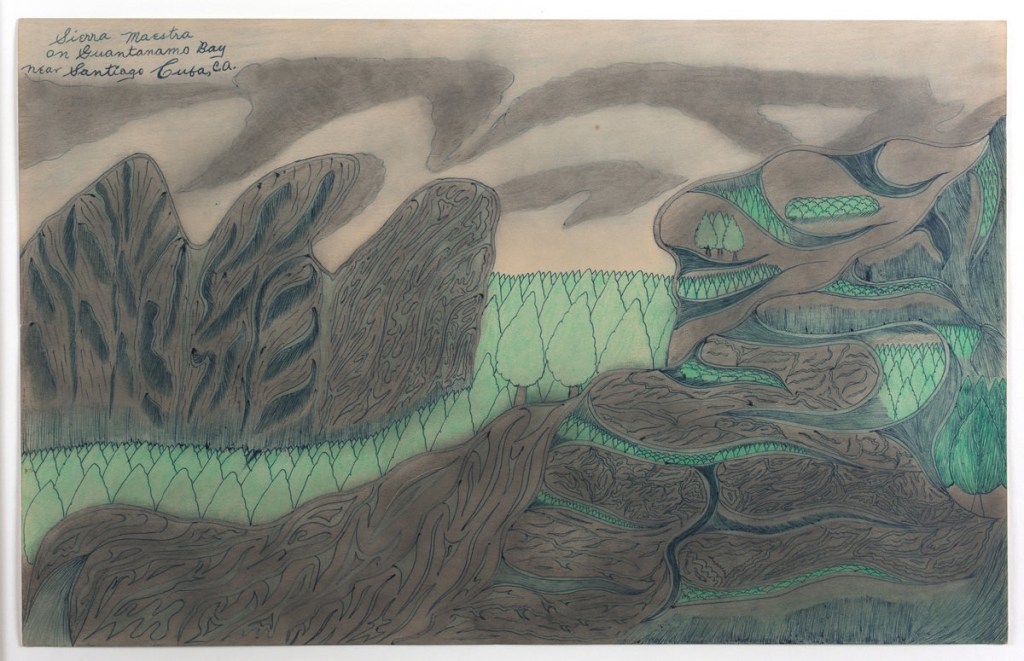
The field of outsider art continues to expand its scope to include not only the work of self-taught artists, folk artists, vernacular artists, and artists with developmental, mental, and physical disabilities, but also nearly all creators who work outside the mainstream, whether by choice or circumstance. At the same time, however, outsider art itself is moving toward the mainstream: in recent years, it has been a focal point or significant presence at institutional exhibitions and biennials, such as the upcoming Minnie Evans show at the Whitney and the 2024 Venice Biennale.
Perhaps most tellingly, it also attracted the attention of the art market, with Christie’s even holding an annual auction dedicated to works by outsiders. In line with these developments, but somewhat paradoxically, the Outsider Art Fair has become a more explicit stakeholder in a growing market category, while at the same time defining “outsider” more broadly than ever before.
This year’s installations cover various aspects of Susan Cianciolo’s resurrection work run shop (2000), showcases clothing and homewares created by the independent fashion designer and 40 of her friends, students and past collaborators, as well as the work of self-taught Gullah artist Sam Doyle (1906-1985) in a solo exhibition booth at the Gallery of Everything.
As every year, the show leaves room for a variety of price points and formats. Ricco Maresca’s exhibition of high-priced works by Bill Traylor, Martín Ramírez and Henry Darger, for example, sit side by side with Keith de Lellis’s crowded salon-style display of affordable vernacular photographs, fashion illustrations and other works on paper, including those by photographer Roy DeCarava DeCarava’s stunning early screen prints. Elsewhere, an academic showcase of raw Surrealist art by Cavin Morris coexisted with the cluttered booths of studios such as New York’s Fountain House Gallery.
Here are five more great booths.
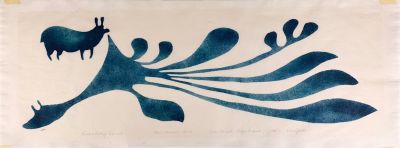
“from the north”

Image credit: Feheley Fine Arts.
The community of Kinngait (known as Cape Dorset until 2020) in the northern Canadian territory of Nunavut has given birth to famous Inuit artists such as Kananginak Pootoogook, Pitseolak Ashoona and Kenojuak Ashevak, mainly through the West Baffin Eskimo Cooperative, an art studio established in 1959. This year, the fair’s annual curated stand is organized by Canadian galleries Elca London and Feheley Fine Arts (which also have their own stand at the fair). The exhibition, “From the North,” showcases a stunning selection of works by Kinngait artists, including prints created between 1959 and 2009 at Kinngait Studios, Canada’s oldest printmaking studio. Notable works include Ashevak’s early prints, which showcase the artist’s signature curvilinear forms, and transport suicide (2011) is a devastating colored pencil drawing by Shuvinai Ashoona (b. 1961), who often explores the sometimes harrowing realities of contemporary Aboriginal life.
Fleischer/Allman

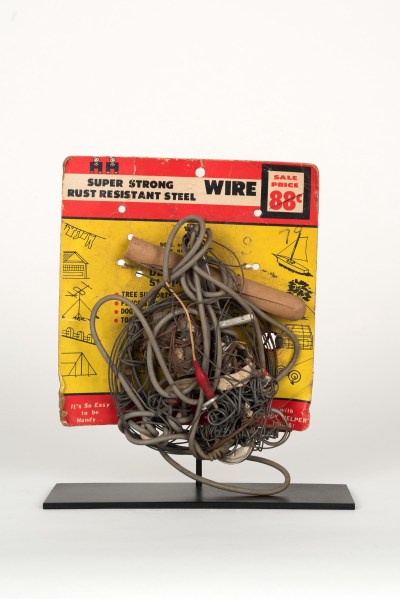
Photo credit: Courtesy of Fleisher/Ollman
A veteran of the Outsider Art Fair, the Fleisher/Ollman gallery features outstanding works by William Edmondson, Joseph Yoakum, James Castle and other 20th-century giants, as well as a group of seven sculptures by Philadelphia Wireman. Wireman is an unknown creator whose sculpture was found abandoned in a Philadelphia alley in the late 1970s. Each of Wireman’s pieces is a collection of found objects, including pens, nails, jewelry, scraps of plastic, and other small objects held together with wire, tape, or rubber bands. The artist rarely incorporates printed packaging of any size into their work, which is what makes this Pop Art-adjacent piece so unusual.
Bonnard Gallery

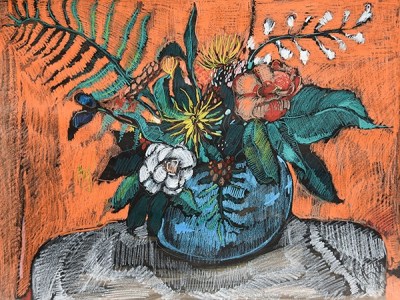
Photo credit: Courtesy of Galerie Bonheur
Bonheur Gallery, St. Louis; Palm City, Florida; and Sapphire City, North Carolina, present two works—a still life and a landscape—by Trinidad-born actor, theater director, and costume designer Geoffrey Holder, perhaps best known for his Tony Award-winning “ Wizard (And his 7-UP commercial). The gallery also displays an oversized beaded Vodou flag from Haiti, which shares a wall with a contemporary interpretation of the traditional Vodou flag by Haitian artist Mirelle Delice, a disciple of famed flag artist Myrlande Constant.
Dutton

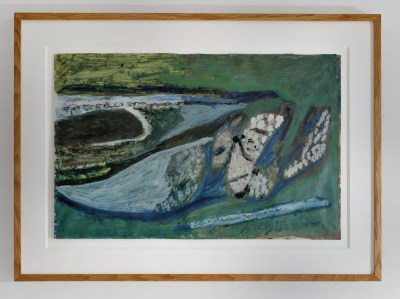
Image source: Courtesy of Darden
One wall of the Dutton Gallery booth features works by Australian Bushman Selby Warren (1887-1979). Warren began painting at age 76 and was discovered at age 85, creating memory paintings that mixed materials such as dirt, sand, grass clippings and construction materials. In these books he documented his life as a migrant worker and the countryside and wildlife of his native New South Wales. They hover between folk and abstract, sometimes appearing surprisingly modernist. More of Warren’s art will be on display at the Dutton Gallery in New York through March 29.
Paul Lemaitas

Photo credit: Courtesy of Pol Lemétais
In addition to examples of classic art, French gallery Pol Lemétais offers a collection of atypical abstract postcards by the visionary British artist Madge Gill (1882-1961), as well as fascinating ink drawings on vintage maps by French outsider Evelyne Postic (b. 1951). Le Maîtres also showed a set of sketchbook pages by newcomer Roman Vissalavski, one of the show’s few political moments. Born in Belarus in the 1990s, Vesalawski first fled to Poland and then moved to France in 2024. His comic-like pencil drawings, filled with armed soldiers and miniskirt-clad activists, offer poignant commentary on his home country and contemporary society as a whole. “To create, you need talent,” reads text in one image. “To destroy, all it takes is malice.” are indeed the words of our time.