The Tamesis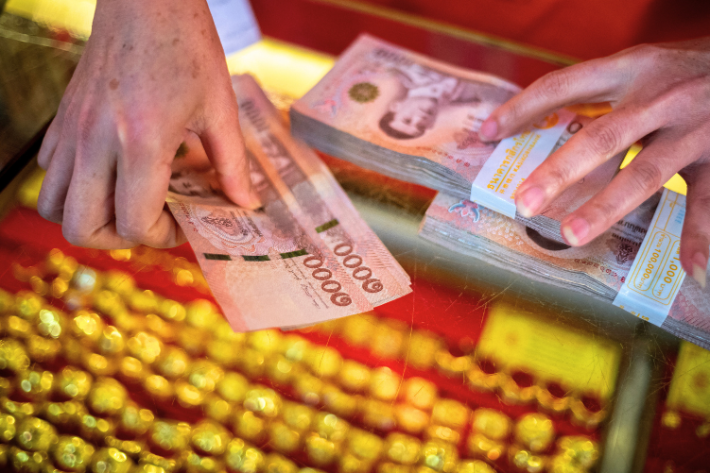
Gold prices continue to trouble Thailand’s top economic official after surging to a five-year high this week.
Meanwhile, citizens are wondering whether a flood of “grey money” from fraud centers in neighboring countries could affect the outcome of the election early next month.
The baht surged above $31 against the dollar on Wednesday, with gold hitting $4,800 an ounce. The stock was still trading above that level late Friday.
See also: Half of global CO2 emissions come from 32 companies: report
Thailand’s top economic officials are alarmed by the strength of its currency, with Finance Minister Ekniti Nitithanprapas this week describing it as a “matter of great concern”.
The minister was in Davos on Wednesday to attend the World Economic Forum and was interviewed by Bloomberg Television. “Thailand is a small open economy and we are a net exporter, so an appreciation of the baht will affect our economy,” Ekniti said.
He explained that every baht rise against the U.S. dollar reduces Thailand’s GDP growth by about 0.1 to 0.2 percentage points, and he expects GDP to grow by about 2% this year.
Ekniti said the baht’s appreciation stemmed from a weak dollar, the country’s large current account surplus and what he called “speculative flows.”
“grey money”
The latter, somewhat vague term, covers flows into Thailand, including Funds to buy gold or invest in online gold tradingIt’s not just the impact of these inflows on Thailand’s economy that is worrying.
This is because Thailand is currently the center of a region with high levels of transnational crime, and it is suspected that large criminal gangs involved in Myanmar, Cambodia and Laos fraud hubs, as well as drug production and trafficking, have been laundering money in Bangkok; perhaps even investing their “grey money” in gold, which is not surprising given the way gold has risen.
Those ones Senior U.N. officials expressed concerns in Bangkok earlier this month He pointed out that the Thai capital is also the banking center of the Mekong region. The amount of money received by scam center operators in Cambodia and Myanmar is huge, reportedly reaching billions of dollars annually.
Ekniti and the Bank of Thailand (BoT) have been doing what they can to control the exchange rate, but central bank officials admit their efforts have so far had limited effect.
He said officials were trying to ease those pressures by increasing foreign investment and curbing speculation related to gold trading.
Central bank may target gold trading
The Bank of Thailand will announce new rules for online trading of baht-denominated gold next week (January 29) to offset its impact on the baht.
Central Bank Governor Vitai Ratanakorn said this week that the baht’s strength “is Mainly affected by rising gold prices“.
He told reporters in Bangkok on Wednesday that its intervention in the foreign exchange market would have little impact due to the size of the market and its limited offshore reach. “We don’t have enough power to set the level of the baht and let it depreciate as others want,” he said.
The baht gained about 8% last year as a weak dollar and a 65% surge in gold prices hit a series of record highs, helping offset weak domestic economic data.
But Bank of Thailand officials have warned they may impose punitive taxes and impose tighter scrutiny on gold bullion trading as a strong baht is hurting its two most important sectors, tourism and exports. and Exporters want Thai baht to trade at 33 to US dollar.
Investors are buying more gold as recent U.S. intervention in Venezuela and trade tensions between Washington and Europe over Greenland heighten geopolitical tensions. Gold was trading above $4,952 in Bangkok as of 10pm on Friday.
a major election issue
Thailand is one of the few countries in East Asia to take action, along with Hong Kong, Singapore, South Korea and Taiwan. Assets frozen total nearly $700 million Suspected to belong to “fraud billionaire” Chen Zhi, who was the leader of the Cambodian Prince Group before being charged. Fly back to China faced a major police investigation earlier this month.

Thais have also been working with Chinese police airlift hundreds of fraud suspects back to mainland China Departing this week from the border town of Mae Sot, critics say it’s flooded with illegal cash from the Myanmar border.
Under pressure from China and the United States, both Cambodia and the Myanmar border enclave adjacent to Thailand have been subject to further “crackdowns”, although there is widespread suspicion that these are just for show.
Indeed, a photo surfaced on social media on Friday showing two Cambodian tycoons whose casinos were suspected of being rackets and allegedly destroyed during shelling in Thailand. December border clashes. The video showed them attending a religious ceremony at the new Senate building, which was reportedly presided over by Senate President Hun Sen.
This shows that it is business as usual in Phnom Penh.
Perhaps unsurprisingly, the influx of “grey money” has become a key issue in the run-up to Thailand’s general election in two weeks, with several parties declaring a hardline stance that they will not form a government with parties suspected of being linked to fraud centers or criminal activity in the neighboring country.
Rak Chart Party’s senior political candidate says they have “intelligence” claiming to have large amounts of “grey money” – Up to 200 billion baht ($6.4 billion) – to buy votes in the February 8 election.
This could be another wild and erratic poll in the Land of Smiles.
See also:
UNODC says cybercrime costs trillions of dollars in losses every year
“Fraud billionaire” Chen Zhi arrested in Cambodia and flown to China
Countries seize US$700 million in Prince Group assets in pursuit of “fraudulent billionaire”
US, UK praised for fraud hub sanctioning and seizing $15 billion in Bitcoin
US targets multi-billion dollar fraud network in Myanmar and Cambodia
Cambodia’s fraud hub has tense relations with countries near and far
U.S. sanctions Cambodian Karen warlord’s money laundering ring
Online fraud hub spreading like global cancer from Asia: UN
Weak ASEAN countries “face the risk of evolving into fraud countries”
North Korean hackers use Cambodian company to launder stolen cryptocurrency
Southeast Asian fraud gangs stole $64 billion in 2023, report says