The Tamesis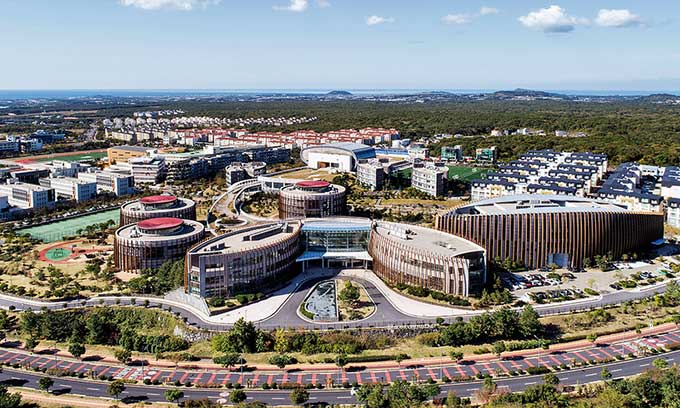
March 9, 2026
Seoul – Building international schools is back on the map as a major education commitment ahead of South Korea’s local elections scheduled for June 3.
Supporters of the program cite the example of Jeju Island, which has four international schools and uses them to help revitalize rural areas, using international schools as a way to transform local communities.
They say the schools can provide an environment that attracts global talent and lures South Korea’s demand for overseas education back home, helping to address the region’s declining population.
However, past experience suggests the outlook is more uncertain, with multiple attempts to establish international schools stalling or taking years to launch.
Meanwhile, schools on Jeju Island face declining enrollment as accredited and unaccredited international schools proliferate across the country.
Ministries object
In Gangwon Province, the issue of establishing international schools had become an important topic even before the general movement began.
The issue resurfaced again after the Ministry of Education reportedly requested that the amendment to the “Special Act on the Establishment of Gangwon Province’s Special Autonomous Province” be deleted that gave Gangwon Province the power to establish international schools.
The revision, proposed by the province and currently being considered by Congress, is part of a broader effort to expand Gangwon Province’s autonomy in promoting economic growth and combating population decline.
“I was very shocked when I received a call recently asking for the regulations to be lifted,” Gangwon Governor Kim Jin-tae of the main opposition People’s Power Party said on Tuesday.
“The central government should participate in consultations with a positive attitude and consider issues from a broader perspective,” he added.
Oh Sang-ho, President Lee Jae-myung’s former chief secretary for political affairs and the ruling Democratic Party of Korea’s sole gubernatorial candidate for Gangwon Province, also said he would ensure the province gets the necessary powers if the issue becomes controversial.
“I have consulted with the central government on this matter, and if there is a problem, I will immediately meet with the education minister to resolve it,” Wu said Thursday after registering as a candidate for governor.
Gangwon Province is not the only region where international schools have emerged as an election promise.
Preliminary candidates in several provinces and cities, including North Gyeongsang Province, Sejong City, and Cheonan City in South Chungcheong Province, have also put forward similar proposals. Candidates for governor, mayor and even local council positions have made such promises.
demographic crisis
International schools offer English-based courses and overseas universities have high admission rates, but only a limited proportion of domestic students are allowed to enroll with approval from the education department.
Despite the high cost, which can run about 60 million won ($40,400) a year including tuition and other fees, supporters say the schools could attract global professionals who are hesitant to move to remote areas because of concerns about their children’s education. The presence of such schools could also encourage international companies to set up operations locally, they said.
Supporters also point out that Korean families can access a global learning environment without sending their children abroad, which local governments see as a way to mitigate the impact of population decline outside Seoul.
The number of regional communities classified as at risk of extinction – where the number of women aged 20 to 39 is less than half that of women aged 65 and over – has almost doubled, from 61 in 2010 to 119 in 2023, as birth rates and inward migration decline, as well as accelerating ageing.
The case of Jeju Island partially supports these expectations.
All four international school campuses on the island are located in the rural town of Daejeong-eup, approximately 35 kilometers from the center of Jeju City. Despite its distance from the airport, the town’s population will increase from about 17,000 in 2010 to 21,600 in 2025, according to the government.
Authorities also estimate that since 2011, these schools have absorbed 1.42 trillion won worth of education spending that might have been spent on overseas study.
Uncertainty about the future
However, recent events on Jeju Island suggest that the impact of international schools may be more limited than many local politicians hope. Protracted or failed attempts elsewhere also reveal significant challenges in establishing such schools.
Enrollment at Jeju International School has been declining in recent years, from 4,868 students in 2023 to 4,133 students in 2025. The enrollment rate also dropped from 90% to 71.7%.
Observers pointed to several factors behind the decline, including limited residential infrastructure in the Dajeongyi area and a general decline in the school-age population nationwide. Unaccredited international schools, which do not offer qualifications recognized by the Korean education system, also absorb some of the demand.
According to a report by International School Consulting, as of 2023, approximately 130 unaccredited international schools are operating in South Korea, with approximately 26,000 students enrolled.
Amid growing concerns about the sustainability of Jeju International School, Jeju Governor Oh Young-hun pledged to expand support at a meeting with school officials in February.
“We will review various policy measures to enable Global Education City to become a global center for residential education services,” he said.
Competition grows fiercer and barriers persist
As competition to attract international schools intensifies, at least eight cities including Busan, Incheon and Ulsan are formulating plans to establish international schools by 2030, building on previous commitments.
While some schools have signed deals with established international schools, others have faced obstacles, highlighting the challenges of establishing schools in new areas.
Challenges include uncertainty about future demand, high construction costs and opposition to using public funds to build schools that only a few families can afford.
For example, Changwon City in South Gyeongsang Province cut its budget in December after two failed attempts in 2011 and 2017.
Local officials said many procedures are still under review, citing disagreements with the Gyeongsangnam Province Education Office and difficulties in acquiring land for the project.
Experts have urged a more careful assessment of plans to build international schools, warning that attracting premium school brands could require significant amounts of taxpayers’ money.
They said demand for international schools in remote areas may be limited because foreign schools serving foreigners already operate in Seoul and other major cities.
“Even taking into account Jeju Island’s unique environment as a leisure destination, it is difficult to say that all schools there are successful,” said Kim Sang-bong, an economics professor at Seoul National University.
“A deeper analysis of demand is needed because there is still great uncertainty about whether schools in remote areas far from Seoul can attract enough students,” Kim added.