The Tamesis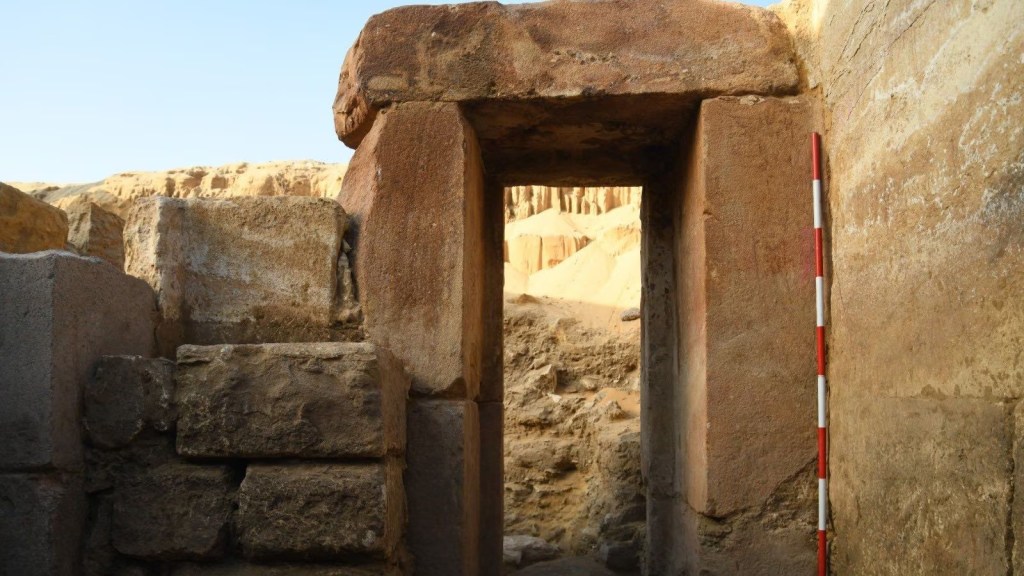
Egyptian archaeologists have discovered the remains of a 4,500-year-old valley temple that was part of the vast Sun Complex built by Fifth Dynasty ruler Pharaoh Nyuserra. The discovery, announced earlier this month by Egypt’s Ministry of Tourism and Antiquities, provides a rare glimpse into the architectural and ritual life of a time when the worship of the sun god Ra was prevalent.
Archaeologists from the University of Turin, in collaboration with the Oriental University of Naples, have excavated the temple complex at Abu Qurab, located southwest of Cairo near the Nile River. Ancient Egyptian sun temples were usually divided into two connected parts: the upper temple was located on higher ground and was used for core ritual activities, while the valley temple was located closer to the river. The two are connected by a causeway that leads visitors from the water’s edge to the sacred site. While the upper temples of Abu Qurab were excavated several years ago, the valley temples were only recently opened, with systematic work set to begin in 2024.
Related articles

The complex of Neuserra is believed to be the earliest temple dedicated to the sun god Ra and was first discovered by German archaeologist Ludwig Borchardt at the end of the 19th century. However, its associated valley temples remained unknown for more than a century, sinking beneath the high water table. It was not until changes in the Nile’s course and the construction of the Aswan Dam that lowered the water table that excavation became feasible.
Archaeological surveys in 2024 and 2025, led by Massimiliano Nuzzolo of the University of Turin and Rosanna Pirelli of the University of Naples, will focus on the entrance to the sanctuary. Their discovery documents one of the few known valley temples associated with an Old Kingdom solar complex, including a monumental structure that spans more than 10,800 square feet — roughly half the size of the entire temple and more than 18 feet tall.
Constructed of high-quality materials such as granite, white limestone, and red quartzite, the building bears inscriptions bearing Nyuserra’s name and references to religious celebrations, including festivals in honor of Sokar (the falcon-headed god associated with Memphis) and the fertility god Min, as well as processions in honor of Ra himself. The placement of these blocks near the entrance means that the temple’s ritual calendar is displayed on its facade, making it one of the earliest known public religious calendars.
Archaeological evidence shows that the sanctuary was in use for about a century before being abandoned and later reoccupied by the local community for over 300 years.
“The critical importance of this discovery is that this temple is one of only two examples of a solar complex, the ‘Valley Temple’, known to exist in ancient Egypt, thus providing us with new insights into the architectural achievements of the Great Pyramid era. Furthermore, in the Memphite region where the temple is located, it is not uncommon to encounter buildings that were used as temples and then repurposed as settlements, but no such well-preserved example has ever been found, especially one that was used for so long,” Nuzzolo said in a statement. “