The Tamesis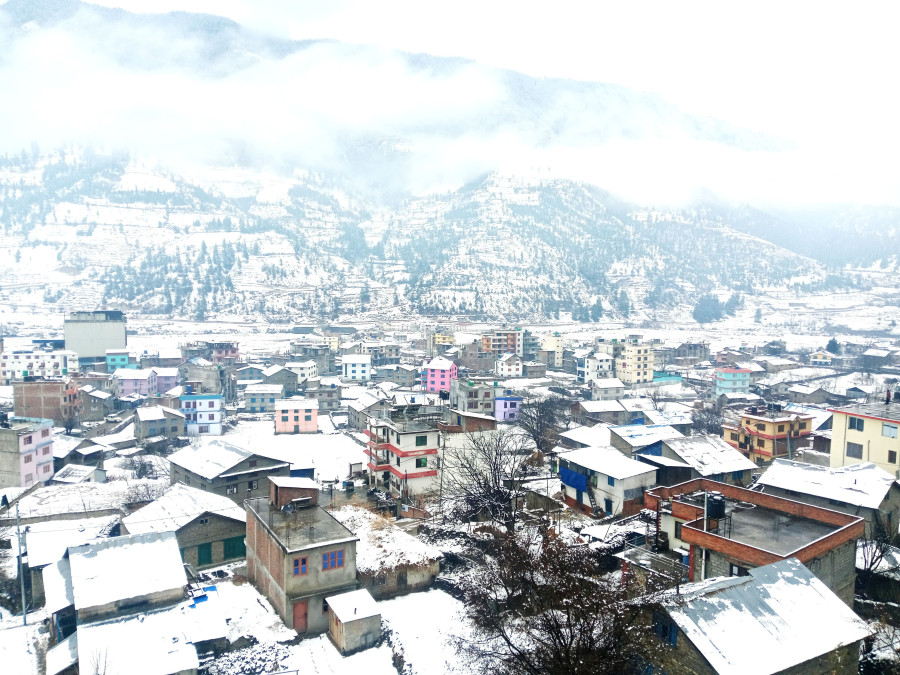
January 29, 2026
Surhit/Taplejung/Pokhara/Gorkha – Heavy snowfall on Saturday disrupted traffic at Hilsa in Sector 5 and Limi in Sector 6 of South Carolina Rural Municipality in Humla district. The villages have been isolated from the Simkot district headquarters after a November snowfall failed to melt before fresh snow fell. Traveling from Simkot to Limi and Hirsa involves crossing the Nyaru Pass and the Naira Pass, both of which are at an altitude of nearly 5,000 metres.
“The snow is currently at least three feet thick. Movements have now come to a complete halt and will be impassable until the snow melts,” District 5 chief Paljor Tamang said.
Limi has three voting centers with a total of 672 registered voters. But according to Paljor, there are currently only about 100 people in the village. Most residents left to escape the cold or to trade, work and study. Of the three villages in Limi, only Tire and Halji currently have guards staying behind, while all houses in Zhang are locked. Nearly 50 homes were also abandoned in Hilsa. Before the snowfall, about two dozen hotels were open in Hilsa. The Simkot-Hilsa road has been closed since the second week of November.
Rimi experienced two snowfalls in November. “There was no snowfall in December, but there was heavy snowfall again in January,” said Gyaljen Tamang, a native of Kharji who is currently sheltering from the cold in Birendra Nagar, Surgate. “It will take at least two months for the snow on the Nara and Nyaru passes to melt. By then, the election will be over and returning home will become a problem in itself.”
Rastriya Swatantra Party candidate Tashi Lhanjom said the snowfall prevented her from traveling to her village to campaign.
There are three voting centers in Limi and one in Hilsa. Prem Bahadur Lama, chairman of the South Carolina Rural Municipality, said chartered helicopters were the only option to transport ballot boxes and election supplies to these centres. “It is impractical to hold elections in the mountains in February. The number of voters is already low and campaigning has become difficult,” he said.
According to him, the polling center at Bhirkuti Primary School in Jang village currently has zero voters as residents left before winter. “Even in other villages, only the caregivers remain,” he said. If polls are held under current conditions, Lama estimates turnout at 30 to 40 per cent at Himshikhar Primary School polling center and Sunkhani Primary School polling center in Litgaun.
Snowfall in the country’s high mountains has cut off villages, stranded voters in cities and reignited long-standing concerns about holding winter elections in high-altitude settlements, with local representatives and election officials warning that turnout could plunge unless weather conditions improve in coming weeks.
Data compiled by the Karnali provincial police showed that excessive snowfall affected 20 voting centers in high-altitude settlements in the province, with about 4,000 registered voters currently living outside the villages. Provincial police spokesman Senior Superintendent of Police Ram Prakash Shah said 10 police posts in cold districts have been moved to district headquarters since mid-November, but efforts are being made to restore them within two weeks.
Mugu, another remote mountain district in Karnali, faces similar challenges. Most residents of Mugugaun, Kirti, Dolphu, Kimri and Kartil villages in Mugum Karmarong township have gone out for the winter to avoid the severe cold.
“About 400 people from Mugugaun alone left here to escape the cold,” said Chhiring Kyapne Lama, mayor of the rural municipality. While some residents have moved closer to Pulu city center or Gangadi, those who left the area are unlikely to return to contest the elections. District government offices and health posts have been temporarily relocated to Saluk after Saturday’s snowfall, which left these villages with up to two feet of snow.
Mugu district chief Khadananda Khatri said security agencies had started collecting data on the number of voters outside the district. He confirmed that helicopters were needed to transport election logistics to the five polling centers in Mugum Karmarong, which had no road access and were still prone to heavy snowfall.
However, Humla chief district officer Tek Kumar Regmi was optimistic, saying there was still some time before polling day. He acknowledged the difficulties of voter education and campaigning, but said about half of Limi’s residents had not left their villages.
“There are more people coming into the village now than going out,” he said, adding that the snow could melt and trails could reopen before voting day. In the last general election, the turnout at Limi’s three polling centers was 72%, and Legomi expressed confidence that the majority of voters would return in early March. Local schools are scheduled to reopen the second week of February, which Rama said will make it easier to conduct voter education programs.
In the eastern region of Taplejung, expectations for the return of voters are closely tied to the Losar (New Year) festival held by the Sherpa community on February 18 this year. Ghunsa Village Primary School, located at an altitude of 3,100 meters, will reopen from February 22.
“People usually return after celebrating Losar,” said Bidyanand Singh, principal of a local school in Kunsar. He said the villagers might have returned last February. While more than half of Gusa residents currently live in Kathmandu, Dharan or Darjeeling, local representatives expect them to return ahead of the vote.
In another settlement, Olangchunggola, about 3,100 meters above sea level, about half of the residents remain in the village. Unlike some other settlements high in the Himalayas, people here do not completely abandon their villages during winter.
However, since there are few jobs during the cold season, many people travel to Phungling’s district headquarters or the capital Kathmandu, mainly to visit relatives and handle personal matters. Most of them usually return to their villages around mid-February.
In Mustang, winter migration has shifted campaign activity from villages to cities. Ram Bahadur Gurung of Lo-Ghekar Damodarkunda Rural Municipality Marang has been in Kathmandu for a month and a half and is not sure whether he will come back to vote.
“If it snows heavily, it will be almost impossible for the election to be held,” he said, predicting that even if voting goes ahead, turnout will be below 60%. District 5 in Lomanthang township has a population of about 900, but currently only has 50 to 60 people. Pasang Gurung, a member of the local unit executive committee, said most residents would not return until April when temperatures rise.
Candidates follow voters south. CPN-ML candidate Indradhara Bista has been canvassing in Pokhara and plans to meet voters in Kathmandu. “The majority of Upper Mustang residents come here for the winter and for business,” he said, though he acknowledged it would be difficult to bring voters back without exceeding the Board of Elections’ spending limits.
Regional authorities have identified nine polling centers in Mustang as sensitive due to weather and topography, with officials warning that sudden snowfall could block access for days.
Manan faces similar restrictions. In the rural municipality of Nalpapumi, most houses remain empty and all five polling centers are classified as highly sensitive. In the days leading up to the vote, electoral materials had to be transported on horseback, while ballot boxes were flown back by helicopter. “The turnout is likely to be low due to weather and geographical factors,” said Govinda Prasad Aryal, information officer at the district election office.
In Gorkha’s Chumunuburi township, candidates are yet to reach high-altitude settlements such as Sandho, Samagaon and Chikanpal, where most residents are currently in Kathmandu or Pokhara. Nima Lama, the township’s chairman, said villagers would return to Losar in early February and stay to participate in the elections, but acknowledged that campaigning and ballot transportation remained daunting in Nepal’s fourth-largest township.
Winter elections in the mountains have repeatedly exposed the mismatch between the national electoral calendar and the seasonal rhythms of mountain life. Despite logistical preparations, local leaders warned that thousands of voters may again be unable to exercise their democratic rights unless weather conditions improve.