The Tamesis
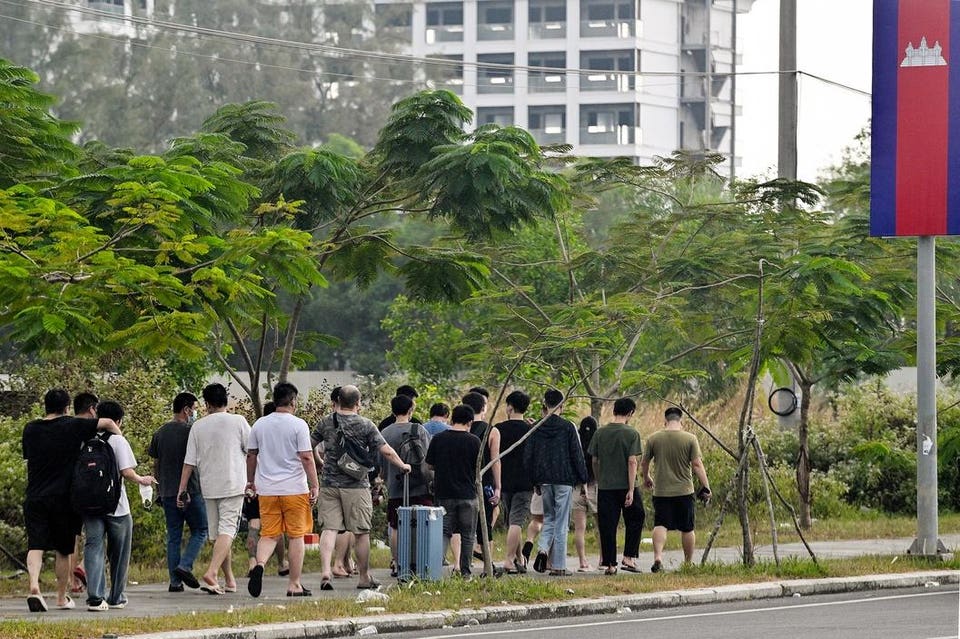
On January 15, 2026, workers walked out of a suspected fraud center compound in Sihanoukville, Cambodia. (Photo: Tang Chhin Sothy)
AFP via Getty Images
In recent months, extraordinary scenes have been unfolding in Phnom Penh. A crackdown on notorious scam hubs – websites where workers are paid and/or forced to commit fraud in wealthy countries – has led to thousands of workers being released or on the run. There are more questions than answers about what will happen to them.
Given its covert nature, people deceived or trafficked into the Cambodia scam may lack work permits.rthese crimes. The $10 per day visa overstay fine has grown into thousands of dollars, with many unable to afford the fines required to leave Cambodia. They may also not be able to get their passports back if they are confiscated by traffickers.
An Amnesty International staff member said: “The exodus of people fleeing scam premises has created a humanitarian crisis on the streets. “This crisis is magnifying the trauma of many people who have suffered horrific physical and sexual violence inside the compounds. Amnesty International has previously identified at least 53 fraud centers in Cambodia; this is likely an underestimate. The group also spoke with dozens of people who fit the legal definition of slavery.
Researcher Li Ling stressed that law enforcement actions targeting the scam industry require better planning for survivors. She is the co-founder of EOS Collective, a non-profit organization that supports survivors of Cambodia’s scam industry. “Without a reception plan, a raid has the potential to create a humanitarian crisis. When hundreds of people are moved at once, they immediately need shelter, identification, translation and a safe way to communicate with family and embassy. Without advance preparation, victims may end up homeless, detained for immigration reasons, or quickly exploited again.” Lee said coordination plans “can help victims cooperate as witnesses and prevent criminal networks from simply replacing them with new members.”
There seems to be no coordinated approach to dealing with people who have recently left the scam. They represent a number of different nationalities, reportedly including U.S. nationals. Embassies are taking their own measures to assist their citizens. Kenya, for example, received exemptions from visa overstay fines, while China and Indonesia offered shelter to citizens awaiting deportation.
Lee reported that the Philippines is conducting its own victim identification and providing support upon repatriation. Ongoing support is crucial because vulnerabilities don’t go away once former fraud center workers return home. Overall, the Philippines has done more than most countries to assist nationals involved in foreign fraud. Generally speaking, Lin said, the embassy is required to provide travel documents and coordinate with the Cambodian government for safe repatriation.
However, Amnesty International criticized the Cambodian government for ignoring the issue. Recent escapees told Amnesty International that police would remove bodies from their scams but would not pursue managers of sites where murders and abuses occurred.
The full scale of the conspiracy is difficult to determine. Jacob Sims, a fellow at Harvard University’s Asia Center, said at a recent Stimson Center event that the current wave of enforcement against fraud centers is more aggressive than previous ones but remains symbolic because elites have been largely untouched. Sims said the Cambodian government protects the industry through lucrative collaborations between criminals and political elites.
It remains dangerous for Cambodian journalists to criticize the government, and they continue to be arrested for reporting on scam compounds. Cambodian government officials say they are screening people to distinguish between victims and perpetrators, but the line between the two can be blurry.
Overall, “experience with victim reports suggests that law enforcement interactions are often conducted through immigration controls rather than victim identification,” Lee said. “The Cambodian government plays a decisive role as it controls legal status and victim identification. Many anti-trafficking organizations can only intervene after a person is officially recognized as a victim of human trafficking… Without identification, individuals are still classified as immigration violators and cannot safely access protection or removal proceedings.”
Given their financial woes and meager options, it’s not surprising that some have returned to scam sites and continue to proliferate and recruit, despite recent crackdowns. Journalist Mech Dara, who was previously arrested for his tenacious reporting on Cambodia’s cybercrime industry, reported that some individuals had been recruited into the operation in Sri Lanka.
Dara and others also condemned the inaction of the International Organization for Migration (IOM). Since early 2025, the International Organization for Migration (IOM) has been severely weakened by US cuts in global development spending. According to Lee, IOM Cambodia has told trafficking victims that they cannot receive support or find temporary accommodation because it is illegal to host people without valid visas. IOM Cambodia did not respond to Forbes’ request for comment.
Emergency shelters are doing what they can, but they are also being reduced by global aid cuts. They are overwhelmed by the scale of the need. People without support are forced to crowd into housing or sleep on the streets or in the forest.
In fact, Li said, international and local organizations “carry most of the direct humanitarian responsibilities” and are best equipped to provide emergency shelter and food, medical and psychological assistance, interpretation and communication, and legal and logistical support.
She warned that “a major gap today is information and immediate support: many stranded people have no idea what will happen to them, how long it will take, or what their rights are. They are also simply trying to survive. Providing clear case management and immediate asylum is paramount now.”
This is part of a series on the transnational romance fraud industry. One article in this series focuses on Ugandan man trafficked to Southeast Asia. The other focuses on one person’s point of view American woman tricked into having sex with someone in West Africa.