The Tamesis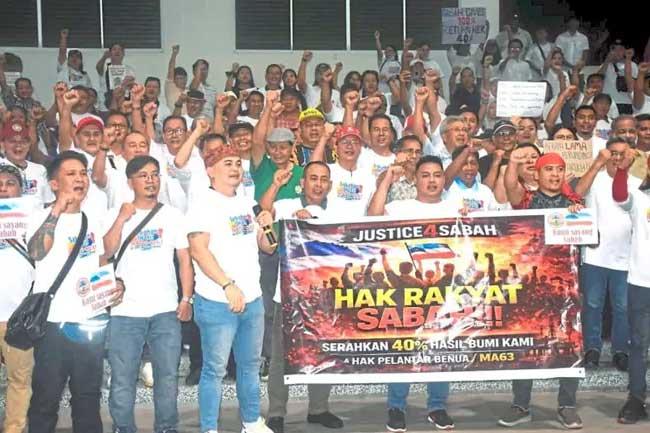
April 13, 2026
Kuala Lumpur – I’m sure many fellow Sabahans felt the same way on Monday after the Putrajaya Court of Appeal allowed the federal government’s application for a temporary stay of the order related to Sabah’s entitlement to a 40% rebate of net income.
On October 17, 2025, the Kota Kinabalu High Court ruled that the federal government must restore Sabah’s 40% revenue entitlement under the Malaysia Agreement 1963 (MA63) in each financial year from 1974 to 2021.
After the Sabah Bar Association filed a judicial review, the High Court ordered the federal and state governments to complete the review within 90 days and reach a final agreement within 180 days, a deadline of April 15.
Sabah state nominated assemblyman Datuk Roger Chin described Monday’s ruling by the Court of Appeal as “deeply disappointing” because it removed the one factor that finally forced the matter forward after decades of inaction: a binding timetable.
Sabahans feel the sting of wiping a fresh wound with iodine, a painful reminder that constitutional promises are treated as optional, leaving the people of Sabah to once again taste the bitter taste of a “final” promise that never seems to come.
The Sabah slang term “oren” has no clear linguistic origin. But one of the most popular theories is that it stems from orange iodine that is commonly used on wounds, often causing a sting. It became a colloquial term used to mock or emphasize the “flavor” of painful consequences.
Under MA63, Sabah should receive 40% of the net revenue collected by the federal government from the state. But for decades, those 40 percent payments were frozen or replaced by smaller, flat-rate payments agreed to by federal and state governments. Monday’s legal action represents a fight to determine whether nearly half a century’s failure to review the 40% rate violates constitutional obligations.
While the specific ruling by the Court of Appeal involves technicalities (such as “status” or “justiciability”, which refers to whether the court can rule on a matter, or whether it is a political issue beyond the court’s jurisdiction), for ordinary Sabahans the outcome amounts to a choice between restorative justice and continued neglect.
Oren tasted the decision.
Over the decades, the flat tax rate, known as the special allocation, has ranged from RM26.7 million (the “lost years” rate from 1974 to 2021) to RM600 million in 2025. To Sabahans, these flat rates are “iodine”. The figures are arbitrarily determined by Putrajaya, while some experts estimate that 40% of constitutional rights are worth billions of ringgit each year, depending on the net revenue collected.
The then state government’s acceptance of a flat tax rate of RM600 million left Sabahans feeling “oren” as it was only a fraction of what was actually owed under the law. The Court of Appeal’s decision to stay the Kota Kinabalu High Court’s review order means Sabah is once again stuck with an “interim” amount that the federal government chose to provide rather than the amount determined by the constitutional formula to which it is entitled.
The sting is strongest when Sabahans compare its “three national curses” of inadequate infrastructure – water, electricity and roads – to Peninsular Malaysia. They feel cheated because development funds have been invested in these states while Sabah has lagged behind.
But sometimes the sting comes from within. You only have to look at the multi-million ringgit road and water projects Putrajaya has funded in Sabah over the years but somehow still result in moon potholes and salt water taps. For decades, the gatekeepers to these contracts have been Sabah politicians – some of the same leaders who now loudly support the 40% claim.
Sabahans have held ministerial or deputy ministerial positions in the Ministry of Rural and Regional Development, which oversees one of the largest federal infrastructure budgets. Sometimes, as a cynical Sabahan, I do wonder: if we end up with 40%, who will really benefit? Me and ordinary Sabahans, or the elite?
Apparently, 40% of the questions were political.
In November, just ahead of the 2025 Sabah elections, Entrepreneurship and Cooperative Development Minister and Upko chairman Datuk Ewon Benedick resigned from the federal cabinet and his party withdrew from the Pakatan Harapan coalition.
Benedick and Upko made the decision because Benedick could no longer remain in a cabinet where his legal adviser – the Attorney General – was directly opposed to Sabah’s constitutional rights. For Benedick, staying would be a violation of principle.
Pakatan Harapan lost two MPs, with Datuk Seri Wilfred Madius Tango of Tuaran also resigning, in addition to Benedikt of Penampang. In the Sabah polls, Upko supported the “Sabah First” agenda, calling for the immediate implementation of the 40% entitlement.
The party won three state seats, tripling the number from the 2020 election, while Pakatan Harapan was almost wiped out. ACT lost eight seats in all contests, while PKR won just one in ten. It can be said that the 40% revenue issue is the main factor in the collapse of Pakatan Harapan in the state.
Prime Minister Datuk Seri Anwar Ibrahim takes a walk at the famous Gaya Street Sunday Market in Kota Kinabalu while campaigning for the state election. Amid the din of crowds and selfies, a Sabahan approached him and asked: “Datuk Seri, I would like to ask, when will the 40% come?”
Anwar has since said that the federal government receives about RM10 billion in revenue from Sabah and returns about RM17 billion through various budget allocations and operating expenses. But most Sabahans believe Anwar is comparing apples and oranges; 40% is a specific legal entitlement based on net revenue, while the RM17 billion includes standard federal obligations that the government must fulfill regardless of revenue sharing claims.
On March 16, Anwar clearly promised a 40% revenue share in Kota Kinabalu: “We [the federal government] No appeal in 40% of cases, which is final… I have announced in Cabinet and in Parliament that there will be no negotiations. We are committed to delivering on our 40% commitment to the people of Sabah. period. “
But to Sabahans, “period” now feels more like “comma”. While the prime minister said he would not appeal the case, the federal government did appeal against the Kota Kinabalu High Court’s mandatory timetable. On Monday, an appeal resulted in a stay of execution, effectively ending the April 15 deadline.
For the federal government, this is a procedural matter. For Sabahans, this is iodine in the wound of 48.
Appa Kaurasa? Oren.