The Tamesis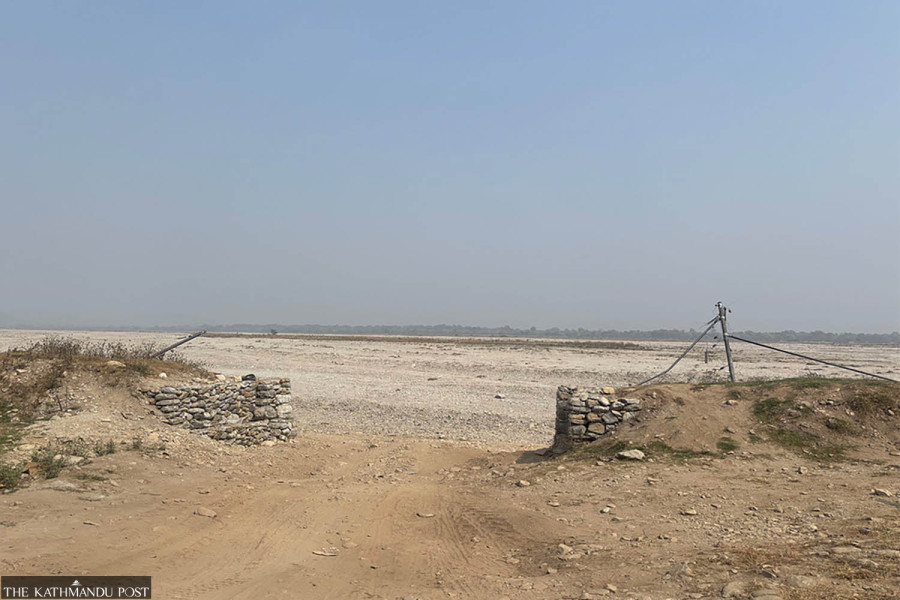
February 19, 2026
jehapa – When dusk falls in Bahundangi, locals brace themselves for familiarity. Herds of wild elephants crossed the Meji River from India into settlements, trampling crops, destroying houses and keeping villagers awake at night. The human-elephant conflict has raged for years without a victory for either side, making the issue a recurring electoral agenda that has yet to produce a lasting solution.
Kamal Rai, 74, a resident of Bahundangi in Sector 4 of Mechi Nagar city, recalled confronting elephants since his childhood. “In the past we used burning torches to scare them away. Now they are no longer afraid of traditional deterrents including fire, noise, bees, pepper smoke and even electric fences,” he said. Rai said the animals had grown accustomed to the methods, and as settlements expanded along traditional elephant routes, villagers became more vulnerable.
In the early years, residents’ anger was so intense that some openly asked authorities to allow the killing of elephants. Nilkantha Tiwari, the then former chairman of the Bahundangi Village Development Committee (local unit), even made controversial remarks advocating armed resistance. Attitudes have since changed. While frustration remains, many residents now talk of coexistence rather than confrontation, acknowledging that elephants have long used the area as a natural corridor.
According to environmentalists, human-animal conflicts have intensified as human settlements have expanded into historical elephant migration routes. Elephant expert Narendra Pradhan explains that the area served as an elephant corridor long before the development of large-scale human settlements. “Elephants have been walking along these routes for generations. When settlements expand, encounters increase and conflicts become inevitable,” Pradhan said. Harassing or trying to provoke an elephant often worsens the harm, he said, because stressed animals can exhibit unpredictable behavior.
Older residents have similar memories. Kamala Dahal, 72, who has lived in the Bahundangi area since 1971, said elephant incursions used to be sporadic and less destructive. “They didn’t do much damage when they passed through in the past. Things became serious after the 1990s [after the restoration of multiparty democracy] when settlement and agriculture expanded,” she recalled.
Despite decades of suffering, locals complain that political promises have repeatedly failed to address their plight. In every election, candidates promise to control the elephant menace, but little changes on the ground.
Women below Bahundangi Bazar were busy harvesting mustard when Januka Khatiwada expressed fresh concerns. “This time even the mustard became elephant fodder. We have nothing left,” she lamented.
Last year, Mech Nagar city ward 4 introduced a mustard seed subsidy to encourage farmers to grow the crop believed to be less vulnerable to elephant damage. But a few days ago, elephants destroyed mustard fields in the Altangi area of the same district, deepening farmers’ anxiety. “They left nothing behind – rice, corn, millet, buckwheat – everything is gone. Our leaders don’t understand our pain,” said Usha Dahal, a local resident.
Locals believe Nepal and India must work together to stop elephants from appearing at the border. “Only then can we get relief. Otherwise this pain will never end,” said Bimala Dahal, another local. While wildlife experts point out that elephants respect no borders, many farmers believe that India is deliberately allowing the herds to cross when Nepal’s crops are ripe.

Kamal Rai, 74, from Mechi Nagar city’s Ward 4, said he has been attacked by elephants since his childhood. Photo: The Kathmandu Post
Over the past two decades, successive leaders in the region’s federal legislature, including Dharma Ghimire, Rabin Koirala, Ram Karki and Bishwa Prakash Sharma, have promised control measures ranging from fencing to surveillance. Yet the intrusion persists. “Leaders won elections and entered parliament with our votes, but our suffering remains,” Dar Bahadur Karki said.
Wards 1 to 4 of Mechinagar city, Chure belt of Arjundhara city and northern areas of Buddhashanti rural municipality are severely affected by the elephant menace, making it a common problem in all five constituencies of Jhapa. Local people also criticized Sharma Oli, chairman of the Nepal Communist Party-United Marxist-Leninist Party and former prime minister, for failing to implement long-term solutions after taking office three times.
More than 100 people killed in elephant attacks over 20 years
According to the Jhapa Municipal Forestry Department, more than 100 people have been killed in the past 20 years due to elephant attacks in the area. During the same period, more than 30 elephants were killed and properties worth millions of rupees and large tracts of farmland were destroyed.
Krishnamaya Khatri, a local resident, questioned why the problem remained unresolved despite obvious infrastructure development in the area. “Dusty roads have been covered with tar and drinking water has reached our homes. What is stopping leaders from solving the elephant problem?” she asked. Khatri, who once cultivated nearly four acres of land as a sharecropper, gave up farming after suffering repeated losses. “Two years ago, we couldn’t get a grain of food,” she said.
Many farmers have switched from growing rice to growing tea, but falling prices have sparked new concerns. “Costs are rising but market prices are low,” complained tea farmer Min Bahadur Karki.
The World Bank-backed electronic fence, built at a cost of about 20 million rupees, has proven largely ineffective. Locals said damaged solar cells, broken or stolen wires and poor maintenance rendered it unusable. “If the fence is effective, how come elephants still come in every day?” said Bimal Khadka.
Frustrated residents are demanding that Bahundangi be officially declared an elephant-affected disaster area, arguing that such recognition would help secure compensation and long-term mitigation plans. They accuse elected representatives of being indifferent.
However, Sector 4 chief Arjun Kumar Karki said efforts are on to expand the insurance and compensation scheme in coordination with Ujyalo Nepal in Bardiya. However, he acknowledged that local initiatives alone would not solve the problem.