The Tamesis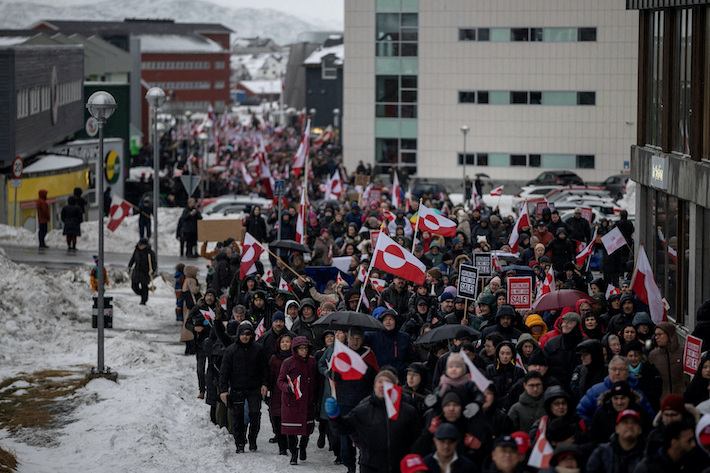
Asian markets faced further volatility on Monday after President Donald Trump threatened to impose tariffs on eight European countries until the United States is allowed to buy Greenland.
Japan’s Nikkei fell for a third day in a row as geopolitical tensions over Greenland sparked a safe-haven yen rally, while economic data unexpectedly declined. The benchmark Nikkei 225 index fell 0.6% to end at 53,583.57 points, while the broader Topix fell 0.1% to end at 3,656.40 points.
Hong Kong’s Hang Seng Index also closed down more than 1%, while Australian stocks were also lower, with the S&P/ASX 200 index falling 0.3% to close at 8,874.5 points, its biggest one-day drop in the past two weeks. The benchmark index gained 2.1% last week, its best week since late November.
See also: Thai construction giants frequently involved in fatal accidents
Saturday, Trump Threats eight European countries with additional tariffs Until the United States was allowed to purchase Greenland.
Trump said he would impose an additional 10% import tariff on goods from Denmark, Norway, Sweden, France, Germany, the Netherlands, Finland and the United Kingdom on February 1. If an agreement is not reached, the tariff will rise to 25% on June 1.
On Sunday, leading European Union countries denounced Greenland’s tariff threat as blackmail. France responded by proposing a series of previously untested economic responses.
Doubts over US-EU trade deal; gold jumps
EU diplomats said EU ambassadors were preparing retaliatory measures if the tariffs went ahead. The U.S.-EU trade deal also looks in doubt unless a diplomatic solution can be found.
Analysts said Trump’s threats created new trade uncertainty, sending stocks lower and weakening the dollar generally.
However, gold and silver prices climbed to new highs on Monday as investors piled into safe-haven assets. Spot gold was up 1.6% at $4,666.11 by 0551 GMT, having previously hit a record high of $4,689.39.
Australian gold mining stocks rose 2.9% to hit a record high. Gold rose nearly 8% in January, following a 64% gain last year.
Meanwhile, the euro initially fell to its lowest level since November before rising 0.26% to $1.1628 as investors broadly sold off the dollar, boosting other major rival currencies.
“Hopes that the tariff situation would calm down this year have now been dashed and we find ourselves in the same situation as last spring,” Berenberg chief economist Holger Schmieding told Reuters.
Trump sweeps everything Tariffs for “Liberation Day” in April 2025 It sent shock waves to the market. Investors then largely ignored U.S. trade threats in the second half of the year, dismissing them as noise and breathed a sigh of relief when Trump struck deals with Britain, the European Union and other countries.
While the lull may be over, Monday’s market moves may be tempered by the knowledge that investor sentiment is more resilient than expected in 2025 and that global economic growth remains on track.
“The dollar takes a hit from political risk”
U.S. markets were closed Monday for Martin Luther King Jr. Day, meaning Wall Street’s reaction would be delayed. In early Asian trading, U.S. stock index futures fell 0.7%. The cash Treasury market was closed, but 10-year futures were firm 1 basis point.
While the dollar was broadly lower on Monday, the impact on the greenback is unclear. It remains a safe haven, but may also feel the effects of Washington being at the center of a geopolitical rupture, as it was last April.
A weaker dollar boosted the safe-haven Japanese yen and Swiss franc. Bitcoin, a liquid proxy for risk, fell nearly 3% to $92,602.64.
Khoon Goh, head of Asia research at ANZ, said, “While you might say that tariffs threaten Europe, in fact, the first brunt of the impact is the U.S. dollar, because I think the market is pricing in an increase in the U.S. dollar political risk premium.”
Capital Economics said the countries most vulnerable to increased U.S. tariffs are the United Kingdom and Germany, estimating that a 10% tariff could reduce the GDP of these economies by about 0.1%, while a 25% tariff could reduce output by 0.2% to 0.3%.
European stock markets are near record highs. Germany’s DAX and London’s FTSE are up more than 3% this month, outperforming the S&P 500 (up 1.3%).
European defense stocks are likely to continue to benefit from geopolitical tensions. Defense stocks have risen nearly 15% this month as the U.S. detention of Venezuelan President Nicolas Maduro heightened concerns about Greenland.
Denmark’s tightly managed crown may also come into focus. It has weakened, but interest rate differentials are a major factor and it remains close to the central rate pegged to the euro, not far from a six-year low.
“The U.S.-European trade war is back on,” said Tina Fordham, geopolitical strategist and founder of Fordham Global Foresight.
Trump’s latest move comes after top officials EU and Mercosur sign free trade agreement Saturday (January 17).
Trump seen as damaging U.S. assets
The Greenland dispute is just one of the flashpoints. Trump also Consider intervening in Iran’s unrestAnd the threat to sue Federal Reserve Chairman Jerome Powell has reignited concerns about the central bank’s independence.
Kallum Pickering, chief economist at Peel Hunt, said escalating tensions with Europe could weigh on the dollar if it heightens concerns about serious damage to the credibility of U.S. policy, given Trump’s recent attacks on the Federal Reserve.
“(This) could be amplified by people’s desire, especially among Europeans, to repatriate capital and avoid U.S. assets, which could also pose downside risks to the high valuations of U.S. technology stocks,” he added.
this world economic forumEconomic confrontation between countries has replaced armed conflict as the top issue, according to an annual risk perception survey released ahead of next week’s annual meeting in Davos, where Trump will attend.
A source close to French President Emmanuel Macron said he was pushing for the launch of “anti-coercion tools” that could limit opportunities for open tenders, investment or banking activities, or trade in services, including digital services, where the United States has a surplus with the EU.
“With the U.S. net international investment position at record extreme negative levels, the interdependence of European and American financial markets has never been higher,” George Saravelos, global head of foreign exchange research at Deutsche Bank, said in a report.
“By far the most damaging to markets is the weaponization of capital, not trade flows.”
- Reuters Additional input and editing by Jim Pollard
See also:
UNODC says cybercrime costs trillions of dollars in losses every year
Coal power use in China and India falls for first time in half a century
China posts record trade surplus of $1.2 trillion despite U.S. tariffs
Trump’s ‘tariffs on countries trading with Iran’ could kill China truce
Bets on snap election push Japanese stocks to record high
Iran unrest expands: Riots, city fires lead to internet shutdown
Trump’s attack on Venezuela ‘could strengthen China’s territorial claims’
India could face higher tariffs if Russia continues to buy oil