The Tamesis
December 23, 2025
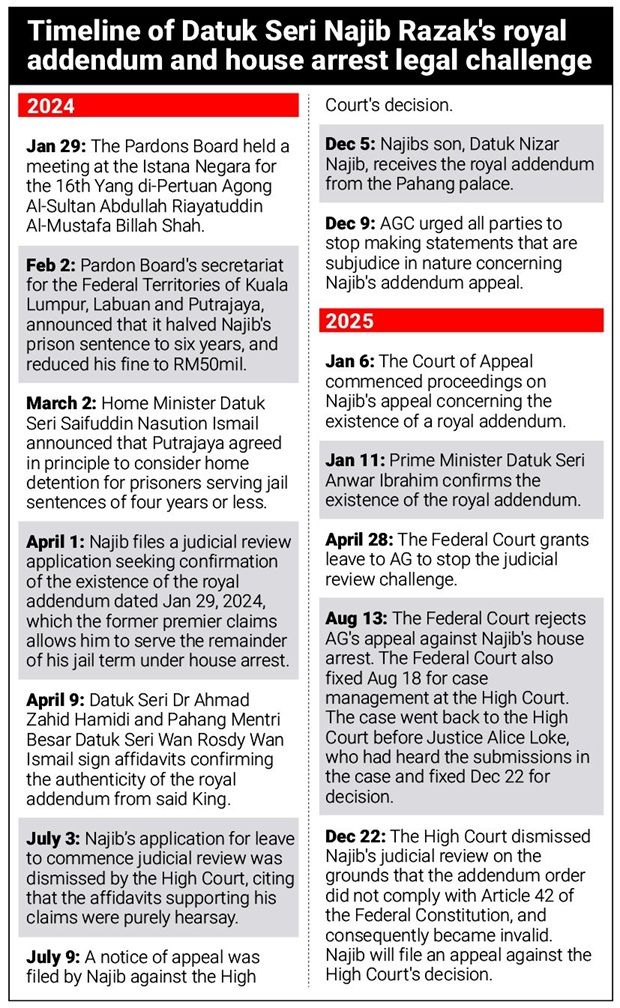
Petaling Jaya – It’s been a crucial week in court for Datuk Seri Najib Razak – who will face another important judgment this Friday as his application for house arrest was rejected – the 1Malaysia Development Bhd (1MDB) case.
The case will be decided after a trial that lasted more than six years.
But for now the former prime minister will continue to serve his sentence in prison.
The Kuala Lumpur High Court yesterday dismissed Najib’s judicial review as he sought to serve out the remainder of his sentence in the RM42 million SRC International Sdn Bhd house arrest case.
Also read: Najib urges rulers to investigate decision, says lawyer
The judgment in the 1MDB case will be delivered by Judge Collin Lawrence Sequerah at the Palace of Justice, as the presiding judge has recently been appointed to the Federal Court.
Senior lawyers have weighed in on several potential outcomes regarding the former prime minister’s fate.
Datuk Keeson Ram Vincent said Najib’s future will be determined by the interplay of three parts, namely the conclusion of the 1MDB trial, the scope and limits of the existing SRC pardon, and the continued availability of the royal pardon.
“Regarding the issue of the SRC, the legal position is now relatively settled. Following a partial pardon, Najib is serving a reduced sentence and today’s ruling makes it clear that there is currently no legal avenue to serve a sentence under house arrest.”
Also read: Najib’s house arrest application rejected
“Of course, this is subject to appeal. In the absence of further leniency, he remains subject to the ordinary commutation rules,” he said.
He said an acquittal in the 1MDB case would limit Najib’s conviction to the SRC and factors such as completion of sentence, commutation or further pardon would come into play.
“Instead, a conviction will almost certainly result in a significant custodial sentence, effectively resetting the clock and diluting the practical impact of any relief granted in the SRC matter,” he said.
Lawyer Kitson Foong said the High Court’s rejection of the judicial review would not be the end as Najib’s team may appeal to the Court of Appeal.
“They may argue that the High Court erred in not recognizing the supplementary order.
“If the Court of Appeal overturns today’s ruling, which could take months, he may be immediately transferred to house arrest regardless of the outcome of 1MDB, unless the 1MDB judge expressly refuses bail or house arrest for that specific case,” he said.
He said that although the release date is August 2028 and the sentence has been reduced after the pardon in the SRC case, Najib may be released early and receive a reduced sentence.
He said if a sentence is imposed in the 1MDB case, the question will be whether the sentences will be imposed concurrently or consecutively.
He said it would be a “worst case scenario” if a High Court judge ordered a new sentence to begin after the SRC sentence ends and Najib could have several years added to his sentence.
Lawyer and former Malaysian Bar president Salim Bashir said yesterday’s High Court ruling listed a number of obscure and novel constitutional issues that should be resolved on appeal by the Supreme Court.
“The High Court dismissed Najib’s application to serve the remainder of his sentence at home, saying the order was unenforceable because it was not considered at the January 2024 pardon board meeting and generally violated the constitutional requirements of Article 42 of the Federal Constitution,” he said.
“To be fair, the context of Najib’s case differs from the plethora of previous cases in which the Supreme Court has held that the power of pardon is purely a discretionary exercise of the prerogative of mercy by the Yang di-Pertuan Agong or His Majesty the Ruler of the country, while the latest approach in Datuk Seri Anwar Ibrahim v Mohd Khairul Azam also insists that the king is not bound by advice and that his discretion is not subject to judicial review.
He added: “The significant difference between the earlier case and Najib’s application hinges on a supplementary order issued by the king that is not relevant to the deliberations at the board meeting.”
Senior lawyer Datuk Baljit Singh Sidhu said the Federal Court is likely to make a decision on the house arrest appeal process by the end of next year.