The Tamesis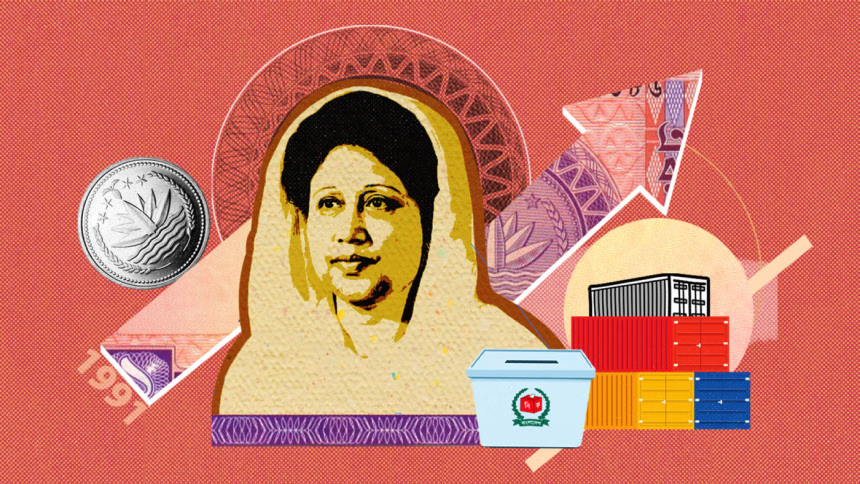
January 8, 2026
Dhaka ——In the 55 years since Bangladesh became independent, the processes of national construction, political transformation and economic reconstruction have been carried out in a closely linked manner. During this period, the country experienced multiple political turning points, each of which left a lasting mark on its economic direction and institutional architecture. In this long and complex history, Mrs. Khaleda Zia’s leadership represents an important stage, especially in terms of economic reforms and policy adjustments.
First, her tenure starting in 1991 coincided with a critical stage in Bangladesh’s gradual shift from a state-controlled economic framework to a market-oriented, export-oriented development model. This is not just a moment for policy adjustments. It signals a broader reconfiguration of the relationship between state, market and society. It may be recalled that the main impetus for this trend came from the Bretton Woods Institutions (BWI), particularly the World Bank and the International Monetary Fund, through the Structural Adjustment Program (SAP) launched in the 1980s. These plans emphasize macroeconomic stabilization through fiscal and monetary discipline, reduced state intervention, trade liberalization, and greater openness to global markets. However, structural adjustment programs have been widely criticized for their uniform policy provisions, which are often associated with rising inequality, weakening social protection, and pressures on domestic industries with weak institutional capacity. While the debate over the SAP remains part of the broader ideological and development literature, Bangladesh’s reform trajectory led to improved macroeconomic performance in the mid-1990s. However, BWI recognizes the need for improved governance and further reforms to achieve better outcomes. Any assessment of Khaleda Zia’s economic role must therefore situate her leadership within the wider transformation of the country, as part of a progressive reform process rather than an isolated intervention.
Secondly, in 1991, Bangladesh had just emerged from military rule and returned to democratic governance after a long period. At the time, the economy was constrained by low productive capacity, a weak income base, and a heavy reliance on regulatory controls. In this context, her government placed the private sector at the center of the development process, expanded the role of markets, fostered an environment conducive to investment, and redefined the state as a facilitator rather than a direct controller.
Third, the ready-made garment industry emerged in the 1980s and received important structural support in the 1990s through policy instruments such as export performance preferences, bonded warehousing facilities, back-to-back letters of credit, cash incentives, and trade facilitation measures. These policies were pragmatic and enabled Bangladesh to quickly establish itself as a significant player in the global apparel value chain, a success that continued to drive economic growth in subsequent decades.
Fourth, one of the most important initiatives during Khaleda Zia’s first term was the enactment of the Value Added Tax (VAT) Act in 1991, which marked a fundamental change in Bangladesh’s tax system. The aim of the reforms is to replace the narrow, inefficient revenue structure with a modern, broad-based framework. Despite implementation obstacles and the need for further adjustments, the initiative strengthens the foundations of tax administration, which are critical for financing development spending, expanding social protection and supporting infrastructure investment.
Fifth, during her tenure, the external service underwent two major changes. In 1994, Bangladesh implemented current account convertibility, which stimulated import and export activities. This was followed by a transition to a floating exchange rate system in 2003. Together, these reforms have enhanced trade and monetary policy flexibility, deepened Bangladesh’s economic integration with the global economy, and helped enhance macroeconomic resilience and long-term stability.
Sixth, financial sector reform became one of the most critical but complex chapters of this period. The Banking Companies Act (1991) and the Financial Institutions Act (1993) were enacted to strengthen regulation, while the Financial Sector Reform Program (FSRP) and the Financial Sector Adjustment Credit (FSAC) were implemented with the support of development partners, including the World Bank. The Bangladesh Bank Amendment Bill 2003 was enacted, giving autonomy to the central bank. Although the results did not meet expectations, the reforms laid an important structural foundation. The Bangladesh Securities and Exchange Commission (BSEC) established in 1993 under the Bangladesh Securities and Exchange Commission Act is also a noteworthy reform, providing an institutional framework for capital market development and strengthening the financial system architecture.
Seventh, economic growth during this period created new jobs, driven by export expansion and rising remittance inflows. From the 1990s to the mid-2000s, gross domestic product (GDP) grew and poverty rates fell significantly. Poverty reduction programs such as rural employment programmes, food security initiatives and targeted assistance were expanded. At the same time, the progressive expansion of the social safety net aims to strengthen state support for vulnerable and low-income groups. Together, these initiatives help strengthen the foundations of social progress. It must be acknowledged that this achievement cannot be attributed to any one government. It reflects the cumulative impact of continued policy continuity. Nonetheless, the relative stability of policies during Khaleda Zia’s term helped hasten the process.
Together, these economic policies and reforms constitute Khaleda Zia’s economic legacy. Despite some economic gains, governance deficits, political polarization and uneven implementation have limited the full impact of the reforms. Despite implementation challenges, these measures remain an important chapter in Bangladesh’s development trajectory.
When governance shortcomings remain unresolved, the lessons learned from that period remain relevant today. A lack of discipline in the banking sector, persistent political influence and weak enforcement mechanisms have slowed the pace of reforms. These challenges are structural and long-term. They remind us that reform is not just a matter of policy design. It requires a combination of political commitment, institutional continuity and a sustained, long-term vision.
As Bangladesh’s February 12 national elections approach, political parties must go beyond rhetoric and seriously reflect on the economic policies of all governments in power to understand what works, what fails and why. The credibility of the future agenda will depend on translating these lessons into reforms that strengthen institutions, restore discipline and meet the daily economic needs of citizens through inclusive and accountable governance.
Dr. Fahmida Khatun is Executive Director of the Center for Policy Dialogue.
The views expressed in this article are solely those of the author.