The Tamesis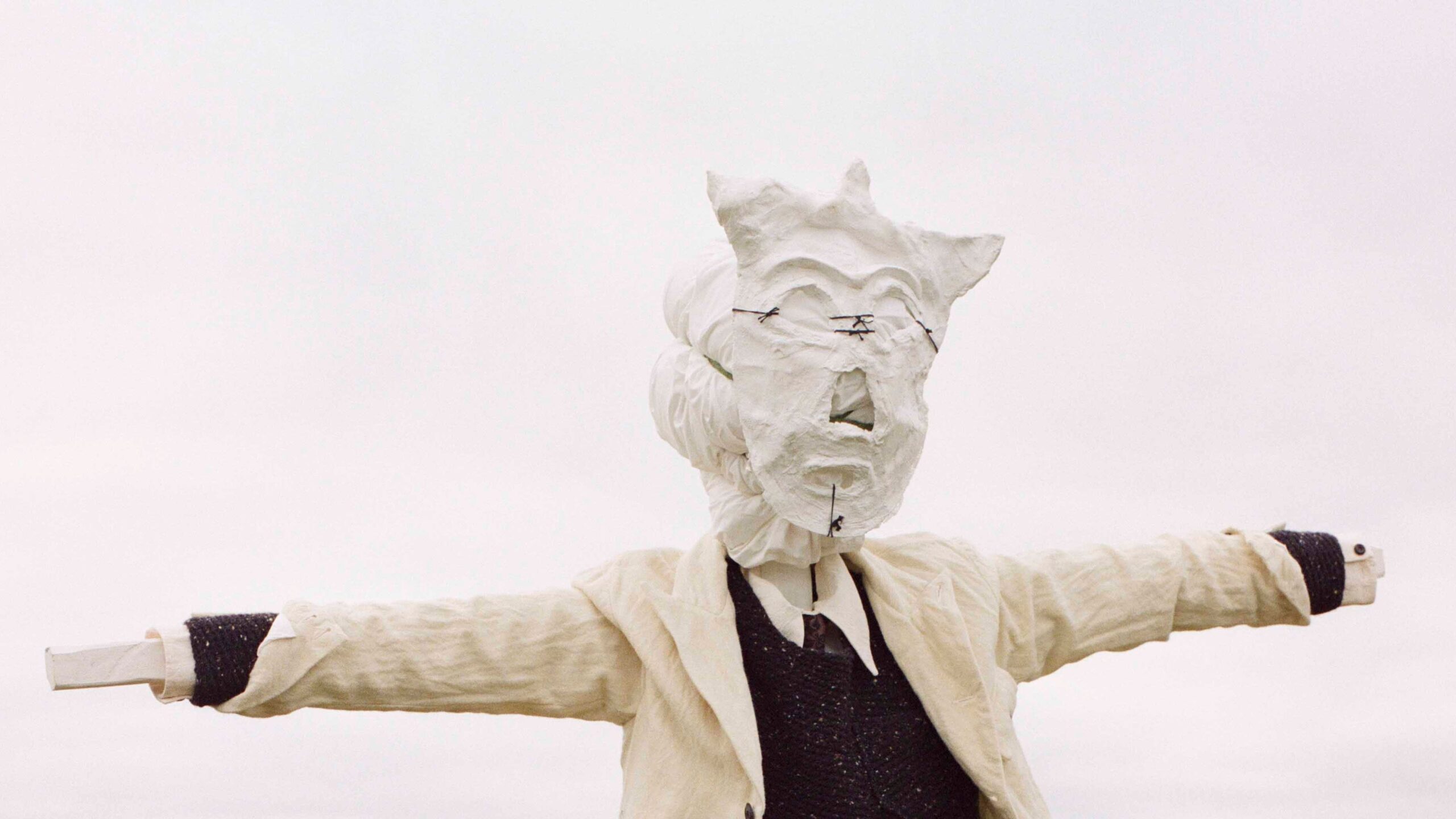
On a cold, dark, drizzly night in London (what other night in January?) one can follow a steady stream of dapper fashion and artsy types along the industrial Old Kent Road in the southeast of the city. Turning onto a brightly lit cobbled sidewalk and passing an imposing wrought-iron fence, we soon found ourselves in the Asylum Church, the centerpiece of a 19th-century almshouse complex. It couldn’t be a better setting for John Alexander Skelton’s show, as he collaborates with some of the most accomplished producers from across the British Isles for his unique take on messy, slightly Dickensian glamour.
This feeling of stepping into a bygone world is enhanced by the shabby interior, with peeling plaster and cobwebs, hot cider served from tureens, a ceiling patched with corrugated iron and the church being bombed during World War II. Antique chairs are arranged in concentric circles around a central podium, and a spotlight is fixed on one of a dozen mannequins placed in the outer ring. Well, not mannequins to be exact, because, after peering in the dark, they turned out to be scarecrows (or crucified figures?) with heads made from papier-mâché, like an effigy or totem left over from some ancient pagan ritual, some with little black pointed hats on their heads. “I’ve always been fascinated by scarecrows,” Skelton said after the show, mentioning his obsession with a ’90s photography book by Colin Garratt. “Some of them are really beautiful and elegant, with beautiful coats, while others have a sinister feel to them. There’s a weird duality where they feel kitsch but also evil, as if they’re going to suddenly come to life.”
That is, one masked figure quickly stepped out and climbed into the rotating spotlight, and then a second figure—whose voice was believed to be Ryan Skelton, the designer’s brother and a regular collaborator on his short films and fashion shows—jumped into the center and started the show by banging on a drum. “Destroy my humanity from here to there,” chants little Skelton with glee, bouncing around the space, leering at guests’ faces and reciting a poem he wrote in response to a collection that invites us into another realm. After each event, he would strut up to a mannequin, tear off the cloth covering it, and shine a spotlight on each mannequin in turn.
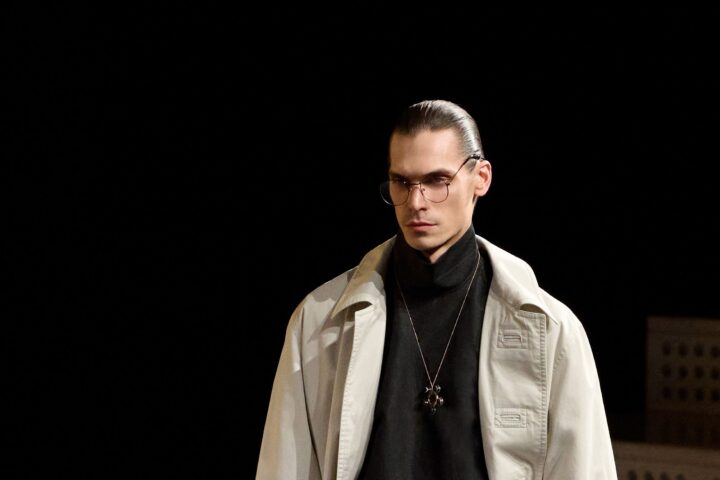
Shown below is a collection of Skelton’s beautifully earthy designs: heavy, textured vests in tonal plaid tweeds; rumpled linen pajamas and outerwear embellished with talismanic jewels; jackets with edges frayed into loose clumps of thread; shirts adorned with messy block prints and eccentric patterns inspired by Celtic gods. (Skelton notes that the Celts have long fascinated him because of their intricate history across the continent and their skills as craftsmen and merchants.)
Incorporating drama into a fashion show might be a bit over the top, but in Skelton’s hands it always felt like the right way to flesh out his world. This something spiritual, or at least something outside of time and place, can also be felt in the film directed by Skelton’s long-time collaborator William Waterworth, which is projected across an entire wall. It features masked figures frolicking around a crackling campfire at the top of a moor, with the wind howling around them: a carnivalesque, Wicker Man -esque ritual with a setting that could have been straight out of a Brontë novel. (Come to think of it, someone needs to get Jacob Elordi dressed as John Alexander Skelton for the Wuthering Heights press tour.)
As always at Skelton, the foundation of everything was the rugged beauty of the clothes, whether it was the highly desirable printed shirts featuring those weird mask-like faces, or the playful proportions of layered coats and jackets, or the rich color scheme of lilac and indigo inspired by the Celtic practice of dying clothes with berries. “I didn’t want to recreate this ancient Celtic costume – it was more based on my emotional response to it, how I felt about it,” Skelton added. The theater that night was not just for show, but for others to feel that powerful emotional response. Even if it did mean we found ourselves a little scared after walking back to the bus stop.