The Tamesis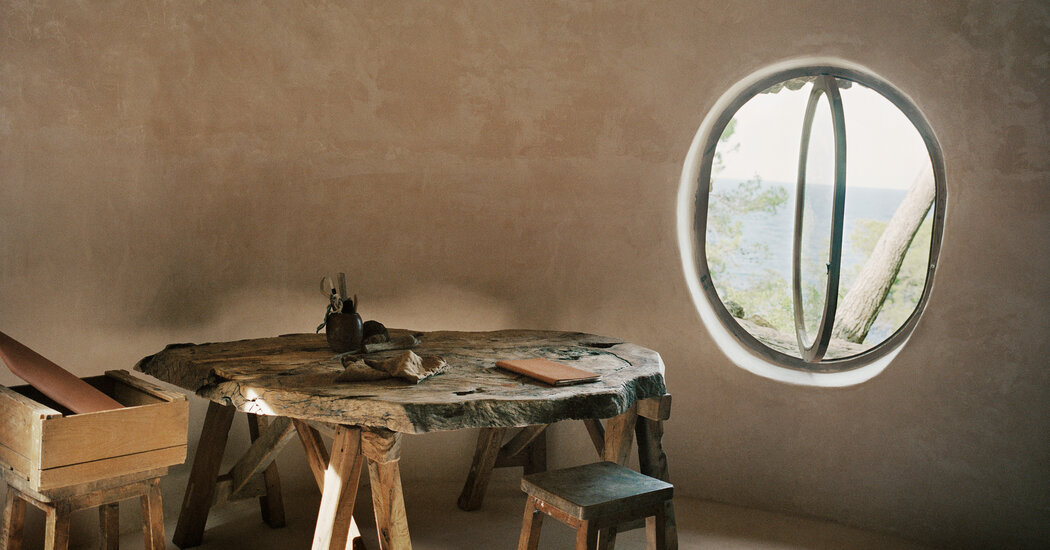
French interior designer François Champsaur is known for designing a variety of large, sophisticated residences and hotels over the past four decades, including the interiors of Ian Schrager’s Edition in Madrid and the Public in Los Angeles, opening next month, which use materials such as steel and glass to reflect a clean, modern style. Yet Champsaur, 61, who grew up in Marseille as the son of a ceramicist, has been drawn to the countercultural, naturalistic impulses of 20th-century American artists from the beginning of his career, such as JB Blunk (who worked primarily with wood and clay) and Isamu Noguchi (whose furniture, lighting and landscape designs are defined by their smooth, organic lines). Six years ago, when Champsaur was invited to participate in the Toulon Design Parade organized annually by Villa Noailles, he said, he mentioned Isamu Noguchi—“my hero,” he says—and Italian radicalism in creating “Utopie Frugale,” a table-cum-kitchen entirely carved from terracotta, with four thick conical legs and a wide surface with areas dedicated to washing hands, cutting vegetables, juicing citrus fruits and serving meals.
The project reflects a change in his lifestyle: he stopped buying from supermarkets and went to small organic shops, switched to natural wine, and replaced refined sugar with honey. Soon after, he reduced the size of the agency from 15 employees to four. He then moved into his own studio behind the Picasso Museum in the Marais district of Paris, where he rededicated himself to taking on fewer and smaller commissions, all of which lacked plastic and relied on materials harvested from the earth, such as plaster and straw. “In human history, I think metals and plastics are a phase. We have to stop,” Champsaur said. “The new modernity is where we find solutions for working with nature.”
He says this while standing next to his terracotta kitchen experiment, which he has transported to his second studio outside the village of Soller in northwest Mallorca. It sits on an acre or so of secluded, wooded coastal hillside so steep that the Balearic Sea looks almost vertical, like a shimmering blue scrim. Champsaur, who has been visiting the island for nearly two decades, discovered the property in 2012 and then spent four years convincing the Mallorcan owners to sell and renovate it. The year he bought the house, he went to a friend’s house for dinner in nearby Deià and met his wife, Catherine Baudet, 55, a French lifestyle journalist who now works in media, in part because she felt the energy radiating from the surrounding Tramuntana mountains — what the couple and other residents call “theatre” because of the emotions it triggers. “The mountain is made of crystal, so it either chooses you or rejects you,” she said. “Are you feeling okay here?”
For summer alfresco lunches of local raw tuna marinated in soy and a tomato salad paired with shiso grown in the garden, it seems impossible not to feel comfortable—especially because Champsaur built a home that was “totally intuitive,” as he puts it, “to listen to the birds and see what I want.” Across the rocky terraces cut into the slope, there are several free-standing buildings, including a small studio built into a decades-old limestone kiln at the highest point, with its discarded wooden roof beams and portholes overlooking the sea. There is an ice-cold open well below where the couple can drink and swim during the four to six months they spend on the island each year. Champsaur plans to soon add a hot stone sauna near the well, along with an outdoor kitchen he has set up. Then there’s the 968-square-foot, two-story main house, originally built in concrete about a century ago on a stone and earth foundation, which is essentially the only part that remains.
Rather than tearing down the blocky cabin, Champsaur rebuilt it from the inside out, attracting island craftsmen to collaborate with him. First, he re-covered the entire building with limestone, plaster, and beeswax, which together cooled the interior and made it waterproof and insect-proof. Only after removing the moisture-prone concrete walls were the designers able to hire local experts to install the natural flooring. Champsaur also improves the flow of the rooms, leading from the kitchen on one side to the dining and living rooms, with a circular sculptural staircase immediately behind the master bedroom leading to a loft where one or two guests can spend the night. Occasionally, renovations went wrong: the horseshoe-shaped fireplace had to be remade by French plasterers because the workers couldn’t match the perfectly symmetrical proportions of Champsaur’s terracotta model. But the designer’s savior was Jaime Bauza, the contractor and stonemason—“his mistress,” Catherine jokes—with whom Champsaur built the perimeter wall, laid out several outdoor dining and relaxing terraces, tied the disparate elements together, and continued to envision new plans. “He calls me crazy, but I love it,” the designer said. “Year after year, we make things. You have to be flexible, which is the opposite of how you learn in design school.”
The overall effect is that of a ramshackle villa squatting in a dusty terrain, even if much of its architecture – if not the craftsmanship and technology that made it possible – is recent. Champsol furnished the place modestly, mostly of his own design, including chestnut dining chairs and a deep daybed with a mattress stuffed with wool sheared nearby. He placed Joan Miró-like antiques and pottery made by local artisans on soft white plaster shelves on most walls. The couple also began hosting art workshops on site, inviting woodworkers as well as natural dyers to use kakishibu, a Japanese pigment made from persimmon tannin, to join them and friends in creating clothing and throw pillows. “Humanity is now in a have Work with nature,” Champsaur said, sheltering from the afternoon sun under a thatched pergola on a stone bench covered in tan fabric. “If we don’t, we’ll get burned. But I don’t want to get political. I don’t want to fight. I just want to do something good. Because we need a simple, cool, and inspiring vision for the future. “In other words, the world still allows us to dream.