The Tamesis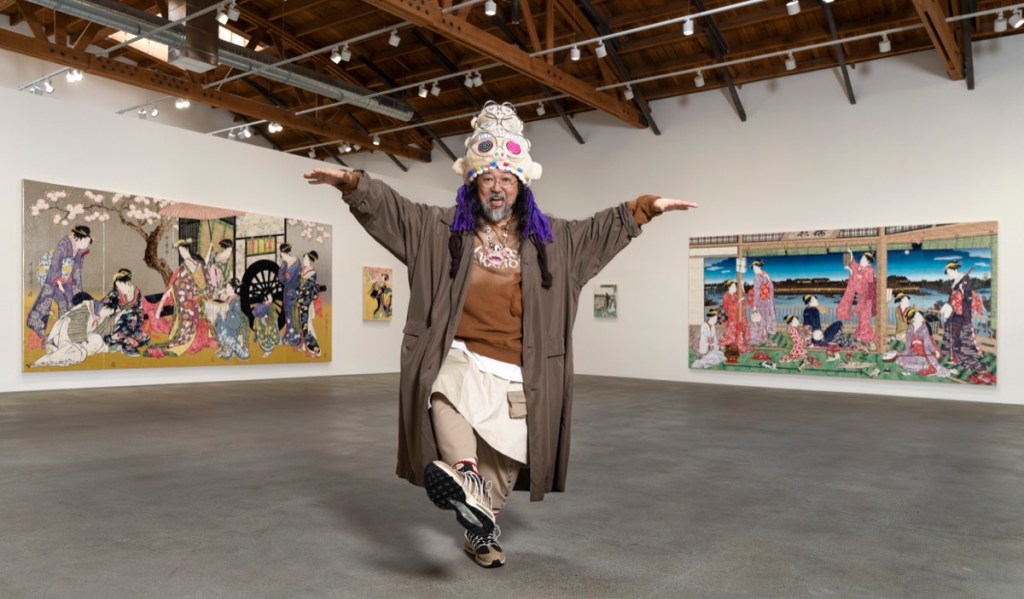
Murakami closed his eyes as he spoke. Still, it energized him: his hands gestured wildly, the pitch of his voice rose and fell. The artist spoke in Japanese, but even before the translator intervened, I could glean some emotion from the proper nouns and range of intonation. We sit in the center of the Perrotin Gallery in Los Angeles, surrounded by a group of stylists, videographers, and representatives from the gallery and Murakami’s Tokyo production studio, Kaikai Kiki. He reaches out to the four massive canvases on either side of us, which took a total of more than three years to complete, and explains why, for him, time does not move linearly.
Related articles

“I’m 64 years old,” he said. “I often wake up not feeling great. A little depressed, a little bored.” But then, in January, while he was coming down with the flu, his daughter received an acceptance letter from a prestigious school. The excitement was so sudden and so intense that he felt as if he were in two moments at once: the joy of the moment and the memory of the acceptance letter he received 40 years ago. “I feel like I’m reborn,” he said. “Where’s the flu? It’s been cured.”
This belief that time folds in on itself—that the past is not distant but tangible and inhabitable—motivates much of Murakami’s practice, including the 24 works in Return to Ukiyo-e: Tracing Superflatness to the Origins of Japonisme. He has long been interested in post-World War II anime and manga culture, and has recently expanded his focus to Japanese history painting. Here, inspiration spans Edo period woodblock prints, nineteenth-century impressionism and Pokémon cards, proving that influence, like sorrow and joy, doesn’t travel in just one direction.
In fact, this is not the first time Murakami has criticized Nihonga (traditional Japanese painting). He began his career studying historical styles at the Tokyo National University of Arts, eventually earning a Ph.D. Although he claims to be indifferent to the subject, he acknowledges that “history is woven into the body and into the skin.” After graduation, Murakami turned to manga, hoping to translate otaku culture into contemporary art and erase the distinction between merchandise, mass media, and works deemed worthy of museum collections. The resulting work—super-flat, candy-colored, animated characters filled with adorable eyes that oscillate between innocence and menace—introduces a new visual language described as new york times Critic Roberta Smith praised it as “radiantly beautiful” and “an art of extreme expression in which everything is pushed in opposite directions.” Adopting the studio-factory model favored by Americans such as Andy Warhol, he founded Kaikai Kiki, which now employs more than 300 people and produces, in addition to labor-intensive silkscreen paintings, a range of branded merchandise: trinkets, trading cards, multi-items, publications and homewares.
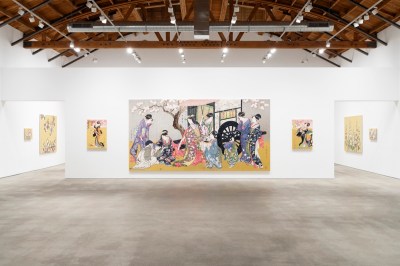
Installation view Kitagawa Utamaro’s “Imitation Royal Carriage Scene” Cherry Blossoms Dance in the Sky – SUPERFLAT2025 – 2026, author: Takashi Murakami.
Photo Guillaume Chicarelli; ©︎Takashi Murakami/Kaikai Kiki Co., Ltd. All Rights Reserved; Courtesy Perrotin.
Then, in 2011, the Tohoku earthquake and tsunami killed nearly 20,000 people. Murakami had been preparing for an exhibition in Doha, Qatar, and asked the curators if he could veer into some more metaphysical territory. turn out Five Hundred Arhats (2012), four murals totaling nearly 330 feet in length, depict five hundred enlightened disciples of the Buddha (the eponymous arhat) in the style of the Hundred Volume Series created by Edo period artist Kanō Kazunobu. In this mesmerizing collection of ancient elders and sacred animals, amidst the whirlwinds and blazing fires, one can clearly see the desire to combat human suffering and offer a vision of hope and healing. “Many people have lost loved ones suddenly and violently, and their lives cannot be separated from a story,” he said. “That’s when I realized that’s why religion exists, to tell a story that you can live with.” In many ways, it was a kind of rebirth of the artist’s career: not into another world, but back into this one. The Japanese paintings he had spent eleven years absorbing but not necessarily wanting to see reappeared with a purpose.
The impulse to look to the past to understand the future is reflected in many of the canvases in the Perrotin exhibition. Formally speaking, Murakami did copy masterpieces as a way of learning from and honoring those who came before him. Two masterpieces, Kitagawa Utamaro’s “Flower of Yoshiwara“ Dogs and cats reveling in cherry blossoms – SUPERFLAT (2025–2026) and Torii Kiyonaga’s “Sumida River Moon Viewing Party“ UFO, flower parents and children and many cats – SUPERFLAT (2025-2026) is based on well-known examples of the ukiyo-e genre of bijinga, which idealized women, particularly prostitutes from the “floating world” pleasure areas. These works are reproductions and not reproductions. They are based on high-resolution photographs of the originals and utilize the same devices to convey sensuality and arouse desire. But they are also unique compositions, reimagined in Murakami’s distinctive style, with colorful outlines, combined metallic backgrounds, and the occasional inclusion of his signature smiling flower figures. Rather than using woodcuts, each piece is made from layer after layer of screen-printed acrylic paint, coated with a high-gloss veneer. The meticulous finish masks the complexity of the craftsmanship, which is both the point and the problem.
“It was like watching Shohei Ohtani hit a home run,” Murakami said. “It looks so easy, you don’t know what’s going to happen.”
Conceptually, the Edo period—especially in its decline—offered a reflective glass. On the surface, this was an era of extraordinary prosperity, with the leisure classes enjoying a hedonistic lifestyle, as evidenced by highly stylized ukiyo-e prints. But this calm is unstable. American black ships arrived in the 1850s, forcing the opening of the country that had been closed for more than two centuries and overthrowing the government. Murakami believes that the artists who created those serene melodrama works must have felt the tremors of what was to come. The parallels to this particular cultural moment—complex anxieties, willful ignorance, and a desire for easy, immediate pleasure—need no elaboration. Still, we can see echoes of our own brunch culture and all the aloofness it portends in the scenes of sumptuous tea sets and women in luxurious kimonos. Deciding to pursue a gentler form of sexuality, especially compared to past exhibitions in Los Angeles, these works include my lonely cowboy (1998), in which a life-size, anime-inspired naked man creates a noose from his own semen, may also embody the censorship and conservatism practiced by the current U.S. administration
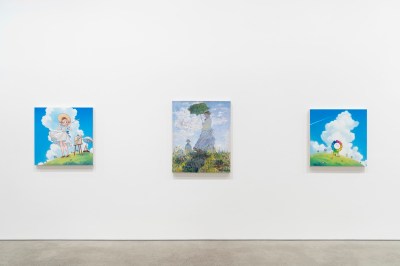
Painting installation drawing Camille Doncieux outdoor painting, 2025 – 2026 (left), Claude Monet’s “Woman Holding a Parasol – Madame Monet and Her Son” Consciousness Time and Space – SUPERFLAT, 2025 – 2026 (C), and Flowers on the mountain2025-2026(R).
Photo Guillaume Chicarelli; ©︎Takashi Murakami/Kaikai Kiki Co., Ltd. All Rights Reserved; Courtesy Perrotin.
In the second of two galleries, Murakami traces a direct visual lineage from the Bijin Painting of Women to the Impressionists, particularly Monet and his seminal paintings Woman holding a parasol – Madame Monet and her son (1875). Reproductions of his portraits—sloping ground, windswept skirts, voluptuous silhouettes, and clouds of cherry blossoms—all but confirm the possibility raised in press materials that Monet saw many of the works in person when Siegfried Bing, the famed Japonisme art collector, brought them to Paris in the late 1800s. Like an hourglass turning over in autumn, the flow of influence rushes back in the opposite direction before the viewer’s eyes. In the final series, Murakami further blurred the lines between past and present. Both Camille Doncieux outdoor painting (2025–26) and Tracks and flowers on the mountain (2025-26), depicts anime characters on a grassy hill against a flat blue sky, based on a trading card design. Although the extremely simplified, deliberately flat aesthetic creates a tension with the gorgeous, overly detailed paintings of Utamaro, Murakami demonstrates their similarities: both are popular, mass-produced, and designed to create a desire for another world.
Murakami has an easily misunderstood version: the brand, the factory, the entourage, the business collaboration, the thriving gift shop in the next room. This version is at least partly strategic, holding up a mirror to the art market that has long rewarded such self-aware spectacle. But the works in this exhibition resist simple consumption—even as they pursue it—while remaining accessible to a wide audience. Follow the thread from floating worlds to Giverny Gardens to Pokémon cards, and you’ll understand that nothing in culture originates; nothing in culture originates; nothing in culture originates. Everything repeats itself, and the distance between past and present, both in art and in life, is mostly just the stories we tell ourselves in order to move on.
Before I left, I saw a rainbow-colored face peeking out from behind the hem of a sexy kimono. For a moment, I couldn’t tell whether he was from the 1800s or the year 2026, or, like his creator, from both eras simultaneously.